
Best 7.2 Kw EV Charger Options for Home Charging
Choosing a 7.2 kW (32A) electric vehicle charger for home use can improve charging speed and convenience. The following five products offer adjustable current, smart features, and portability to support a variety of vehicles and outlets. This guide highlights what to look for, how these chargers perform in real-world use, and which scenarios each model best serves.
| Product | Brand | Key Feature | Socket/Connector | Approx. Power |
|---|---|---|---|---|
| 7.2kW Type 2 Charging Cable | AFYEEV Store | Adjustable current; remote app control | Type 2 CEE Plug | Up to 7.2 kW |
| 7.2kW Level 1 & 2 EV Charger | AIMILER Store | Delay charging; portable with adapters | NEMA 14-50P / 5-15 Adapter | Up to 7.2 kW |
| Level 2 EV Charger (WiFi App) | AIMILER Store | WiFi app control; ETL listed | J1772 Connector; NEMA 14-50P | Up to 7.68 kW |
| EVIQO Level 2 EV Charger | EVIQO Store | Smart app control; 46 mph charging | J1772 to NACS compatibility | Up to 11.5 kW (46 A) |
| Type 2 EV Charger CEE 7.2KW 5M | GUWIEYG Store | Digital display; 8–32A adjustable | Type 2 plug; IEC 62196-2 | Up to 7.2 kW |
For American drivers, a 7.2 kW (32 A) Level 2 charger can substantially reduce charging times at home compared with a basic Level 1 setup. The options below cover portable and stationary styles, with features such as adjustable current, Wi‑Fi or Bluetooth app control, delay charging, and compatibility with common North American outlets. Each product has been selected for reliable performance, safety standards, and practical everyday use.
AFYEEV 7.2kW Type 2 Charging Cable

The AFYEEV 7.2kW Type 2 charging cable is a portable Level 2 EV charger with adjustable current settings: 6A, 8A, 10A, 13A, 16A, 20A, 24A, and 32A. It uses a Type 2 CEE plug and supports up to 32A at 240V, delivering up to 7.2 kW of charging power. It includes remote operation via a mobile app (Smart Life) over Bluetooth or Wi‑Fi, enabling current and charging time to be set remotely. A built-in touchscreen provides direct control, and a delay charging feature allows scheduling up to 15 hours. The charger comes with a carrying bag for portability and travel convenience.
AIMILER 32A Portable Level 2 Charger

This 7.2 kW Level 2 charger offers versatile use with a NEMA 14-50P socket and a NEMA 5-15 adapter for 110V operation. It supports adjustable current from 32A down to 8A and includes a delay charging option from 1 to 15 hours to help avoid peak rates. A dedicated carrying bag is included, making it suitable for travel. Note that Tesla owners may require a Tesla adapter to use this unit effectively, and the included adapters ensure compatibility with common North American outlets.
AIMILER Level 2 EV Charger With WiFi App
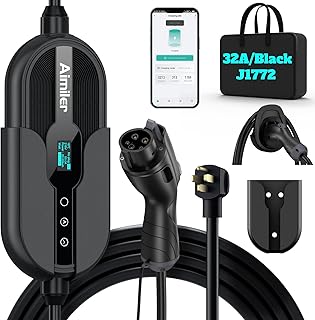
This AIMILER Level 2 charger supports Wi-Fi app control and a J1772 connector compatible with many North American EVs. It is ETL listed for safety, with a maximum 32A (7.68 kW) output, adjustable current, and a delay charging feature (1–15 hours) to help manage electricity costs. The unit ships with a NEMA 14-50P plug and also supports 110V through a separate adapter, offering flexible installation options. The product emphasizes fast charging with a broad compatibility profile for non-Tesla EVs.
EVIQO Level 2 EV Charger With App

The EVIQO Level 2 charger is designed for Tesla compatibility and broader North American EV use with a SAE J3400/SAE J1772 basis and NACS adapter compatibility. It delivers up to 11.5 kW (46 A) with smart Wi‑Fi control for remote charging management, including scheduling and firmware updates. The unit supports indoor or outdoor installation and requires a compatible 60A circuit for optimal performance. It integrates with a mobile app for easy monitoring and control of charging sessions from anywhere with an internet connection.
GUWIEYG Type 2 Portable 7.2kW Charger

GUWIEYG’s Type 2 portable charger delivers up to 7.2 kW with adjustable current from 8A to 32A for IEC 62196-2 compatibility. It includes a digital screen for easy monitoring and a delay charging feature of up to 6 hours to help manage energy costs and avoid peak demand. The IP66-rated enclosure ensures durability in various weather conditions, and the unit is designed to work with Type 2 sockets, making it compatible with a wide range of EVs and charging setups, including outdoor use when properly installed.
Buying Guide: Key Considerations for 7.2 kW EV Chargers
When selecting a 7.2 kW EV charger, consider compatibility, installation, and everyday practicality to maximize value and reliability.
- Outlet and plug compatibility: Check whether the charger uses a Type 2 (IEC 62196-2) plug, a NEMA 14-50P outlet, or other adapters. Ensure your home wiring and circuits match the required amperage and voltage (typically 240V for 32A charging).
- Adjustable current: A charger with adjustable amperage (8–32A) lets you tailor charging speed to your circuit capacity and energy costs, improving compatibility with different home electrical setups.
- App and remote control: Wi‑Fi or Bluetooth app support enables scheduling, monitoring, and firmware updates. Evaluate app reliability and privacy, plus whether remote control aligns with your needs.
- Delay charging: This feature helps you avoid peak electricity rates by starting charging at a chosen time. Consider the maximum delay window (often 1–15 hours) and how it integrates with your daily routine.
- Safety certifications: Look for ETL, UL, or equivalent safety certifications relevant to the U.S. market. Outdoor use requires weather-rated enclosures (e.g., IP66) and proper mounting.
- Portability vs. fixed installation: Portable Level 2 chargers are ideal for renters or travelers, while fixed wall-mounted units can offer a neater setup and potentially longer warranty coverage.
- Vehicle compatibility: Most Level 2 chargers use J1772 connectors, but Tesla owners may need adapters. Confirm compatibility with your EV model and charging standards.
- Power delivery and energy management: Some chargers handle up to 46 A and beyond, enabling faster charging but requiring a robust circuit. Ensure your electrical panel can support the amperage without overloading.
In evaluating options, balance charging speed with installation cost and ongoing electricity savings. For multi-car households, a charger with app-based scheduling and remote monitoring can help distribute energy across different charging windows. If you travel often or rent, portability and included carrying cases add practical value. Finally, verify warranty length and customer support quality to protect your investment over time.