
Best Solar Panels for Camper Roof Installations: Quick Picks for RV, Camper and Off-Grid Needs
Answering the common question “what solar panel is best for a camper roof?” this guide highlights five well-suited options for RVs, campers, and other off-grid setups. Each option is evaluated for durability, efficiency, and suitability to different traveler needs. Ideal buyers include weekend campers seeking simple setups, full-timers needing reliable power, and travelers with limited roof space who prioritize efficiency and shade tolerance.
Summary table of selected products:
| Product | Best For | Key Benefit | Potential Limitation |
|---|---|---|---|
| ECO-WORTHY 200W Kit | Mid-size RVs and caravans | High efficiency monocrystalline panels with robust frame | Includes 30A PWM controller; may lack MPPT efficiency in shaded days |
| Callsun N-Type 400W (2x200W) | Larger installs and higher power users | Bifacial design and anti-shade features for reliability | Higher upfront complexity |
| Renogy 100W Starter Kit | Budget-friendly RVs and beginners | Comprehensive kit with controller and mounting hardware | Smaller wattage per panel |
| AeternaSol 400W (2x200W N-Type) | Max-efficiency setups on larger roofs | IP68 waterproofing and bifacial energy capture | Premium option with higher price |
| SOLPERK 20W Kit | Trickle charging and maintenance for smaller systems | Smart MPPT controller and robust all-weather build | Low power output; for maintenance rather than primary charging |
ECO-WORTHY 200 Watts Kit With 30A PWM Controller
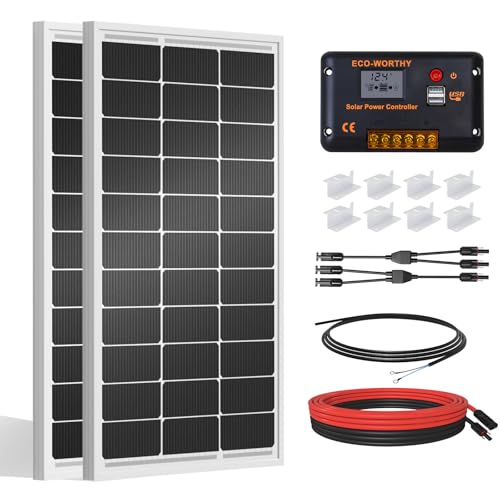
The ECO-WORTHY kit includes a high-efficiency monocrystalline panel and a 30A PWM charge controller. Best for RVs or campers needing a straightforward, durable power setup with a single panel and reliable charging. The panel’s corrosion-resistant frame supports long-term outdoor use and withstands typical RV roof conditions. The kit is well-suited for buyers who want a solid all-in-one solution without advanced MPPT tuning.
Who it’s best for: mid-sized RVs or campers with adequate roof space who prefer a simple, robust system without MPPT complexity. Why selected: strong panel efficiency and a proven frame design, plus a wide operating range for off-grid days. Caution: PWM controllers are less efficient than MPPT in partial sun; plan for slightly longer charging times in less-than-ideal light.
Key features at a glance:
- Wide application: daily output around 800Wh under good sun, suitable for RVs and cabins
- High performance: monocrystalline cells with up to 21.5% efficiency potential
- Durable: corrosion-resistant aluminum frame; IP65 junction box; wind/snow load tolerance
Callsun N-Type 400W Dual Panels (2 x 200W)

This Callsun kit uses N-Type 16BB high-efficiency cells, delivering up to 25% conversion efficiency. The dual 200W panels are designed with a bifacial feature to harvest light from both sides, increasing potential energy output. The twin-cell anti-shade design helps maintain power when part of the panel is shaded. Best for RVs or vans that need reliable performance in varied light and modest roof space.
Best for: travelers who face variable sun and shade or want higher overall system output in a compact footprint. Choose this if: you value bifacial gain and shading tolerance. Limitation: bifacial performance depends on reflective conditions, so real-world gains vary with surroundings.
Key features:
- N-Type cells with 16BB design for reliability and efficiency
- Bifacial design can boost output by up to ~30% in optimal conditions
- Two-module parallel setup provides shading tolerance and redundancy
Renogy 100W Solar Panel Starter Kit

The Renogy Starter Kit pairs a 100W mono panel with a 30A LCD PWM charger, mounting hardware, and cables. It targets RV and camper setups that need dependable power within a smaller footprint. The kit leverages a 22.5% efficiency panel and a service plan that covers long-term durability and power output. Best for: first-time solar users seeking a ready-to-install bundle with clear monitoring. Limitation: 100W per panel may require multiple panels for larger power needs.
Why chosen: reliable brand with thorough testing and extended service coverage. Caution: PWM controller is straightforward but not as efficient as MPPT in varying sunlight, so plan for daylight charging windows to maximize output.
Highlights:
- Efficient 22.5% panel with EL testing and protection features
- UL and weather-grade protections ensure weather resilience
- Includes mounting hardware and cables for RV or camper setups
AeternaSol 400W N-Type Dual Panels

The AeternaSol kit uses high-efficiency N-Type cells with 18BB busbars, delivering up to 25.2% efficiency and improved durability. The panels are IP68 waterproof, with enhanced heat dissipation and a bifacial design that can capture additional energy from reflective surfaces. Best for: larger roof areas and users who want higher efficiency and longer-term durability. Limitation: higher upfront cost and more complex installation considerations due to two panels and waterproofing needs.
Why selected: the combination of IP68 sealing and bifacial capability supports long-term outdoor RV use and potential energy gains in bright conditions. Caution: ensure roof space and weight capacity align with two 200W panels.
Product notes:
- Up to 15% more energy with bifacial design under ideal conditions
- IP68 waterproof and high-heat dissipation design
- A+ N-Type cells minimize microcrack risks
SOLPERK Solar Panel Kit 20W With Smart MPPT Controller
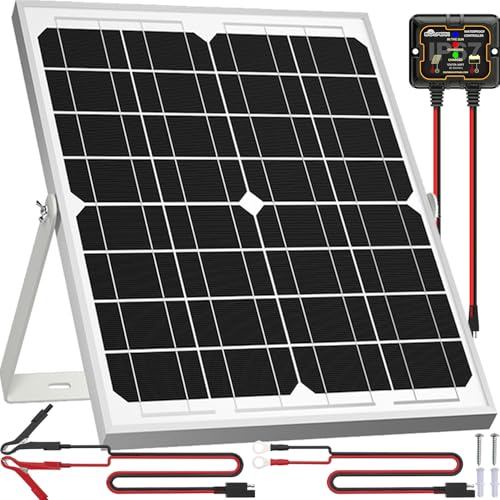
This SOLPERK kit includes a 20W panel and a smart MPPT controller with a three-stage charging design. Suitable for maintaining 12V batteries in boats, cars, trailers, and RVs when a full solar upgrade isn’t practical. Best for: trickle charging, maintaining 12V systems, or small auxiliary charging on a camper roof. Limitation: low wattage means it won’t meet higher daily energy needs by itself.
Why chosen: the compact kit suits constrained roofs and provides modern MPPT efficiency at low power levels. Caution: not ideal for powering high-demand appliances; primarily a maintenance charger.
Key features:
- Monocrystalline A+ cells with high efficiency
- Weatherproof frame and all-weather performance
- Smart MPPT controller improves charging efficiency
Buying Guide: Key Considerations For Camper Roof Solar
System size and roof space: Match wattage to daily energy needs and available roof area. Off-grid campers with fridges and climate control benefit from higher wattage but must respect weight limits.
Cell technology: N-Type and mono-crystalline cells generally offer better high-temperature performance and durability. Bifacial designs can add extra output in reflective environments, but gains vary with lighting and mounting.
Controllers: MPPT controllers maximize energy harvest, especially in partial sun or mixed weather. PWM is simpler and reliable but less efficient under lower light or higher voltage demands.
Durability: Look for corrosion-resistant frames, IP ratings, and weatherproof junction boxes to withstand wind, hail, and road spray. For campers, a robust installation that seals roof penetrations is essential.
Installation and maintenance: Kits that include mounting hardware, cables, and clear instructions simplify DIY installs. Consider service plans or warranties for long-term confidence.
Budget versus need: If power needs are modest, a 20W or 100W kit may suffice for maintenance and lighting. For full-time RV living, larger panels with MPPT and bifacial capability can deliver more reliable daily outputs.
FAQ
- What size solar panel do I need for a camper? Answer: It depends on daily energy use. A typical lightweight setup might start with 100W–200W, while full-time RVs may require 400W–800W or more, split across multiple panels.
- Is MPPT worth it for camper roofs? Answer: Yes, MPPT controllers optimize energy harvest, especially in fluctuating sunlight or when the roof wiring length increases.
- Can I install solar panels on a curved roof? Answer: Yes, but flexible panels or carefully mounted rigid panels with adaptable brackets help achieve secure, leak-free installations.
- Do bifacial panels work well on campers? Answer: Bifacial panels can provide extra energy where there is reflective surface and proper mounting. Real gains depend on mounting angle and surroundings.
- Which panel is most durable for travel conditions? Answer: Panels with IP65/IP68 ratings, corrosion-resistant frames, and robust junction-box protections tend to perform best in travel scenarios.
- Do I need a battery or inverter as part of the kit? Answer: Most camper solar setups pair panels with a battery bank and an inverter if you plan to run AC devices. A charge controller alone keeps a battery topped up.