
Best Tankless Hot Water Heating Systems for Quick, on-Demand Comfort
When you need instant hot water without a bulky tank, a tankless system is the clear choice. This guide highlights five compact, point-of-use or whole-home options that fit American homes and busy households. Each product list focuses on reliability, energy efficiency, and space-saving design, with clear notes on who benefits most. Ideal buyers include apartment dwellers seeking under-sink units, small households needing reliable on-demand water, RV or remote setups, and kitchen/bathroom upgrades where space is at a premium.
| Product | Best For | Key Benefit |
|---|---|---|
| 9kW Electric Tankless Water Heater 240V | Under-sink users with WiFi needs | Self-modulating heating maintains water within 1°F |
| Tankless Water Heater Electric, 240V 6.5 KW Mini Tankless | Compact, versatile point-of-use | 3-second hot water, LED temperature control |
| Midea 13KW Electric Tankless Water Heater | Home use with smart features | App control, automatic modulation |
| FOGATTI InstaShower 8 Plus RV Tankless Water Heater | RVs and mobile setups | Propane, 12V DC with remote |
| 110V Tankless Water Heater Electric, Jflapil 3000W | Budget-friendly, space-saving | Precise temp control, compact wall mount |
9kW Electric Tankless Water Heater 240V

Best for under-sink installs with WiFi control and precise temperature stability. Self-modulating heating helps maintain water temperature within 1°F, ideal for single-point hot water needs.
Caution: This unit is designed for point-of-use at 240V and may require electrical capacity checks for main service upgrades.
Tankless Water Heater Electric, 240V 6.5 KW Mini Tankless

Best for compact spaces where under-sink installation is preferred. Delivers hot water in about 3 seconds and includes a precise LED touchscreen to adjust temperatures from 85°F to 131°F, reducing temperature swings during daily use.
Limitation: The output is best for single-point tasks; scaling up to multiple fixtures may require a higher-capacity model.

Best for households seeking smart features and energy efficiency. The 13 kW model offers automatic power modulation and a smart app for monitoring and control, with a compact footprint suitable for many homes.
Caution: Higher wattage requires adequate electrical service; ensure panel capacity before installation.
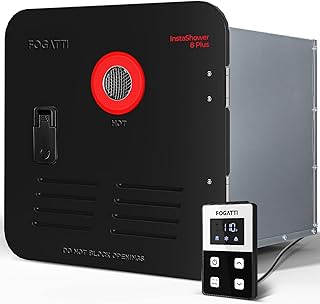
Best for RV families and campers needing mobile hot water. Propane power with a 12V DC setup and multiple door size options makes retrofitting easier for mobile living spaces.
Limitation: RV installations require venting and fuel considerations; verify compatibility with vehicle or camper electrical setup.
110V Tankless Water Heater Electric, Jflapil 3000W

Best for cost-conscious buyers who want a compact 110V option. It heats instantly and offers precise temperature control with an LED display, suitable for kitchens or small bathrooms.
Caution: 110V units generally have lower flow rates; plan for single-taucet use to avoid temperature drops when multiple fixtures demand hot water.
Buying Guide
What to Consider When Choosing a Tankless System
Water flow rate (GPM) and the number of outlets
- How many fixtures will run at once? Choose higher GPM for busy households or multi-fixture kitchens
Power Type and Installation Space
Electric vs propane
- Electric models fit indoor spaces and apartments; propane options are common for RVs and remote locations
- Check available space, mounting options, and impact on electrical panel capacity
Temperature Control and Safety
Look for precise temperature regulation and safety protections
- Self-modulating or automatic modulation helps maintain stable temperatures
- Leakage protection, dry-burn protection, and IP ratings improve safety in wet environments
Smart Features and Connectivity
Smart control can simplify daily use
- WiFi/app access for monitoring and scheduling
- LED displays for easy on-site temperature adjustments
Space-Saving and Placement
Under-sink or compact wall-mounted units work best in tight spaces
- Under-sink models maximize cabinet or pantry space
- RV or mobile setups prioritize lightweight, compact designs with remote features
Compatibility and Upgrades
Consider existing electrical capacity and plumbing configurations
- Ensure main service can support the unit’s wattage
- Verify inlet water temperature and required rise to achieve desired output
FAQ
- What is the main advantage of a tankless water heater?
Answer: They provide hot water on demand, reducing standby energy losses and saving space. - Can I install a tankless system myself?
Answer: Some models are designed for DIY installation, but electrical or gas connections may require a professional. - Do tankless heaters work well in cold climates?
Answer: Yes, but high-flow households may need higher capacity units or multiple units to maintain temps in cold incoming water. - What maintenance do tankless heaters need?
Answer: Routine flushing and filter checks help prevent mineral buildup and maintain efficiency. - Are electric tankless heaters energy efficient?
Answer: Many are, especially those with self-modulating heating and precise temperature controls. - Is there a risk of temperature fluctuation?
Answer: Reputable models use modulation to minimize fluctuations, but very high demand can cause minor shifts.