
Best Low Profile Hardwired Smoke Detectors for Home Safety and Easy Interconnection
When shopping for a low profile hardwired smoke detector, the goal is clear: reliable early warning with minimal nuisance alarms and simple interconnection across multiple rooms. This guide compares five top options to fit various home layouts and safety needs. Best fits include homes with kitchens prone to nuisance alarms, multi-story houses needing wired interconnect, and households prioritizing long battery backup. The summary table below helps you weigh key features at a glance.
| Product | Best For | Key Benefit |
|---|---|---|
| SITERWELL Smoke Detector (1 Pack) | Small to medium homes seeking accurate photoelectric sensing | Fast, low-false-alarm detection with 10-year life |
| First Alert SMICO100-AC | Homes needing carbon monoxide monitoring in addition to smoke | Precision detection with easy Quick Connect installation |
| First Alert SMI100-AC | Multi-alarm interconnect with 9V backup | Broad compatibility and continuous protection |
| Siterlink GS562A 6-pack | Larger homes or multi-room setups | Reliable interconnection across up to 12 devices |
| First Alert SMI105-AC | Long-term reliability with 10-year backup | Consistent protection during power outages |
SITERWELL Smoke Detector With 9V Backup
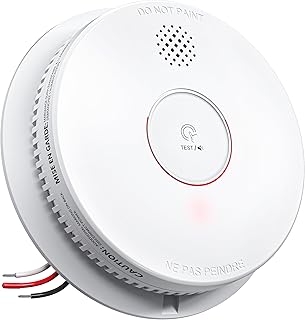
The SITERWELL hardwired detector uses a photoelectric sensor for fast, accurate detection and reduced nuisance alarms. It operates on 120V with a DC 9V backup battery for continued protection during outages. The model is designed for interconnected use, enabling synchronized alerts across multiple detectors. It is best for households where kitchen or living area false alarms are a concern and where a long device life is preferred.
Best for: Homeowners who want a high-sensitivity, low-false-alarm detector with a decade-long life and power outage resilience. Why selected: It emphasizes fast response and reduced nuisance alarms, which helps maintain peace of mind in everyday living spaces. Caution: The 10-year lifespan assumes no mechanical issues; replace if the unit shows signs of wear or malfunction.
First Alert Hardwire Combination Smoke & Carbon Monoxide Alarm

This hardwire unit combines smoke and carbon monoxide detection with Precision Detection technology to minimize cooking nuisance alarms while delivering early warning. It interconnects easily with other alarms via a Quick Connect Plug, reducing installation hassle. Best for households seeking trusted dual-sensor protection in a single, wall-mounted device.
Best for: Buyers who want both smoke and CO detection in one device and straightforward installation. Why selected: The Quick Connect feature simplifies wiring across multiple units. Caution: Some installations may require compatible interconnect planning across rooms or floors.
First Alert Hardwire 9V Battery Backup Smoke Alarm

Designed to meet current industry standards, this detector minimizes nuisance alarms and delivers early warning. It includes a 9V battery backup to maintain protection during a power outage and supports interconnection with compatible alarms across the system. It is a solid choice for larger homes or those needing robust wired interconnection.
Best for: Users needing consistent interconnection across many rooms and reliable outage protection. Why selected: It emphasizes coordinated alarms and continuous operation. Caution: Ensure any new wiring matches the local electrical code for interconnected detectors.
Siterlink Hardwired Interconnected Smoke Detectors

The SITERLINK 6-pack provides hardwired interconnection across up to 12 devices, ensuring that a smoke event in one room triggers all connected units. The detectors use photoelectric sensors for accurate detection and include a 9V battery backup for power resilience. Best for large homes or multi-story layouts where synchronized alerts are essential.
Best for: Large homes needing extensive wired interconnectivity. Why selected: The 12-device interconnection and 9V backup provide broad coverage and reliability. Caution: Bulk installation requires careful wiring planning to maintain interconnect integrity across all devices.
First Alert 10-Year Battery Backup Hardwire

This model combines First Alert’s Precision Detection with a 10-year battery backup, ensuring continued protection during power outages. Interconnection lets all compatible alarms sound together, which helps coordinate evacuation in larger homes. Best for households prioritizing long-term reliability and outage resilience.
Best for: Homeowners who want a long-lasting backup and coordinated multi-unit alerts. Why selected: The 10-year battery backup reduces maintenance frequency while preserving the safety network. Caution: Battery health should be checked upon installation and during routine inspections for optimal performance.
Buying Guide: Key Considerations For Low Profile Hardwired Detectors
- Sensor Type: Photoelectric sensors reduce nuisance alarms from cooking and steam and are typically preferred in living areas and kitchens. Consider whether you also need CO detection in the same unit.
- Interconnection: Wired interconnection ensures all connected alarms alert simultaneously. Check how many devices the system supports and whether the network spans all floors or rooms where detectors are needed.
- Power Backup: A 9V battery backup is common and essential for power outages. A longer backup life is convenient, but ensure the unit remains accessible for battery replacement when needed.
- Lifetime And Maintenance: Some detectors advertise a 10-year life. Confirm what promises are included in warranty and how often to test and silence alarms to maintain reliability.
- Installation Ease: Quick Connects and clearly labeled wiring simplify installation. Verify compatibility with existing home wiring and local electrical codes.
- Placement Considerations: Place detectors away from direct cooking smoke, vents, and large air currents. Spotlight areas include hallways, bedrooms, and living spaces where early warning is critical.
- False Alarm Management: Look for models with advanced sensing to minimize false alarms. Understand how test/silence functions operate to restore normal operation quickly.
FAQ
- What is the difference between photoelectric and ionization detectors?
Photoelectric detectors are more responsive to smoldering fires and are less prone to nuisance alarms from cooking, making them common in homes. - Do hardwired detectors require a full home interconnect?
Interconnect capability is optional in some models but beneficial for synchronized alerts across multiple rooms and floors. - How long do hardwired detectors last before replacement?
Many models offer a 10-year life; however, ongoing testing and battery checks are important for reliability. - Is a CO detector included with fire detectors?
Some models combine smoke and CO detection in one unit, providing dual-sensor protection in a single device. - What maintenance steps keep detectors functioning well?
Regular testing, occasional cleaning, and timely battery or unit replacement help ensure reliable performance. - Can I install hardwired detectors myself?
Yes, many people install them using the Quick Connect features, but follow local codes and consider professional help for complex wiring.