
Best 6 Ft Battery Cable Options for Automotive, Marine, and Solar Setups
Answering the most common questions about 6 ft battery cables, this guide highlights practical, durable options for automotive, marine, RV, and solar projects. Each product is selected for reliability, compatibility with standard 3/8 in lugs, and suitability for high-current connections. This overview helps buyers choose cables that perform under temperature extremes and demanding installations. The top picks are best for: DIY enthusiasts balancing cost and durability, professional installers needing reliable wiring, and users upgrading aged battery runs in boats, cars, or campers.
Summary table of chosen products:
| Product | Best For | Key Benefit |
|---|---|---|
| 4 AWG Battery Cable 6FT | Powerful inverter setups; wide compatibility | Pure copper, dual 3/8 in lugs |
| 2 Gauge AWG Battery Cables 6 Ft | High-current systems; flexible runs | Dual-color, robust construction |
| 6 AWG Battery Cable 6 Gauge (6FT) | Moderate to high-current rigs | 1 red + 1 black; wide lug fit |
| ECO-WORTHY 2AWG Battery Cable | Budget-friendly builds | Tinned copper for corrosion resistance |
| GOODYEAR Heavy Duty Jumper Cables | Emergency or redundancy; general use | Long reach; rugged construction |
4 AWG Battery Cable 6FT — Pure Copper
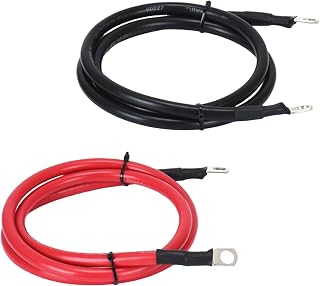
This 4 AWG option offers pure copper construction with dual 3/8 in lugs, suited for high-current inverter connections. Best for: larger solar or inverter installations where minimal resistance matters. Limitation: heavier gauge may be less flexible in tight spaces.
2 Gauge AWG Battery Cables 6 Ft — Red & Black

This 2 AWG set features 6 ft lengths in red and black with 3/8 in lugs. It’s best for high-current needs where flexibility is appreciated. Best for: larger inverters or solar arrays requiring thicker conductors. Caution: slightly stiffer than thinner gauges in tight routing.
6 AWG Battery Cable With 5/16 Inch Lugs

This 6 AWG option includes 5/16″ lugs, compatible with battery disconnects and switches. It’s suitable for automotive, solar, marine, and RV applications. Best for: users needing a balance of current capability and lug compatibility. Limitation: 6 AWG carries less current capacity than thicker options in extreme environments.
ECO-WORTHY 2AWG Battery Cable with 5/16” Lug Terminals

Best for: budget-conscious buyers needing corrosion resistance via tin-plated copper. This option suits quick installs in cars, boats, or RVs where cost per foot matters. It’s a solid all-around pick for moderate to high current in varied environments. Limitation: 2 AWG provides less current headroom than thicker gauges in sustained, high-demand systems.
GOODYEAR Heavy Duty Jumper Cables — 4 Gauge

Best for: general purpose with long reach and rugged build. Choose this if you need reliable emergency or everyday use jumper cables that can handle a variety of vehicles. Limitation: 4 gauge is thicker than some compact setups, which may affect routing in tight spaces.
2AWG Battery Cable — UL Outdoor
Best for: outdoor or exposed installations needing tin-coated copper for corrosion resistance. It’s suitable for cars, trucks, and RVs where the environment can be harsher. Limitation: lower current capacity than thicker gauges in high-demand systems.
Buying Guide
What gauge should you choose?
Gauges range from 2 AWG to 6 AWG. Thicker gauges carry more current with less voltage drop. Select gauge based on inverter size, desired current, and run length. For 6 ft runs, 4 AWG to 2 AWG is common for moderate to high-current setups.
Do lug sizes matter?
Most cables in this guide use 3/8 in lugs or 5/16 in lugs. Ensure lug size matches your battery terminals, disconnects, and any power distribution blocks to avoid loose connections and heat build-up.
Material and durability considerations
Pure copper provides excellent conductivity. Tin-plated copper offers corrosion resistance in damp environments. For marine or outdoor use, consider tin-coated or weatherproof insulation to extend life.
Compatibility with applications
Car, RV, marine, and solar installations have different bending radiuses and routing constraints. Flexible jackets aid in tight spaces, while rigid runs excel in longer, straight paths.
Safety and installation tips
Disconnect power before routing cables. Use proper clamps and eye protection. Avoid routing near sharp edges; apply insulating sleeves where needed to prevent chafing or insulation damage.
What makes a 6 ft cable a good buy?
A 6 ft length provides flexibility for passenger vehicles, boats, and small solar setups. It should balance current capacity, lug compatibility, and ease of routing in confined engine bays or hull compartments.
Summary tips for buyers
- Match lug size to your equipment (3/8 in or 5/16 in).
- Prefer copper or tin-plated copper for reliability and corrosion resistance.
- Choose the gauge based on current draw and routing constraints.
- Consider color-coded red and black for easy polarity identification.
Frequently asked questions
- Q: What does 6 ft battery cable mean for installation? A: It indicates the pull length between battery terminals and devices like inverters or disconnects, affecting routing options.
- Q: Are these cables suitable for marine use? A: Some options are; look for corrosion-resistant insulation or tin-plated copper for saltwater environments.
- Q: Can I use a thicker gauge than needed? A: Yes, if routing allows; thicker gauges reduce voltage drop but may be harder to fit in tight spaces.
- Q: Do all cables come with lugs? A: Most listed options include lugs; verify lug size (3/8 in or 5/16 in) before purchase.
- Q: What is the advantage of dual-color cables? A: Red and black coloring helps ensure correct polarity and reduces wiring mistakes during installation.
- Q: How should I store these cables to maximize life? A: Keep in a dry environment, away from direct sunlight, and avoid kinking the insulation.