
Best Clip on Power Meter for Precise Energy Monitoring and Diagnostics
Looking for a clip-on power meter that’s accurate, easy to use, and Suitable for both DIY projects and professional work? This guide highlights five top digital clamp meters that cover AC/DC voltage, current, resistance, and more. They’re ideal for electricians, hobbyists, solar enthusiasts, and energy auditors who need quick, clamp-based measurements without breaking circuits. Each option is explained with who it’s best for, key strengths, and a practical caution. The table below compares core specs to help you choose at a glance.
| Product | Best For | Main Benefit | |
|---|---|---|---|
| AstroAI Digital Clamp Meter 2000 Counts | General electrical troubleshooting | Auto-ranging, live wire test with NCV | Cannot test DC current |
| KAIWEETS Digital Clamp Meter (KC400) | Professional electrical work on complex circuits | TRUE-RMS, D-shaped jaw for easy clamping | NCV feature relies on contactless sensing |
| AstroAI Digital Clamp Meter 4000 Counts | Industrial and home electricals | Wide range, backlit display, multiple tests | Same caution: clamping for current only |
| KAIWEETS Digital Clamp Meter (KC400) | Compact, portable on-the-go measurements | High-precision, backlit display | Clamp capacity limits how big cables can be |
| Hioki CM3286-50 | Industrial and commercial power analysis | All-in-one clamp meter with power analytics | Higher-end device; may be overkill for simple tasks |
AstroAI Digital Clamp Meter 2000 Counts

The AstroAI CM2K0R is a versatile clamp meter that measures AC/DC voltage, AC current, resistance, capacitance, and continuity. It includes live wire testing with non-contact voltage (NCV) capabilities and a backlit LCD screen. It features data hold, auto shut-off, a low battery indicator, and a continuity buzzer. The device requires clamping around a conductor to measure current rather than the whole power cord. This model is best for homeowners and facility technicians who need a compact tool for routine electrical checks and service tasks. A practical limitation is that it cannot test DC current directly in clamp mode, so plan to measure DC current with alternative methods if needed. Batteries are included in the package for immediate use.
KAIWEETS Digital Clamp Meter KC400

The KAIWEETS KC400 provides TRUE-RMS readings for AC/DC current and voltage, plus temperature measurement, NCV detection, capacitance, frequency, resistance, and diode testing. Its distinctive D-shaped jaw opens up to 1.1 inches, making it easier to clamp larger or awkward cables. It includes audible and visual alarms for voltage detection, which helps in noisy environments. This model is best for professionals and hobbyists who need accurate readings on varied cables and a compact form factor. A potential limitation is that NCV detection relies on non-contact sensing and may require careful handling around live circuits to avoid false positives.
AstroAI Digital Clamp Meter 4000 Counts
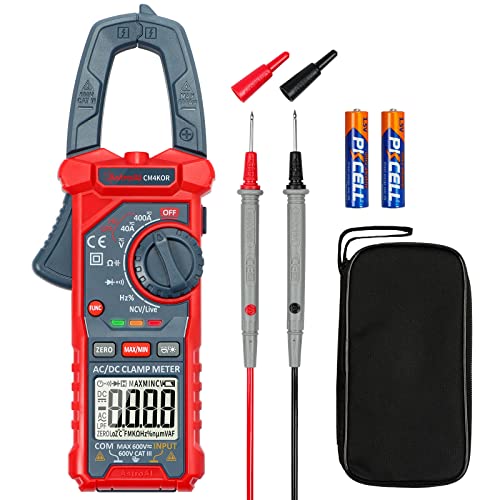
This AstroAI model handles higher-count measurements and expands tests to include frequency, duty cycle, and a powered-on display with backlight. It supports non-contact voltage testing with audible and visual alarms, and offers a ZERO function to reduce errors caused by magnetic interference. It is well-suited for industrial and home applications where engineers need robust data and a wide measurement range. A caution is that the unit’s clamp is optimized for current measurement; clamp alone is not used to test voltage directly, and proper technique is required to obtain accurate current readings.
KAIWEETS KC400 Compact Clamp Meter

The KC400 is a compact, palm-sized clamp meter designed for technicians who travel between job sites. It measures AC current (2A/20A/200A/400A max), AC/DC voltage (up to 600V), resistance, and includes continuity and diode testing. Its 2000-count display provides solid readability, with an auto power-off feature to save battery life and a backlit screen for dim environments. Choose this if you need a portable, multi-function tool for quick checks in tight spaces. One limitation is the clamp’s cable size; very large conductors may require multiple attempts to clamp effectively.
Hioki CM3286-50 AC Clamp Power Meter

The Hioki CM3286-50 consolidates AC/DC voltage, current, power, frequency, and power factor in one handheld device. It supports single- and three-phase testing up to 600 A and 1000 V, making it suitable for industrial, commercial, and residential systems. It includes a built-in power analyzer to monitor harmonic content, phase sequence, and energy usage for troubleshooting and energy audits. This model is best for professionals needing deeper power analysis and higher voltage/current capabilities. A potential limitation is its higher cost and complexity for casual users who only need basic measurements.
Buying Guide
Key considerations when selecting a clip-on power meter
- Measurement range: Ensure the device covers the voltage and current levels you encounter. Look for models with 600V and 400A ranges or higher for robust testing.
- True RMS: True-RMS readings provide accuracy for non-sinusoidal waveforms common in modern electronics and variable-speed drives.
- clamp jaw design: D-shaped jaws can accommodate larger cables; consider the jaw opening if you test thick wires.
- Non-contact voltage (NCV): NCV helps detect live circuits without direct contact, enhancing safety in field work.
- Display and usability: Backlit displays, data hold, auto power-off, and flashlight features improve readability in dim areas.
- Additional features: Power analysis (harmonics, power factor), frequency, and duty cycle can be critical for energy audits and complex troubleshooting.
- Portability vs. capability: Compact meters are easier to carry; higher-end meters offer deeper analytics but may be heavier and more expensive.
Frequently Asked Questions
- What is a clip-on power meter used for?
It measures electrical parameters by clamping around a conductor, enabling non-invasive current readings and voltage checks. - Do all clamp meters test DC current?
No; many models measure AC current in clamp mode and DC current only with specific configurations. - Is NCV reliable for identifying live wires?
NCV provides quick safety cues but should be corroborated with other measurements in high-risk situations. - Which features matter most for electricians?
TRUE-RMS, high current range, backlit display, and the ability to test multiple parameters (voltage, resistance, continuity, frequency) are valuable. - When should I choose a high-end power meter?
Choose a high-end meter when professional diagnostics require advanced analytics like harmonics, phase sequence, and energy audits. - Are battery life and auto-off important?
Yes; long battery life and sensible auto-off help ensure meters are ready when you need them.