
Best Argon Regulator for Mig Welder: Top Regulators for Precise Gas Control
Finding the right argon regulator for MIG and TIG welding helps ensure stable arc performance, consistent flow, and safer operations. This guide highlights five reliable regulators that work well with argon or argon-based gas blends, with clear flow gauges and robust build quality. Each option supports common CGA-580 tank connections and multiple outlet fittings to match your welding hose and torch setup. Read on for objective, feature-based comparisons to help you choose the best regulator for your shop or project needs.
| Product | Brand | Key Benefit |
|---|---|---|
| RX WELD Argon Regulator Flowmeter | RX WELD | Accurate flow regulation from 10–60 CFH with brass construction |
| RX WELD Argon Regulators Gauges | RX WELD | Versatile outlet connectors for MIG/TIG with CGA-580 |
| ARCCAPTAIN Argon CO2 Regulators | ARCCAPTAIN | 0–4000 PSI input, 0–30 CFH argon, 0–20 CFH CO2 outputs |
| Yeswelder Argon/CO2 Flow Meter | YESWELDER | Clear CFH scale up to 60 with large gauge for precise control |
| Forney 85363 Argon/CO2 Regulator Kit | Forney | Dual-scale gauge, durable brass body for reliable use |
RX WELD Argon Regulator Flowmeter for Mig Tig

The RX WELD flowmeter regulator is designed for argon and lightweight gas blends, offering a CGA-580 inlet and multiple outlet adapters. The brass body is built to withstand harsh shop environments. The flowmeter indicates adjustable gas flow from 10 to 60 CFH via a moving ball in the flow tube, helping welders maintain steady shielding during long runs. It includes a standard 1/4″ barbed fitting for versatile hose compatibility and fittings for both common female and male connectors.
RX WELD Argon Regulators Gauges for MIG/TIG

This regulator emphasizes compatibility with argon, helium, and CO2 tanks through a CGA-580 inlet. It provides reliable outlet options (9/16″ male and 5/8″ female) to match a variety of hoses and adapters. The design focuses on stable pressure delivery and straightforward setup, making it a practical choice for users who switch between welding environments or gas blends.
ARCCAPTAIN Argon CO2 Regulators With Hose

ARCCAPTAIN offers a regulator with a wide 0–4000 PSI input range and precise 0–30 CFH argon and 0–20 CFH CO2 outputs. The CGA-580 inlet, a built-in filter, and a pressure relief valve contribute to safe operation and extended gauge life. A brass body ensures durability for frequent welding sessions, especially in workshops dealing with mixed gas operations.
Yeswelder Argon/CO2 Flow Meter Regulator

Yeswelder’s regulator is aimed at MIG and TIG welding with argon/CO2 blends. It features a square flow tube with a 0–60 CFH scale and a large 0–4000 PSI pressure gauge for easy reading. The unit accepts both 9/16″ x 18 and 5/8″ x 18 outlets and ships with a standard 1/4″ barbed fitting. This balance of clear measurement and flexible fittings makes it a practical pick for diverse welding tasks.
Forney 85363 Argon/CO2 Regulator Kit
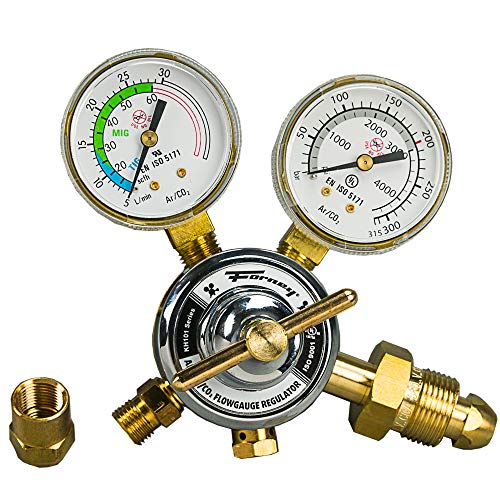
Forney’s regulator kit targets light-to-medium welding work with reliable gas flow control. The dual-scale gauge and polycarbonate lens provide durable, readable measurements in busy shop environments. A machined brass body adds to longevity, and the kit typically includes essential components for immediate setup on MIG or CO2-inclusive TIG projects, offering a straightforward way to manage shielding gas.
Buying Guide: Key Purchase Considerations
Gas regulators vary in output ranges, connection types, and durability. Consider these factors to choose the best regulator for your MIG or TIG setup:
- Gas compatibility: Most regulators support argon or argon-based blends; ensure it matches your tank (CGA-580 inlet is common).
- Output range: Typical argon setups require 0–30 CFH or up to 60 CFH for high-speed operations. Select a range that matches your welding technique and nozzle size.
- Outlet fittings: Verify compatibility with your hose fittings (9/16″ x 18 or 5/8″ x 18, plus any barbed fittings) to avoid leaks or adapters.
- Gauge readability: Larger gauge faces and clear flow tubes help maintain stable shielding gas during long welds or in bright shop lighting.
- Safety features: A pressure relief valve and a robust build reduce overpressure risks and extend regulator life.
- Durability: Brass bodies and impact-resistant lenses improve longevity in workshop environments.
- Included accessories: Some kits include hoses, clamps, or mounting nuts—assess overall value for your setup.
- Maintenance: Look for fittings and filters that shed impurities to protect downstream equipment and improve weld quality.
In choosing among these options, consider your typical welding tasks, gas blends, and the degree of precision you need in shield gas delivery. For frequent TIG work with argon, a regulator with clear CFH readouts and stable regulation is beneficial. For MIG applications using argon/CO2 blends, models offering durable dual-connectivity and robust housings can support longer, steadier welds. By weighing compatibility, gauge clarity, and build quality, you can identify the regulator that best aligns with your workflow and safety priorities.