
Best PCIe Low-Profile Graphics Card for Small Form Factor PCs
If you need a compact GPU for a slim PC chassis, a PCIe low-profile graphics card is the right choice. This guide highlights five budget-friendly options suited for small form factor builds, home offices, HTPCs, and basic gaming or multimedia tasks. Each card is evaluated for compact size, output options, and compatibility with modern Windows versions. The top picks are best for people upgrading older systems, users with limited space, and those who want multi-monitor setups on a tight footprint.
| Product | Best For |
|---|---|
| GeForce GT 610 2G DDR3 | Entry-level SFF/HTPC users needing HDMI/VGA in small builds |
| MSI GeForce GT 1030 4GB | Light gaming and modern Windows 11/10 setups in compact PCs |
| SOYO GeForce GT 740 4GB | Multi-monitor productivity in slim desktops |
| QTHREE GeForce GT 730 4GB | Budget upgrade with multiple outputs in small cases |
| QTHREE GeForce GT 210 | Very compact, basic display tasks and low power builds |
GeForce GT 610 2G DDR3 Low Profile

Best for entry-level builds where space is at a premium. This card uses a 40nm GeForce GT 610 GPU with 2 GB of DDR3 memory and a 64-bit bus. It supports HDMI and VGA outputs, making it suitable for basic multimedia, office tasks, or a compact HTPC. It is noted for straightforward setup on Windows 11 with no manual driver download required in many cases.
- Low-profile form factor, PCI Express 1.1 x16
- HDMI and VGA dual outputs
- Max HDMI resolution up to 2560×1600; VGA up to 2048×1536
Who it’s best for: buyers upgrading very small systems who need a simple, space-saving GPU for video playback or basic graphics tasks. Caution: performance is limited for gaming or modern 3D workloads.
MSI GT 1030 4GB DDR4 LP OC

Best for light gaming and everyday tasks in small form factor PCs. The GT 1030 4GB DDR4 offers more memory and a higher Boost Clock (up to 1430 MHz) than entry-level GT 610 cards, enabling smoother 1080p video and basic gaming. Suitable for compact builds that still require decent display capability and DirectX 12 support.
- NVIDIA GeForce GT 1030, 4GB DDR4
- 64-bit bus; supports DirectX 12
- Low-profile design with single fan OC variant
Best for: better for moderate gaming and media tasks in an SFF PC. Caution: 4GB of DDR4 helps, but this is still a budget card with limited 3D performance compared to mid-range GPUs.
SOYO GT 740 4GB DDR3 Low Profile

Best for legacy PC upgrades needing multi-output flexibility. The GT 740 4GB DDR3 provides 4GB VRAM with a 128-bit bus and triple-output HDMI, DVI-D, and VGA. This makes it a strong choice for a dual-monitor or triple-monitor small-form-factor setup, especially if you want to preserve legacy displays while upgrading from integrated graphics.
- 4GB DDR3, 128-bit bus
- HDMI, DVI-D, VGA triple outputs
- Windows 11/10/8/7 compatible (DirectX 12/11_0)
Best for: upgrading older desktops to improve productivity with multiple displays. Caution: not optimized for modern demanding titles; performance is best for office tasks and media.
QTHREE GT 730 4GB Dual HDMI
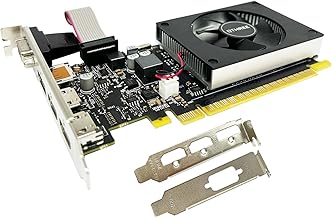
Best for compact builds needing flexible outputs. The GT 730 4GB DDR3 offers multiple video outputs, including HDMI, VGA, and DP. It uses a 64-bit memory interface and is designed to save space in ITX or SFF cases while providing a reasonable upgrade path for basic display tasks, office work, and light multimedia.
- 4GB DDR3, 64-bit bus
- 2x HDMI, VGA, DP outputs
- Low-profile PCIe x8 form factor
Best for: choose this if you want multi-monitor capability in a compact PC. Caution: intended for light workloads; avoid for modern gaming or heavy 3D apps.
QTHREE GT 210 1GB/2GB Low Profile

Best for tiny, ultra-budget builds requiring basic display output. The GT 210 offers a compact, low-power solution with HDMI and VGA. It is suitable for simple tasks like email, web browsing, and basic photo or video viewing on a small form factor PC.
- PCI Express 2.0 x16, low power
- HDMI and VGA outputs
- Small size ideal for slim ITX cases
Best for: choose this for a minimal upgrade in a space-constrained system. Caution: very limited performance for modern software or gaming.
Buying Guide
What to consider when choosing a low-profile PCIe GPU
- Form factor and compatibility: Ensure the card fits your chassis and uses a compatible PCIe slot (x16 or x8).
- Memory and bandwidth: More VRAM and a wider memory bus improve multitasking and video playback; prioritize 4GB for modest gaming and multitasking.
- Output options: Verify the number and types of ports (HDMI, VGA, DVI, DP) to match your monitors.
- Power and cooling: Low-profile cards typically have lower power draw; confirm your PSU and case cooling are adequate.
- Operating system support: Most listed cards support Windows 11/10; check driver availability for your setup.
Performance expectations by use case
- Office and multimedia: GT 610 and GT 210 offer solid basics with HDMI/VGA outputs.
- Light gaming and modern media: GT 1030 4GB provides smoother 1080p playback and modest gaming capabilities.
- Multi-monitor workstations: GT 740 4GB and GT 730 4GB offer multiple outputs for productivity boosts.
Space-saving strategies
- Choose a low-profile card with a compact bracket and consider ITX or SFF enclosures.
- Plan cable routing to avoid obstructing fans in tight cases.
FAQ
- What is a low-profile graphics card?
A low-profile graphics card is designed to fit small form-factor PC cases with a shorter bracket and reduced overall depth, suitable for slim desktops and HTPCs. - Do these cards support Windows 11?
Several listed models advertise Windows 11 compatibility, often with driver support provided by the manufacturer or automatically via Windows updates. - Can I run multiple monitors with these GPUs?
Yes, many offer HDMI, VGA, DVI-D, or DP outputs; check the specific card’s ports to match your displays. - Is 4GB RAM enough for light gaming?
For basic games at modest settings and general multimedia, 4GB is workable, but performance varies by title and resolution. - Are these cards suitable for 1080p gaming?
Some models can handle 1080p at low to medium settings; expect limited performance on newer, demanding titles. - Will these cards fit ITX cases?
Most low-profile options are designed for small cases, including ITX builds, but verify the exact dimensions and bracket height.