
Best 50 Amp Dryer Plug Adapters for Home, RV, and EV Use
Answering the needs of installers, hobbyists, and DIYers, these 50 amp dryer plug adapters help you connect traditional, older, or nonstandard outlets to modern devices. They are best suited for people working with older dryers, RV hookups, generators, welder outlets, or Level 2 EV charging setups. The top picks below balance ease of use, durability, and compatibility across common NEMA configurations. The quick-reference table highlights who each adapter is ideal for.
| Product | Best For | Key Notes |
|---|---|---|
| NEMA 10-50P to 10-30R Dryer Adapter | Older Style Dryers | 3-prong to 3-prong, ETL listed |
| Nilight 14-50P to 14-30R EV/ Dryer Adapter | EV Charging with Dryer Outlets | 4-prong, copper conductors |
| Nilight 14-30P to 14-50R EV Adapter | Level 2 EV Charging | 4-prong, compact length |
| Kanayu 6-50P to L6-30R Welder Adapter | Welder and Generator Uses | Locking L6-30R, 240V |
| Kanayu 14-50P to 10-30R Dryer/Generator Adapter | RV, Generator, Dryer Transitions | 4-prong to 3-prong, ETL listed |
NEMA 10-50P to 10-30R Dryer Adapter Plug

Best for customers upgrading older-style appliances without rewiring. This 50A to 30A adapter converts a traditional NEMA 10-50P male to a NEMA 10-30R female, enabling compatibility with older ranges or dryers. The unit uses heavy-duty copper conductors and an STW jacket for durability. It is ETL listed and designed for straightforward plug-and-play use, making it suitable for users who want a simple connection without tools. Choose this if you need a compact, reliable solution for older equipment; avoid if you require a 4-prong configuration for newer EV charging or modern dryer outlets.
Best for: Homeowners with legacy 3-prong dryers or ranges who want a quick adaptor without rewiring.
Why selected: Simple, ETL-listed, durable construction, fast setup.
Caution: Not intended for 4-prong EV charging or modern 14-50 outlets.
Nilight EV Dryer Charger Adapter Cord 50A to 30A
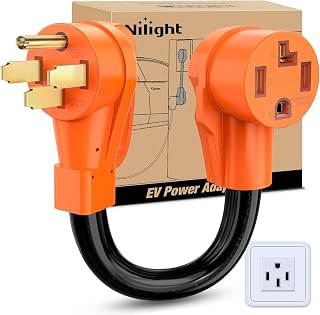
This 50A to 30A adapter converts a 14-50P (4-prong) to a 14-30R for EV charging and dryer use. It features 10 AWG copper conductors and a STW jacket with flame-retardant PVC insulation, designed for high-conductivity and outdoor durability. It is clearly labeled for Level 2 EV charging contexts and explicitly notes it is not for RV use. It’s best for EV owners who need to link a home 50A outlet to a 30A EV cord. A limitation is that it’s not suitable for RV or universal 4-prong dryer connections beyond the intended 14-50P to 14-30R conversion.
Best for: EV charging setups in garages with 14-50P receptacles.
Why selected: Strong copper construction, jacket protection, and explicit usage guidance.
Caution: Not for RV or non-EV dryer applications.
Kanayu NEMA 6-50P to L6-30R Welder Adapter

This 50A to 30A welding adapter connects a NEMA 6-50P male to a locking NEMA L6-30R female. It supports up to 30A at 240V and features a grip-friendly handle for easy pushing and pulling. It’s designed for welders, dryers, and EV charging setups that need a secure, locking connection. Best for professionals or hobbyists who frequently switch between different high-current devices. It may not fit non-locking 30A outlets, so verify receptacle compatibility before use.
Best for: Welding, generators, and EV charging scenarios requiring a locking connection.
Why selected: Locking L6-30R compatibility provides a secure connection under load.
Caution: Limited to 30A rating on the receptacle side; ensure outlet compatibility before use.
Kanayu 14-50P to 10-30R Dryer/Generator Adapter

This adapter translates a 14-50P direct dryer/generator connection to a 10-30R outlet. It is ETL listed, uses 10 AWG conductors, and is designed for RV hookups, generators, and older dryer connections. It provides a practical bridge for travelers or seasonal setups where a 14-50P outlet must power a 10-30R device. A potential limitation is that it converts between 4-prong and 3-prong configurations, which may not be compatible with all modern breakers or circuits without professional assessment.
Best for: RV parks, generator hookups, and older dryer configurations needing a 14-50P to 10-30R transition.
Why selected: Flexible cross-configuration option for travel or temporary setups.
Caution: Ensure circuit protection and receptacle compatibility before use.
Buying Guide
What should I look for in a 50A dryer adapter?
Consider the plug and receptacle types, current rating, wire gauge, jacket material, and intended use. A larger gauge (10 AWG or thicker) supports higher current with less heat. Look for ETL or similar safety listings for reliability. Verify that the adapter aligns with your outlet configuration (four-prong vs three-prong) and the device you plan to power.
Is it safe to use adapters for EV charging?
Yes, but only when the adapter is rated for the intended charging level and outlet type. Do not exceed the rated amperage of the receptacle. Use adapters with durable jackets and copper conductors to minimize resistance and heat. Always consult the device’s charging requirements and local electrical codes.
Which adapters are best for RV and generator use?
Adapters that offer four-prong to three-prong conversions or vice versa are common for RV and generator setups. Ensure the adapter is ETL listed and compatible with your specific outlets (for example, 14-50P to 10-30R). For travel, a compact, durable model with clear labeling reduces misconnection risk.
Are locking connectors a better choice?
Locking connectors (such as L6-30R) provide a secure connection under load and are advantageous in environments with movement or vibration. They can be harder to misalign during setup, which adds a safety margin. Check compatibility with your equipment before purchasing.
What are common limitations of these adapters?
Adapters do not create electricity; they only adapt the plug configuration. Some models are not suitable for RVs, some are not designed for 120V operation, and certain configurations may require higher-grade installation or dedicated circuits. Always ensure the adapter matches both the device and the outlet ratings to prevent overheating or tripping breakers.
Usage tips for safer operation
- Inspect adapters for damage before use and replace if cracked or frayed.
- Avoid running high-draw appliances for extended periods on marginal connections.
- Keep adapters away from water exposure and ensure outdoor-rated jackets for weather resistance.
- Do not “stack” adapters or use parallel power cords to increase capacity.
FAQ
- What is the difference between three-prong and four-prong adapters?
Answer: Three-prong adapters typically correspond to older outlets and do not offer a ground connection; four-prong adapters include a ground pin for safer operation with modern equipment. - Can I use a 50A to 30A adapter for EV charging at home?
Answer: Some adapters are designed for Level 2 charging contexts but verify that the receptacle and EV charger are compatible with the adapter’s configuration and ratings. - Are these adaptersETL listed?
- Will using these adapters void my warranty?
Answer: It depends on the device and manufacturer policies. Always check the documentation for your specific dryer, EV charger, or generator. - Do adapters affect charging speed or appliance performance?
Answer: Properly rated adapters maintain safe operation but do not increase the device’s rated performance; use within the intended amperage to avoid overheating.
Answer: Several models in this range are ETL listed, indicating compliance with safety standards for electrical products.