
Best Sine Wave Function Generators for Precise Signal Testing
Selecting a reliable sine wave function generator is crucial for accurate signal testing and waveform calibration. Whether you are calibrating oscilloscopes, testing audio equipment, or debugging circuits, having a versatile and stable signal source matters. Below is a summary table highlighting the top 5 sine wave function generators available on Amazon, prioritizing features like waveform versatility, frequency range, display clarity, and portability.
| Product | Brand | Key Features |
|---|---|---|
| Signal Generator Module with LCD Display | Caredy | Multi-mode: PWM, pulse, sine; strong load capacity; adjustable voltage/frequency; clear LED screen |
| Koolertron 15MHz Dual-Channel DDS Signal Generator | Koolertron | High precision DDS, dual-channel, multiple waveforms, frequency measurement, sweep functions |
| 0.01Hz-500kHz DDS Signal Generator with Schumann Resonator | TKXEC | Wide frequency range, 15 waveform types, Schumann resonator included, multipurpose generator |
| EastTester Dual-Channel Arbitrary Waveform Generator | EastTester | 2.4″ LCD screen, 200MSa/s sampling, independent dual channels, supports internal modulation |
| Seesii 1Hz-500kHz DDS Signal Generator with Schumann Resonator | Seesii | Multiple waveform options, switchable filter, AC/DC power, portable for field use |
Signal Generator Module With LCD Display By Caredy

This function signal generator module supports multiple modes including PWM, pulse, signal voltage/current source, and sine wave with frequencies ranging from 1 to 1000Hz. Its bright LED display distinctly shows output current and voltage for easy monitoring. Users can switch display modes with a simple button press. The device is capable of outputting a strong load current up to 30mA, ideal for signal source applications though it should not be used to directly drive high-power components. Voltage, frequency, and duty cycle can be adjusted within PWM mode, making it a versatile module for different signal generation needs.
Koolertron 15MHz Dual-Channel DDS Signal Generator

Featuring a high precision DDS design, this advanced function generator employs an FPGA IC together with a high-speed MCU for strong signal stability. It offers dual independent channels capable of generating sine waves, square waves, triangles, sawtooth, pulses, white noise, and user-defined waveforms. Both channels allow custom parameter settings. Additional functions include linear and logarithmic sweep capabilities, along with frequency, period, and pulse width measurement tools, making it suited for comprehensive waveform analysis and complex signal measurement.
0.01Hz-500kHz DDS Signal Generator With Schumann Resonator By TKXEC

This multifunction DDS signal generator covers a broad frequency range from 0.01Hz up to 500kHz for sine waves and 100kHz for other waveforms. The inclusion of a 7.83Hz Schumann Resonator allows emission of natural frequencies for applications beyond standard signal testing, such as promoting relaxation and well-being. This model supports 15 waveform types, making it highly adaptable—from basic sine waves to complex pulses—ideal for oscilloscope calibration, audio testing, and even health-focused usage.
EastTester Dual-Channel Arbitrary Waveform Generator With LCD
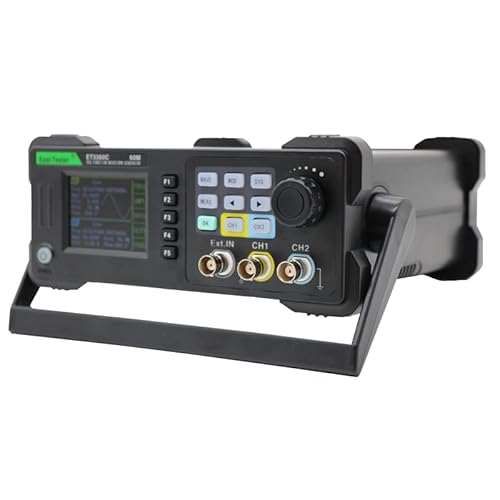
The EastTester device uses a 2.4-inch TFT color LCD to show waveforms and settings clearly. It has a sampling rate of 200MSa/s and offers a long waveform length of 8192 points with 13-bit vertical resolution. Dual channels operate independently with phase synchronization options. Other advanced features include internal amplitude, frequency, and phase modulation, along with ASK, FSK, and PSK modulation types. It supports storage of 50 user-defined waveforms, making it suitable for advanced experimental setups and communication signal generation.
Seesii 1Hz-500kHz DDS Function Generator With Schumann Resonator

This portable device combines the capabilities of a high-frequency DDS signal generator with a built-in 7.83Hz Schumann resonator, offering both accurate circuit testing and stress-relief benefits. It produces sine, square, triangle, and sawtooth waveforms, with a switchable low-pass filter to obtain clean sine or pulse signals. Power options include AC/DC adapter or battery, allowing for versatile use in classrooms, laboratories, or on-site testing scenarios. This model stands out for its combination of electronic testing and health-conscious waveform generation.
Buying Guide For Sine Wave Function Generators
When choosing a sine wave function generator, consider the following key aspects to ensure it meets your specific testing or calibration needs:
- Frequency Range: Ensure the generator covers your required frequency span. For oscilloscope calibration and general electronics testing, devices offering from ultra-low frequencies (sub-Hz) up to several hundred kHz or several MHz provide meaningful flexibility.
- Waveform Variety: Beyond sine waves, having access to square, triangle, sawtooth, pulse, and user-defined arbitrary waveforms expands usability for diverse applications, including communication testing and signal analysis.
- Output Stability and Precision: DDS (Direct Digital Synthesis) technology offers stable frequency and low distortion. FPGA-based models enhance signal fidelity and reduce jitter.
- Display and Interface: Clear, intuitive color LCD or bright LED screens facilitate waveform visualization and parameter adjustments. Graphical interfaces simplify operation.
- Channels: Dual-channel generators allow simultaneous signal output for comparative testing or phased signals, valuable in differential circuits or modulation experiments.
- Modulation Features: Built-in AM, FM, PM, and digital modulations (ASK, FSK, PSK) support communication signal simulation and advanced waveform manipulation.
- Load Capacity and Output Power: Check maximum output current and voltage specifications to avoid overloading and to ensure compatibility with your devices. Some signal generators provide only signal source levels, not high-power driving output.
- Portability and Power Options: Battery-powered or compact devices enable use in fieldwork and classroom demos. AC adapters provide continuous operation for bench testing.
- Additional Functionalities: Features such as frequency counters, sweep functions, waveform storage, and calibration-specific modes enhance practical testing versatility.
By weighing these factors based on application needs—such as professional lab measurements, educational use, or hobby electronics development—you can select the best sine wave function generator that balances capability, precision, and convenience.