A garage with its big door open can look like an outdoor space, especially when rain is coming sideways and your refrigerator has stopped running. For a fuel-burning portable generator, that impression can lead to a deadly mistake.
The engine makes carbon monoxide, and you cannot decide whether the air is safe by looking at the door opening or smelling the exhaust. Choose an outdoor operating location before an outage, and treat a home without a suitable location as a home that needs a different backup plan.
Why the open door does not settle the question
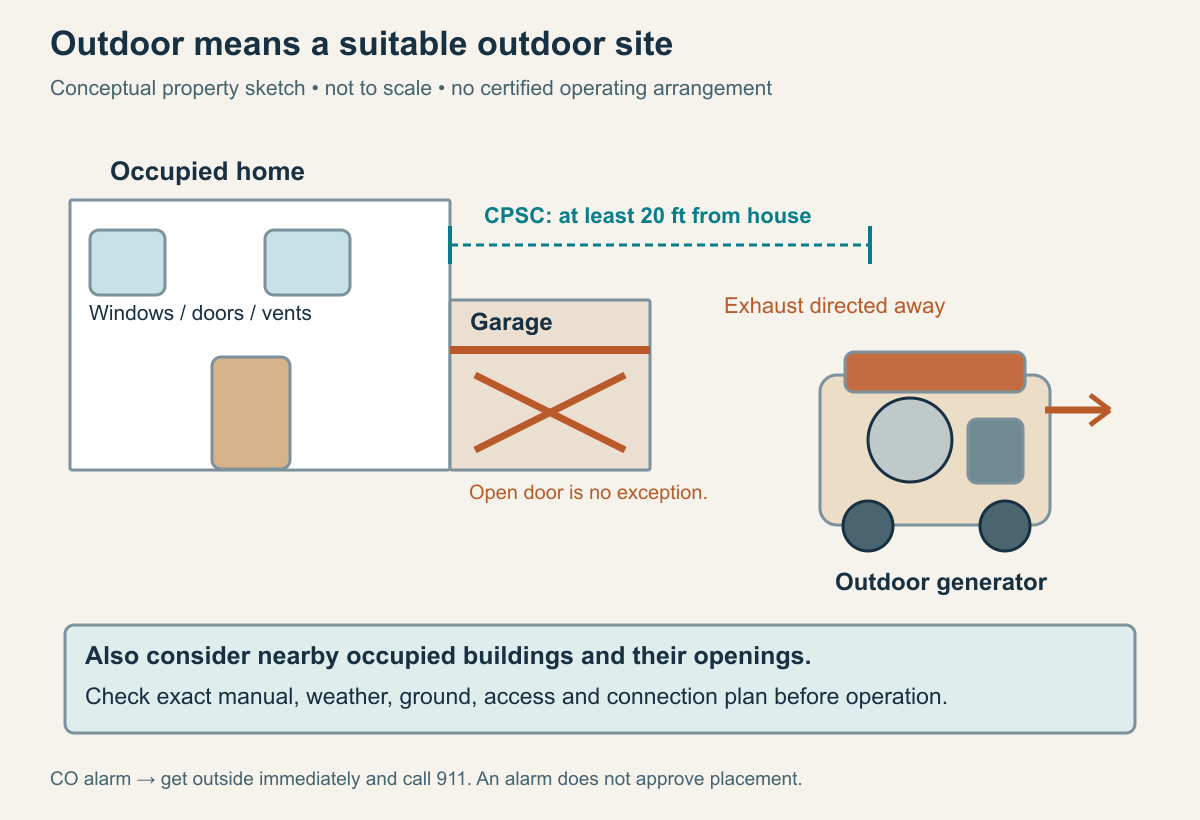
The CPSC warns against running generators inside garages, homes, basements, crawlspaces, or sheds, including when doors and windows are open. A fan and an open garage door do not turn an enclosed structure into an acceptable generator location.
It is easy to picture exhaust traveling straight out through the opening, but the actual space has walls, corners, and connections to other rooms. You cannot supervise those air movements by standing nearby and watching the machine.
An attached garage also sits next to places people occupy, which makes a convenient extension-cord route a poor starting point for the decision. Start with where the exhaust belongs, then work out whether the rest of the arrangement is feasible.
A detached shed is not a workaround just because nobody sleeps there. The prohibition concerns operating in that enclosed space, rather than whether you have labeled the building as storage.
Similarly, placing the machine near the garage opening while its exhaust points outward does not establish a safe location. The whole machine needs an appropriate outdoor operating site, consistent with its instructions and the CPSC's guidance.

Walk the site before you need it
The CPSC's generator brochure calls for operating outdoors at least 20 feet from the house, with exhaust directed away from buildings. Its safety alert also identifies doors, windows, and vents as openings that can admit exhaust.
Measure rather than guess, and consider neighboring buildings as well as your own. A narrow side yard that looks generous on a listing photograph might leave you with no suitable place when you account for occupied structures and openings.
Make a simple sketch showing the house, nearby structures, windows, doors, and vents you can identify from outside. Then mark proposed generator positions and the distances that matter, keeping the manufacturer's additional requirements with that sketch.
The 20 feet is a minimum in the cited guidance, not a promise that every arrangement at exactly that distance is safe. If the layout, openings, or equipment instructions leave you uncertain, resolve the question before relying on the generator.
For example, an apartment balcony may seem outside while remaining right beside windows and doors on several homes. A shared courtyard also introduces other occupants, building rules, and access routes that a homeowner's backyard sketch does not address.
Ask your property manager about restrictions before buying a machine for that setting. If there is no suitable outdoor site, plan for battery-powered essentials, community resources, or relocation instead of trying to negotiate with the geometry during an emergency.
Rain creates another problem, not an exception
A forecast full of rain is often exactly when backup power becomes attractive. It is also when a person may be tempted to move the generator into a garage to keep the equipment dry.
The CPSC's safety alert explains that wet operation creates shock hazards and that moisture protection must not introduce an indoor or near-opening carbon-monoxide hazard. That means solving the weather problem while preserving the outdoor location requirements.
Read the generator's weather instructions and the instructions for any manufacturer-compatible shelter you intend to use. A tarp, storage box, or improvised enclosure is not automatically an operating shelter simply because it keeps rain off the fuel cap.
Look at the ground as well as the sky: where would water drain, puddle, or collect around the proposed location? If you cannot keep the arrangement suitable through the expected conditions, use your alternate plan rather than bringing the machine closer to the house.
Think through how people would reach the controls without walking across a flooded area or handling wet equipment. This is a planning question you can answer on a dry afternoon, before urgency makes every inconvenient detail feel optional.
The same applies to theft concerns and noise complaints. A quieter or more concealed location does not qualify if it compromises the required placement, and a security arrangement must follow the equipment instructions rather than obstructing its operation.
Keep alarms separate from placement
Working carbon-monoxide alarms belong in the household plan, but they do not authorize an otherwise prohibited operating location. The CPSC brochure recommends battery-operated alarms or alarms with battery backup outside sleeping areas and on each floor, with monthly testing.
Follow the alarm manufacturer's installation, testing, and replacement instructions for the devices you actually own. A button press, an indicator light, and an end-of-life warning have specific meanings that should be clear before the lights go out.
Check who can hear the alarms while sleeping, and make sure everyone knows the agreed response. Visitors and children may have no idea what an unfamiliar sound means if the household has never discussed it.
Do not build a plan that requires someone to stay inside and watch a detector while another person experiments with generator placement. The equipment location must already comply with the guidance, and the alarm remains an additional safeguard.
If a carbon-monoxide alarm sounds, the CPSC says to get outside immediately and call 911. If you suspect carbon-monoxide poisoning, get into fresh air immediately and call 911 rather than waiting indoors to see whether symptoms improve.
Headache, dizziness, weakness, nausea, or other illness around a running generator should not be dismissed as an inconvenient part of a storm. Do not reenter to investigate or retrieve possessions; follow emergency responders' instructions.
Plan the power route without improvising house wiring
A usable outdoor position still leaves the question of how to supply the intended loads. Identify those loads, their requirements, and the approved connection arrangement before you need to run anything.
The CPSC warns never to feed generator power into household wiring through a wall outlet. That practice can expose utility workers and others to electrocution and bypass household protection, regardless of whether the main breaker appears to be off.
Supplying building circuits requires a properly designed and installed arrangement handled by qualified professionals under applicable local requirements. This article is not a connection diagram or a procedure for configuring a transfer device.
For equipment connected directly under the generator's instructions, the cord selection and route also matter. Read those instructions alongside the cord's ratings, and resolve any route that would pinch a cable or create an unsafe crossing.
Avoid purchasing first and assuming an assortment of adapters will sort out the plan later. The generator, load, location, and connection method need to fit together as one workable arrangement.
A short handoff prevents the familiar shortcut
Keep the site sketch, exact generator manual, intended load list, and approved connection information together where the household can find them. Record the conditions that would make you abandon operation, including unsuitable weather or loss of the planned outdoor access.
Give another adult a walk-through while the equipment is off and the weather is calm. Ask them to identify the location and the reasons it was selected, because remembering a rule is easier when you can point to the doors and neighboring windows it protects.
Finally, decide where you will go if the plan cannot be used that day. Having an alternate destination makes it much easier to leave the garage door open for ordinary access without treating it as permission to run an engine inside.
Sources and scope
- CPSC: Generators and Engine-Driven Tools
- CPSC: What to Know—Generators and CO (2022 brochure)
- CPSC: Portable Generator Safety Alert
Sources checked October 14, 2026. This guide uses documented information; it does not claim independent product testing or professional inspection.