As an Amazon Associate I earn from qualifying purchases. These links may earn this site a commission when you buy, at no extra cost to you.
Match the light to the route you actually walk
Choose the GE 37299 if you want a low background glow that becomes brighter as you approach; choose the GE 12201 if you prefer a straightforward motion-activated plug-in light. The Mr Beams MB723 three-pack is the alternative when the useful positions do not have nearby wall outlets.
These picks compare documented behavior, placement, and power source rather than measured brightness or fall prevention. We have not tested their sensors in a home, and a night light does not replace normal room lighting, emergency lighting, clear walking surfaces, or a handrail where one is needed.
Start by walking the route in normal lighting and identifying the first point where you need visibility. A light at the far end of a hallway may look convenient on a floor plan but provide little help with the doorway or change of level you meet before reaching it.
| Exact model/package | Power | Documented behavior | Best reason to choose |
|---|---|---|---|
| GE 37299, brushed nickel, one light | Plug-in | Low glow with motion boost; selectable mode documented by Jasco | Background orientation light |
| GE UltraBrite 12201, white, one light | Plug-in | 40 lumens, low-light motion activation | Simple hall or utility route |
| Mr Beams MB723, white, three-pack | Four AA alkaline cells per light | 20 lumens per light; dark-only activation; 30-second timeout | Placement away from an outlet |
GE 37299: for a background glow before motion triggers

Jasco’s documentation describes a Motion-Boost mode that holds a three-lumen guide glow in darkness, rises to forty lumens with detected movement, and returns to the lower level after ninety seconds without movement. It also describes a selectable motion-activated mode, so verify the switch and instructions on the unit supplied.
The background glow is the meaningful distinction for a bedroom doorway or short corridor where you want to see the route before stepping into sensor range. It may also make the room less dark than you want while sleeping, so consider whether the outlet faces the bed.
The cover-style body is intended to cover an outlet area, and Jasco warns that repositioning it to leave another receptacle open may affect light sensing. Skip it when preserving both receptacles or maintaining complete darkness between trips is more important than its decorative appearance.
The linked listing is the brushed-nickel model 37299, not every GE night light with a similar shade. Check the model and mode description before checkout because a product-family name does not establish that a particular variant has the same controls.
GE UltraBrite 12201: a simpler motion-only plug-in choice
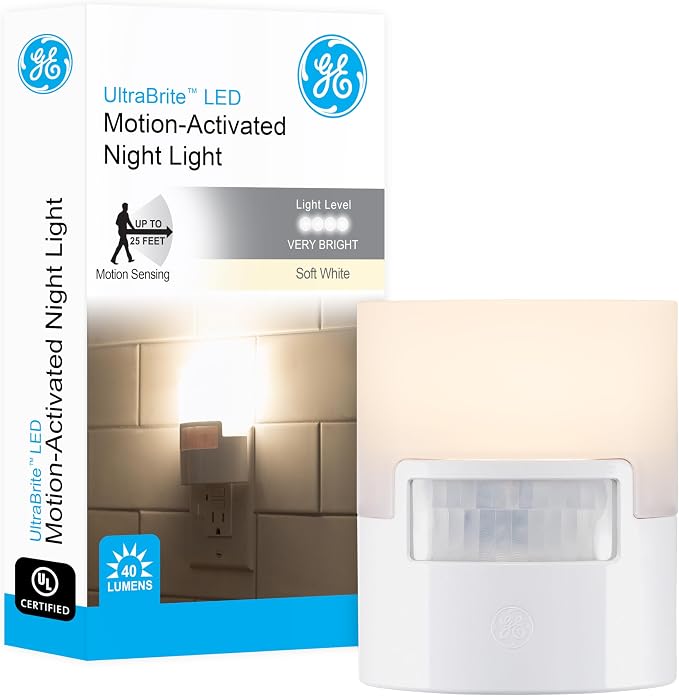
Jasco identifies the white 12201 as a forty-lumen plug-in light that activates on movement in low light. Its documentation says the compact design leaves the second receptacle available, which can matter in a hallway where the same wall plate also serves a vacuum or another occasional appliance.
Choose it for an uncomplicated route with an accessible outlet and no need for a permanent dim glow. A utility-room entrance is a more natural example than a bedside position directly in someone’s line of sight, although the best location still depends on the actual room.
The manufacturer’s detection-distance description is a maximum-condition claim rather than a measured promise for every angle or obstacle. Before committing to multiple units, test your normal approach from both directions with the room dark enough for its light sensor to permit activation.
Skip it for an outlet hidden behind a dresser, curtain, or an open door. Power being available there does not mean the sensor can see your approach or that the emitted light will reach the floor where you need it.
Check GE UltraBrite 12201 on Amazon


Mr Beams MB723 three-pack: flexible positions with battery upkeep

The Mr Beams instructions for the MB720–723 family specify four fresh AA alkaline batteries per light, twenty lumens, motion detection in darkness, and a thirty-second shutoff after movement stops. The linked Amazon package is the white MB723 three-pack, so equipping all three lights requires twelve AA cells.
This is useful when a stair approach, closet entrance, or short connecting passage has no convenient outlet. The included bracket gives the light a removable mounting arrangement, but choose the mounting method and surface using the actual instructions rather than assuming adhesive is suitable everywhere.
The manual warns that the strong adhesive may damage the mounting surface. Renters and anyone working on fragile paint should evaluate that trade-off before applying it, and should avoid any position where a loose light would become an obstruction.
Choose this package for several distinct positions you can maintain regularly, not merely because three sounds like better value. Skip it if the household will not inspect battery condition or if you expect a light to remain dependable indefinitely after it is installed and forgotten.
Check Mr Beams MB723 three-pack on Amazon
Use the sensor as part of the layout
Mark the first doorway, turn, or step on a simple sketch, then mark the usable outlets and mounting surfaces. Those three sets of information often decide between plug-in and battery-powered lights before brightness specifications become relevant.
Keep the sensor’s view clear and inspect how doors change that view when open or closed. A sensible location in the daytime can be blocked by the very door you open during a nighttime trip, making the light trigger later than expected.

Try the light under the conditions in which you will use it, including the nearby bedroom door position and any other lamps normally left on. If another light keeps the sensor from considering the area dark, the absence of activation may be expected behavior rather than a defective product.
Check the result from a standing position and from the bed or chair where glare would be annoying. Advertised lumens describe output, while the location and shade determine how much light reaches the route and how much reaches someone’s eyes.
Avoid buying brightness to solve the wrong problem
A dim orientation light can be useful for locating a doorway, but it is not task lighting for sorting medication, reading labels, or cleaning a spill. Turn on the appropriate room lighting when the activity requires clear detail rather than trying to do everything in the night light’s glow.
Likewise, a motion light can time out while a person remains still. Where continuous visibility is necessary, consider an appropriate continuous-lighting solution instead of assuming that occasional body movement will always keep a motion sensor satisfied.
For battery lights, choose a routine inspection interval appropriate to how often they activate and to the manufacturer’s instructions. Replace cells as directed, keep polarity correct, and follow the specified battery type; the Mr Beams manual calls for fresh alkaline cells rather than a mixed drawer of leftovers.
When none of these is enough
None of these products is a documented substitute for a building’s required emergency or egress lighting, and the plug-in models have no battery-backup claim in this comparison. If maintaining light through an outage is the requirement, select a product specifically documented for that function.
If there is a persistent mobility or vision difficulty, the right answer may involve brighter room lighting, changes to the route, or appropriate professional advice. For ordinary household convenience, begin with one useful position, verify the actual result, and expand only when you know what the first light leaves unresolved.
There is also a practical difference between temporary experimentation and permanent mounting. Test a battery light while you can still move it easily, confirm that both normal approaches trigger it soon enough, and only then use the mounting method appropriate to its instructions and your wall surface.
After the first week, ask whether the light activates before the part of the route you wanted illuminated and whether it wakes anyone unnecessarily. That feedback can justify moving one unit a few feet rather than buying a stronger model or multiplying the same placement error through the house.
Keep packaging and instructions until you have tested the planned location under realistic conditions. Confirm the seller’s applicable return terms before purchasing several units for a route that has not yet been tried.
For a shared bathroom route, check the lighting from the other bedroom as well as your own starting point. Two people approaching from opposite directions may need different sensor positions, and the location that helps one person can leave the other walking around a corner before the light notices movement.
Sources and scope
- Jasco GE Motion-Select 37299 — Boost mode, output, timeout, outlet coverage limitation
- Jasco UltraBrite 12201 — 40-lumen output, plug-in power, low-light activation, second receptacle
- Mr Beams MB720–723 installation instructions — Battery requirement, dark-only activation, output, timeout, adhesive warning
Research-based editorial comparison. No ownership, laboratory testing or hands-on experience is implied.