
Best Wireless Remote Thermostat Sensor Solutions for Home Comfort
Wireless remote thermostat sensors help you optimize comfort and energy use by measuring temperatures in multiple rooms and guiding heating and cooling systems accordingly. This guide highlights five highly relevant options, covering smart room sensors, wireless sensors, and compatible thermostats. Each product is evaluated for range, setup, and compatibility to help American homeowners choose the right system for focused comfort and energy savings.
| Product | Brand | Key Benefit | Link |
|---|---|---|---|
| Honeywell Home T9 WiFi Smart Thermostat with Smart Room Sensor | Honeywell Home | Room-specific comfort with Auto Home/Away & energy rebates | See product section |
| Honeywell FBA C7189R1004 Wireless Indoor Sensor | Honeywell | Simple installation with factory calibration | See product section |
| Honeywell Home RCHTSENSOR-1PK | Honeywell Home | Multi-room sensing for T9/T10 thermostats | See product section |
| Google Nest Temperature Sensor (2nd Gen) | Easy room-by-room scheduling integration | See product section | |
| MOES Smart Programmable Thermostat | MOES | 7-day programming with zone sensor options | See product section |
Note: This article presents objective information about each product’s features and specifications. Prices are not listed to keep content focused on value and fit for various homes.
Honeywell Home T9 With Smart Room Sensor

The Honeywell Home T9 is a WiFi-enabled thermostat that integrates with Smart Room Sensors to deliver precise comfort in chosen areas, such as bedrooms or living rooms. It supports Auto Home/Away Scheduling and works with energy rebates via participating providers. The T9 can respond to schedules and occupancy patterns, helping reduce energy waste while maintaining user comfort. Sensors extend the system’s reach with a range that can be effective up to 200 feet in typical homes, enabling flexible placement. This option is suitable for users seeking room-specific control and remote management from a mobile device.
Honeywell FBA C7189R1004 Wireless Indoor Sensor

This wireless indoor sensor from Honeywell offers factory calibration and quick installation, reducing setup time for a multi-room temperature strategy. It’s designed to operate within a broad temperature range (approximately 35-114 degrees Fahrenheit) and transmits data to compatible thermostats, enabling better zone-based control. The sensor family is ideal for households seeking a simpler, plug-and-forget approach to room-specific temperature management without manual recalibration after setup.
Honeywell Home RCHTSENSOR-1PK

The RCHTSENSOR-1PK is designed to work with Honeywell T9 and T10 WiFi smart thermostats, expanding the number of zones you can monitor. It supports sensing temperature and humidity across multiple rooms, enabling more precise focus on areas that matter most for comfort. This option is well-suited for larger homes or apartments with several live spaces where occupants spend time, helping to balance energy use with actual occupancy.
Google Nest Temperature Sensor (2nd Gen)

The Google Nest Temperature Sensor (2nd Gen) offers straightforward setup and app-based control through Google Home or Nest. Place the sensor in rooms with hot or cold spots to ensure the Nest thermostat maintains comfortable and balanced temperatures. With long battery life (up to around three years) and simple placement options, it provides a practical way to optimize single-room comfort without a complex installation.
MOES Smart Programmable Thermostat
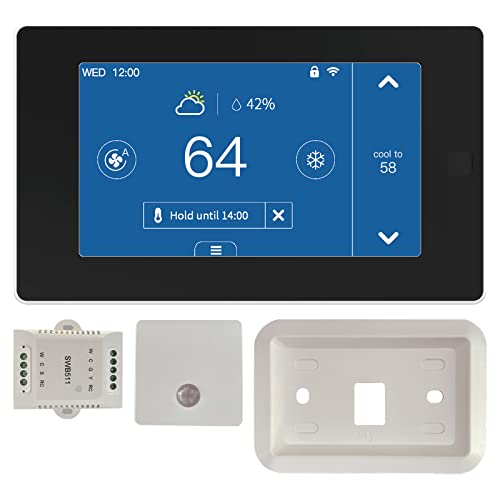
MOES offers a smart thermostat with zone sensor compatibility and seven-day programmable scheduling. It supports Tuya/Smart Life integration, enabling control via popular voice assistants like Alexa and Google Assistant. Designed for 24VAC HVAC systems, it provides flexible scheduling and energy-saving modes, with a C-wire option for more reliable power, which can help maintain stable sensor readings and thermostat responsiveness across rooms.
Buying Guide: Key Considerations For Wireless Remote Thermostat Sensors
Choosing the right wireless remote thermostat sensor setup involves balancing comfort, energy savings, and ease of use. Consider the following perspectives to guide a purchase decision.
- Compatibility: Confirm that the sensor works with your existing thermostat or that you’re selecting a system with an integrated thermostat. Look for 24VAC compatibility, C-wire support, and whether the platform (Alexa, Google Assistant, or HomeKit) aligns with your smart home.
- Sensor range and placement: Check the advertised signal range and whether additional repeaters or sensors are needed for larger homes. Plan placement in rooms that are prone to temperature variance, such as bedrooms, living rooms, or sunlit areas.
- Energy management features: Prioritize auto scheduling, occupancy sensing, and demand-response options offered by providers. These features help reduce energy use while maintaining comfort across zones.
- Installation complexity: Factory calibration and clear installation steps save time. Some sensors require pairing with a smart thermostat, while others are self-contained.
- Data and reporting: Look for real-time temperature/humidity readings, history, and notifications. A helpful app interface makes ongoing adjustments easier.
- Battery life and maintenance: Wireless sensors rely on batteries; consider sensor power consumption and how often batteries need replacement or recharging.
- Security and privacy: Ensure firmware updates and secure communications between sensors and the thermostat or hub.
- Future-proofing: If you plan to expand, choose a system with multiple compatible sensors and a clear upgrade path for additional rooms or new devices.
Overall, the best choice depends on your home size, existing smart home ecosystem, and whether you want room-by-room control or a simpler single-zone solution. The options above provide a balance of straightforward installation, reliable wireless connection, and room-level comfort adjustments for American households.