
Best Wind Power Kits for Homes: Grow Power Independence With Efficient Off-Grid Solutions
Finding the right wind power kit for a home depends on your energy goals, location, and budget. This guide highlights five top options that balance reliability, ease of installation, and suitability for different households. Best for off-grid living, small cabins, or emergency backup, these kits vary from compact 800W setups to high-capacity 12kW systems. The selection focuses on clear, practical advantages and practical limitations to help you choose confidently.
| Product | Best For | Key Benefit |
|---|---|---|
| Giosolar 1120W Kit | Small homes, off-grid charging | Combined wind + solar with included batteries |
| VEVOR 1000W Kit | Homes, farms, boats needing compact hybrid power | Balanced wind and solar with MPPT control |
| Lbxlhr 12000W Vertical Turbine | Energy-heavy setups | High capacity, low-start wind operation |
| Thames & Kosmos Wind Power V5.0 | Educational kits & lightweight use | Hands-on learning with safe wind turbine model |
| 3000W Wind Turbine Kit | Mid-size homes & cabins | Vertical axis design with solid power output |
Giosolar 1120W Kit for Home Off-Grid

Best for compact homes or cabins, this kit pairs a 400W wind turbine with 6x120W solar panels and a 3000W inverter. The turbine’s low start-up speed and auto windward direction adjustment maximize generation in light to moderate winds. The 400W wind component complements the solar array to extend usable energy into the night or cloudy days. The set is well-suited for off-grid living where space allows multiple panels and storage capacity is a priority.
Who it’s for: homeowners seeking a combined wind-and-solar solution with included battery storage, suitable for off-grid charging and backup power. Limitation: performance depends on wind consistency and sunlight, so siting and storage capacity should be carefully planned.
VEVOR 24V 1000W Solar Wind Kit
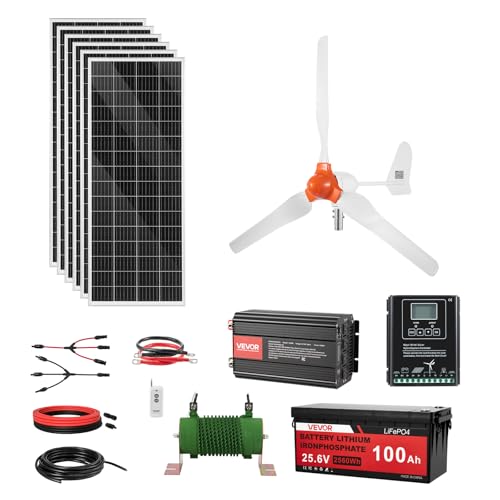
Best for homes needing a balanced power mix in a compact footprint, this kit includes six 100W solar panels and a 400W wind turbine with 25.6V 100Ah LiFePO4 storage. It’s designed to deliver up to several kilowatt-hours daily under good wind and sun. The MPPT controller optimizes energy harvest, and the system aims for reliability in varying outdoor conditions. Choose this if you want a straightforward, scalable hybrid installation.
Best for: homeowners with moderate energy use who want predictable daytime solar production paired with wind-assisted nighttime charging. Caution: ensure proper ventilation and battery management for LiFePO4 chemistry.
Lbxlhr 12000W Vertical Wind Turbine Kit

Best for large energy needs or remote properties, this upgraded vertical-axis turbine claims high capacity with a maglev generator for lower start torque and longer service life. The 12V/24V/48V/220V options accommodate various electrical configurations, making it a robust choice for big off-grid setups. It’s most suitable where robust wind resources and long-term energy independence are priorities. A caution: heavier systems require secure mounting and proper electrical integration.
Best for: users planning substantial off-grid power, with space for a tall turbine and a sturdy mounting solution. Limitation: installation complexity and weight may demand professional electrical and structural support.
Thames & Kosmos Wind Power V5.0 STEM Kit

Best for educational use and light outdoor exploration, this kit lets users build a 3-foot-tall model turbine to explore wind energy concepts. It’s optimized for indoor and outdoor experimentation and offers practical insight into turbine mechanics, energy conversion, and renewable technology. Choose this if the goal is hands-on learning or classroom demonstrations rather than full-home power independence.
Best for: families, students, or educators seeking a tangible wind energy demonstration. Caution: not designed to meet household electricity demands on its own.
3000W Wind Turbine Kit

Best for mid-size homes or cabins seeking higher wind energy capture, this vertical-axis design emphasizes reliable power generation with a three-phase AC PMG. The kit supports a broader wind speed range and aims to maximize annual energy production. It’s a good fit where wind resources are steady enough to justify a higher-capacity turbine.
Choose this if you need more capacity than small 400–800W systems but have space for a taller turbine and appropriate support structure. Limitation: larger system requires careful siting, wiring, and storage planning.
Buying Guide: Key Considerations For Home Wind Power Kits
What size kit do I need? Start with your average daily energy consumption and available wind resource. Small homes may do well with 800–1200W wind capable kits; larger homes or remote cabins may require multi-kilowatt systems.
Hybrid vs standalone: A hybrid wind-solar kit can provide more consistent power. If your area has limited sun or wind, prioritize the component that best fits your local climate.
Location and mounting: Siting affects performance. Avoid obstructions, ensure steady mounting, and consider tower height to access stronger winds while complying with local regulations.
Storage and inverter capacity: Choose a battery type compatible with your controller, and ensure the inverter can handle peak loads. LiFePO4 offers stability but requires proper management.
Maintenance and durability: Look for corrosion-resistant frames, robust blades, and reliable MPPT/PMW controllers. Consider service life, weather exposure, and ease of component replacement.
Scalability and future upgrades: If you expect energy needs to grow, select kits that allow additional panels, turbines, or battery expansion without complete rework.
Frequently Asked Questions
- What is the typical start-up wind speed for small wind turbines? Answer: Many compact turbines begin generating power around 2–3 m/s, with performance improving as wind speed increases.
- Can wind kits power a whole home by themselves? Answer: It depends on wind resources and system size. For reliable daily use, combine wind with solar or grid-tied backup options and proper storage.
- Do wind-turbine kits require professional installation? Answer: Installation can be straightforward for some kits, but many systems involve electrical wiring, mounting considerations, and safety regulations that may require professional help.
- What maintenance is common for wind kits? Answer: Regular inspection of blades, mounting, wiring, and controller components; battery health checks; and ensuring proper lubrication of moving parts where applicable.
- Are vertical-axis turbines better for residential use? Answer: They can be quieter and compact in some designs, but overall performance depends on wind conditions and specific model specifications.
- Is a buying table or comparison table helpful for choosing? Answer: Yes. It highlights capacity, wind range, and compatibility with storage, aiding quick, decision-focused comparisons.