
Best Whole House Fan Remote Control Solutions for Easy, Remote Optimization
Answering the demand for convenient, wireless control of whole-house fans, this guide highlights five top remote-control options. These devices are best suited for homeowners who want to adjust airflow from anywhere in their home, improve energy efficiency, or replace a failing wall switch. Ideal buyers include busy households, tech-savvy homeowners, and those upgrading older QuietCool or generic ceiling fan setups. The following picks emphasize ease of installation, broad compatibility, and clear on-screen feedback where available. A quick summary table follows the introduction to help compare at a glance.
Product Quick Comparison
| Product | Best For | Key Benefit | Notes |
|---|---|---|---|
| QuietCool IT-RFGLSSWITCH-01 | Whole-house fan users | 12-hour timer, multi-speed, 100 ft range | No hard wiring needed |
| Quietcool Glass Wireless Control Kit | New installations or upgrades | Wall-switch-style wireless control, three speeds | Simple setup, battery included |
| Briidea Wireless Remote Kit | Attic and indoor monitoring | Temp/RH display, energy visualization | Works with many exhaust fans |
| Smekitlly Small Size Universal Remote | Small canopy fans | Ultra-compact receiver, 3 speeds, light control | Limited to specific canopy space |
| LPHUMEX Universal Remote Kit | AC motor fans | 3-speed control, light dimming, simple installation | Check motor type before purchasing |
QuietCool Wireless Switch for Whole House Fan

This QuietCool IT-RFGLSSWITCH-01 offers wireless control with no hard wiring required. It provides three speeds and a 12-hour countdown timer, plus a long 100 ft range. Best for buyers seeking a straightforward, plug-and-play remote that covers a large home area. The primary limitation is reliance on batteries and RF signals, so in environments with heavy interference, range may vary.
Quietcool Glass Wireless Control Kit

This Wireless Control Kit enables remote operation of a QuietCool whole-house fan without hard wiring. It supports multiple speeds and is designed for easy installation with a battery-powered receiver. It’s ideal for homes upgrading from a wall switch or for new ceiling fan-to-fan integration. A caution: verify that the kit matches your fan model for best compatibility.
Briidea Wireless Remote Kit with Temp/RH Display

This Briidea control system provides wireless operation for Quiet Cool and other exhaust fans, with temperature and humidity visualization to help set the optimal speed and timer. It supports remote monitoring of attic and indoor conditions and emphasizes safety with UL1015-compliant wiring. Best for homes needing energy-aware operation and environment feedback. Limitation: the system’s temperature/humidity display might not be essential for all users.
Smekitlly Small Remote Kit for Ceiling Fans

This compact universal kit is designed for mini fan ceilings, featuring 3 speeds plus a light dimmer. It’s a strong pick for small canopy fans from brands like Hampton Bay, Harbor Breeze, and Westinghouse. Best for upgrading compact fittings; however, not all larger or ultra-slim canopy models may accommodate the standard-size receiver.
LPHUMEX Universal Ceiling Fan Remote Kit
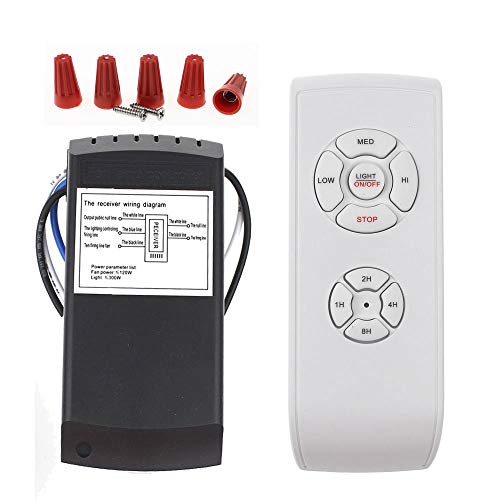
The LPHUMEX kit targets traditional AC motor ceiling fans, offering three speeds and a light dimmer with simple installation. It’s best for users who want a direct replacement that doesn’t require fan disassembly. Use this if your fan matches AC motor specs and you need basic speed plus light control. Caution: DC motor fans are not compatible.
Buying Guide: How to Choose a Whole House Fan Remote
- Motor compatibility: Confirm whether your fan uses an AC motor or a DC motor. Many universal remotes are designed for AC motors and will not work with DC motors.
- Control range and interference: If your home has thick walls or multiple floors, prioritize remotes with longer RF range and robust signal performance.
- Power options: Some kits are battery powered, while others piggyback off the fan wiring. Battery-based options are simpler to install but require battery replacements over time.
- Speed and dimming: Decide if you need 3-speed control only or additional features like light dimming. If your lights are non-dimmable, avoid dimming functions that could cause flicker.
- Temperature and humidity feedback: If attic conditions matter for your setup, a unit with TEMP/RH visualization can help optimize fan speed and energy usage.
- Installation effort: Consider how much wiring or canopy space is available. Some receivers require more room; measure canopy space and verify receiver dimensions before purchasing.
- Safety and standards: Look for UL or equivalent compliance on wiring to ensure safe operation in attic or high-humidity areas.
Frequently Asked Questions
- Can I use a universal remote with any ceiling fan?
– Universal remotes work with many AC motor fans but not all models. Always check compatibility with your specific fan model and motor type. - Do these remotes require professional installation?
– Most kits are designed for DIY installation, but some installations in high ceilings may benefit from professional help. - Will these remotes interfere with other wireless devices?
– RF remotes can be affected by metal dashboards or dense metal structures; ensure a clear line of sight and consider models with longer range for larger homes. - Is a battery-powered remote as reliable as a hard-wired receiver?
– Battery-powered remotes are convenient, but battery life and replacement needs should be considered for busy households. - Can I replace multiple fans with a single remote?
– Most remotes are designed for individual fan control. Some ecosystems support multiple units, but verify compatibility across all units before buying. - What if my fan is DC motor-equipped?
– Many universal kits are not compatible with DC motors; select a model explicitly labeled for DC motor compatibility if needed.