
Best Wet Underfloor Heating Thermostats for Precise Floor Comfort
Find the right thermostat for a wet, electric floor heating system with dual-sensing and dual-voltage capability. This guide highlights five top options that suit different homes and installation preferences. Best for homeowners seeking strong safety features, simple setup, or smart control integrations.
Summary table of selected products:
| Product | Best For | Key Benefit | Voltage/Power |
|---|---|---|---|
| Programmable Thermostat for House Radiant Underfloor Heating (BOWSEN) | Safety-minded spaces | Built-in GFCI with sensor options | 120/240V, up to 3600W |
| 6iE Smart WiFi Thermostat (Warmup) | Smart homes | SmartGeo scheduling, app control | 120/240V |
| OJ Microline UDG-4999 | Flexible, dual-sensor setups | Dual Sensing, dual voltage, 7-day program | |
| 7-Day Programmable Thermostat (starEEl) | Easy daily routines | Auto-adaptive voltage, dual sensors | 120/240V |
| HEATIT 25 Sqft Mat + ET-7A Thermostat | Mat installations | Self-adhesive mat with monitor | 120V |
Programmable Thermostat for House Radiant Underfloor Heating
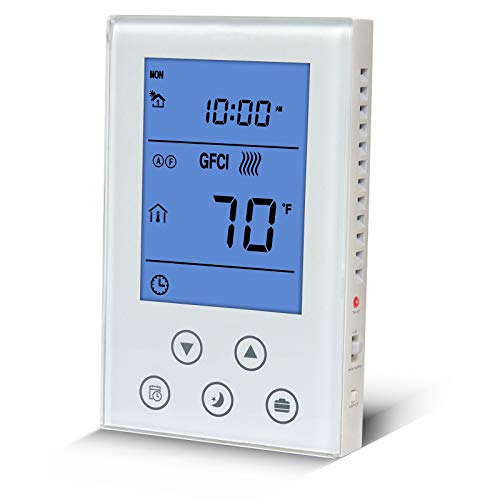
Best for safety-conscious installations. This dual-voltage thermostat supports 120VAC or 240VAC and provides up to 3600W of heating power. It includes a built-in GFCI and floor/air sensors for balanced, protected operation. The GFCI test feature helps verify safe function after installation, reducing the risk of electrical shock or fire due to leakage. Suitable for homes needing robust protection in radiant floor systems.
Who it’s best for: homeowners prioritizing electrical safety and easy floor- and air-temperature management. Why selected: the integrated GFCI and dual sensing offer reliable protection and precise control for concrete, tile, or wooden floors. Caution: if the GFCI trips, follow the on-device guidance to reset and inspect for leaks or short circuits before reconnecting power.
6iE Smart WiFi Thermostat for Underfloor Heating

Best for smart-home enthusiasts and energy-savvy homes. The 6iE uses smartGeo technology to predict heating needs and offers MyHeating app control. It avoids unnecessary heating by knowing when you’re away and preheating for your return, potentially saving energy. The ultra-thin design blends with modern interiors and provides an intuitive touchscreen experience.
Who it’s best for: buyers wanting app-based control and automated efficiency. Why selected: its geo-location features and smartphone control can reduce energy waste. Caution: relies on app connectivity; if Wi-Fi is unstable, on-site manual adjustments are still straightforward but less automated.
OJ Microline UDG-4999 With Built-In GFCI

Best for flexible floor-covering projects. This dual-voltage, dual-sensing thermostat includes two floor sensors and a backup option, making it suitable for varied floor types like tile, marble, and wood. It provides a seven-day programmable schedule and a floor-sensor feature for temperature limiting to protect delicate floors. Ideal for spaces needing precise floor temperature control alongside overall room comfort.
Who it’s best for: homeowners who want reliable programming with extra floor protection. Why selected: built-in GFCI plus dual sensors support robust, safe operation across multiple flooring materials. Caution: ensure correct sensor placement to maximize protection and accuracy across rooms with different heat loads.
7-Day Programmable Thermostat for House Radiant Underfloor Heating

Best for straightforward daily routines with automatic energy savings. This thermostat features auto-adaptive voltage 120/240V, dual sensors for floor and air, and a built-in Class A GFCI. The seven-day programmable schedule supports wake, away, home, and bedtime modes, helping balance comfort with energy savings. The dual-sensor setup enhances floor protection and consistent room warmth.
Who it’s best for: households seeking easy setup and consistent daily programming. Why selected: strong emphasis on energy savings through programmable routines. Caution: the device notes compatibility with various heating systems, but confirm compatibility with existing floor-minish systems to avoid fit issues.
HEATIT 25 Sqft Mat Heating System with ET-7A Thermostat

Best for small-area installations and DIYers. The kit includes a 25 sq ft self-adhesive warm mat with a dedicated non-WiFi ET-7A thermostat and an alarm monitor. It’s suitable for a range of surfaces and is designed for wet areas, but not outdoor or pool-related installations. The mat’s flexibility allows turns and angles, expanding heat coverage in irregular spaces.
Who it’s best for: homeowners installing floor heating in compact baths or small rooms. Why selected: an all-in-one mat kit simplifies setup and monitoring. Caution: the yellow heating element cannot be cut; plan paths around obstacles to avoid damaged sections.
OJ Microline UDG4-4999 With Built-In GFCI

Best for modern, touchscreen control with advanced features. The UTN4-4999 model offers a built-in Class A GFCI and dual voltage (120V/240V) with dual-sensing for floor and air. A responsive touchscreen and adaptive functions provide a user-friendly programming experience while maintaining energy efficiency. Ideal for contemporary interiors seeking a sleek control interface.
Who it’s best for: buyers wanting a modern, touch-screen thermostat with reliable safety features. Why selected: combination of GFCI, dual sensing, and intuitive UI supports comfortable, safe operation. Caution: ensure proper wiring and sensor calibration to achieve optimal performance.
OJ Microline UTN4-4999 Non Programmable

Best for simple heat control without programming. This non-programmable thermostat offers dual sensing and dual voltage with a built-in GFCI for safety. It’s designed for quick setup and compatibility with many flooring types. Includes a floor sensor for precise local temperature control. A practical option for users who prefer straightforward operation.
Who it’s best for: those who want a plug-and-play solution without programming. Why selected: simplicity and safety with GFCI and dual-voltage support. Caution: lacks scheduling features; energy management relies on manual adjustments and ambient conditions.
Buying Guide: Key Considerations For Wet Underfloor Heating Thermostats
- Voltage compatibility: Most homes use 120V or 240V. Choose a thermostat that clearly supports your circuit voltage (and consider dual-voltage models for future flexibility).
- Sensor configuration: Dual-sensing (air and floor) provides precise comfort and protects floors from overheating. If you have delicate flooring, prioritize floor sensor accuracy.
- Safety features: A built-in GFCI is critical for wet environments. Verify GFCI type, test procedure, and reset options after a fault.
- Programming vs. smart control: Decide between seven-day programs and smart apps. Smart thermostats can save energy with geolocation, schedules, and remote control, but require reliable connectivity.
- Floor type and coverage: Ensure the thermostat supports your floor material (tile, stone, wood, carpet) and the heating area size. Some kits include mats or cables with specific coverage.
- Installation considerations: Some units are easier for DIY installations; others may require basic electrical knowledge. Check installation wizard availability and sensor placement guides.
- Safety and compliance: Look for CE, UL, CSA markings or equivalent safety certifications indicating standard compliance for electrical devices used in wet areas.
- Future flexibility: If you plan to expand or modify zones, consider thermostats that support multiple zones or additional sensors.
Frequently Asked Questions
- What is a GFCI in floor heating thermostats used for?
- It protects occupants from electric shock by interrupting current if a leakage is detected. It’s a standard safety feature for wet environments.
- Do I need dual-sensing on my thermostat?
- Dual sensing (air and floor) offers better comfort and floor protection, especially for delicate flooring. It is recommended for most modern installations.
- Can I use a Wi-Fi thermostat with a wet underfloor system?
- Yes, many models support Wi-Fi and mobile apps. Ensure your Wi-Fi network is reliable for consistent control.
- Will a programmable thermostat save energy on floor heating?
- Yes, by scheduling temperatures to align with occupancy and routines, you can reduce unnecessary heating and lower energy use.
- Is manual control sufficient for floor heating?
- Manual controls work well for simple setups, but programmable or smart models provide better long-term energy savings and consistency.