
Best Water Testing TDS Meter Reviews for Accurate Home Testing
Looking for a reliable water testing TDS meter to check drinking water, RO/DI systems, or aquarium needs? This guide highlights five top options that balance accuracy, ease of use, and practical features. These meters suit homeowners seeking quick readings, hobbyists monitoring hydroponics, and professionals needing dependable performance. Below you’ll find quick comparisons and clear recommendations to help you choose the right 4-in-1 or 3-in-1 testers for your setup.
Summary table of selected products
- MEXYBE 2026 All-New 4 in 1 TDS Meter – Best for: multi-application use with backlit display and auto-off
MEXYBE 2026 All-New 4 in 1 TDS Meter

Best for: households needing a dependable, multi-function tester for drinking water, RO/DI systems, and aquariums. The 4-in-1 capability covers TDS, EC, and dual temperature readings with a titanium alloy probe for accuracy. A large backlit LCD and auto-lock simplify use in dim environments. This model auto-off after 2 minutes to conserve battery life.
Why selected: It combines precision with user-friendly features, including factory calibration, a hold function, and a 0-9999 ppm range suitable for most domestic water testing scenarios. The titanium probe boosts durability and measurement stability for repeated testing.
Caution: The device auto-off may interrupt a rapid single-spot check if you forget to press a hold. Ensure calibration is verified for critical testing.
Craft911 TDS Meter – Digital Water Tester

Best for: measuring drinking water quality with a reliable titanium alloy probe and an easy-to-read backlit display. Its auto-lock feature makes it simple to capture a stable reading during inspections of filtered or bottled water, aquariums, and hydroponics.
Why selected: The combination of accuracy and a clear display makes it ideal for quick, repeatable testing in kitchens, labs, or field testing. It supports precise TDS measurements and practical use in varied water sources.
Caution: Readings can be influenced by temperature; use the automatic temperature compensation (ATC) for consistent results across temperature changes.
HoneForest TDS Meter with 3-in-1 Capability
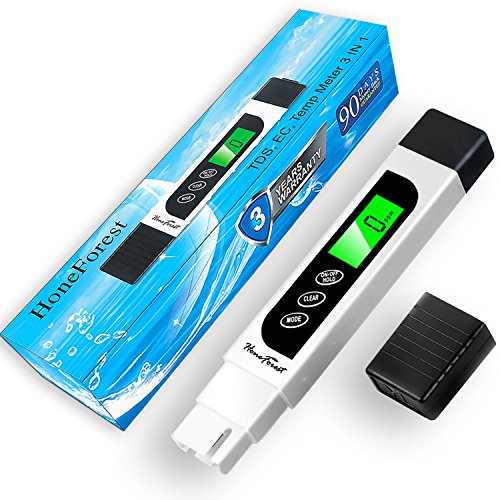
Best for: users needing an accurate 3-in-1 tester for TDS, EC, and temperature with a large backlit display. It’s a solid choice for RO/DI systems, aquariums, and general water quality checks.
Why selected: It emphasizes reliability with a premium titanium alloy probe and a user-friendly auto-lock feature. The device stabilizes readings quickly and conserves battery with auto-off after two minutes of inactivity.
Caution: The meter’s 0-9990 ppm range is typical for freshwater testing; it may not be ideal for seawater or saline solutions without adjustments or different probes.
VARIFY TDS Meter Digital Water Tester

Best for: quick, 4-in-1 testing with a compact handheld design. It measures TDS, EC, and temperature in °C/°F, which makes it suitable for drinking water, aquariums, hydroponics, and RO systems.
Why selected: It offers fast digital readings and a backlit display for visibility in dim environments. The titanium sensor helps ensure durability and stable readings across uses.
Caution: Some users may prefer more feature-rich calibration options; verify calibration steps if you rely on highly precise measurements for critical applications.
Arendsace New 4 in 1 TDS Meter

Best for: users who want a comprehensive 4-in-1 tester covering TDS, EC, and temperature with a bright backlit display and automatic features. Suitable for homes testing drinking water and RO/DI systems.
Why selected: The device emphasizes accuracy with a titanium alloy probe and an intelligent chip for stable readings. It includes automatic lock and shutdown features for convenient daily use.
Caution: The device relies on proper calibration for best results; periodic recalibration may be needed for long-term accuracy in critical samples.
Buying Guide
What should I test with a TDS meter?
A TDS meter evaluates total dissolved solids, indicating water quality. Many users also want EC (conductivity) and temperature data to understand how ions in water behave. For household needs, TDS readings help assess filtration effectiveness and general safety.
4-in-1 vs 3-in-1 meters: which is better?
4-in-1 meters add EC and dual temperature readings to TDS, offering broader water characterization. 3-in-1 meters provide TDS, EC, and temperature, which is sufficient for most home uses. Choose 4-in-1 if you test across multiple water sources and require richer data without manual calculation.
Calibration and accuracy considerations
Look for devices with factory calibration, a titanium alloy probe, and automatic temperature compensation. Calibration verification with standard solutions is advised for critical testing. A backlit display improves readability when testing in dim areas.
Ease of use and maintenance
Consider auto-off to save battery, auto-lock to stabilize readings, and a hold function for convenient recording. A larger screen and simple one-button operation reduce user error and streamline repeated tests.
Durability and design for everyday testing
Probes made from titanium or stainless steel resist corrosion and provide consistent measurements. A rugged housing and a clear indicator when readings are out of range help users interpret results quickly.
Practical tips for interpreting results
High TDS values do not always indicate danger; they reflect overall mineral content. For drinking water, compare readings against local guidelines, and verify filtration system performance with consistent testing over time.
Who should buy these meters?
Homeowners, aquarium keepers, hydroponics enthusiasts, and RO/DI users benefit from quick, reliable metrics. Choose based on whether you need 3-in-1 or 4-in-1 capabilities and the importance of features like backlighting, auto-off, and data stability.
Frequently Asked Questions
- What does a high TDS reading mean? It indicates more dissolved solids in water, which may affect taste and filtration performance but is not a direct measure of safety. Consider context and local guidelines.
- Do I need temperature compensation? Yes. Temperature affects conductivity and TDS readings, so ATC improves accuracy across varying temperatures.
- How often should I calibrate a TDS meter? Calibrate per manufacturer guidelines or if readings drift noticeably. Regular calibration ensures consistent results.
- Can I test seawater with these meters? Most consumer testers are designed for freshwater. Seawater has high salinity that can exceed typical ranges and may require specialized equipment.
- Which meter is best for drinking water testing? Meters labeled for drinking water and featuring a stable, easy-to-read display with auto-lock are well-suited for this purpose.
- Are digital meters safer than analog? Digital meters provide quick numerical readings that are easier to compare over time and across tests, reducing misinterpretation from visual inspection.