As an Amazon Associate I earn from qualifying purchases. These links may earn this site a commission when you buy, at no extra cost to you.
Choosing the right variable speed switch for a fan can improve airflow, reduce noise, and help manage energy use in living spaces, workshops, or grow rooms. This guide highlights five dependable options commonly found on Amazon, focusing on compatibility, safety features, and ease of installation. Each product section explains what makes the model suitable for variable-speed control in standard electrical setups.
Product Comparison Summary
| Product | Brand | Voltage | Max Current |
|---|---|---|---|
| KB Electronics 8811007 | KB ELECTRONICS | 115V | 6.0A |
| Leviton 612-6616-W | Leviton | 120V | 5A |
| Fantech WC 15 | FANTECH | 120V | 5A |
| BN-LINK Variable Fan Speed Controller | BN-LINK | 125V | 4.8A |
| CDMALL AC Motor Speed Controller | CDMALL | 110-120V | 15A max |
The following sections review five widely used models, emphasizing installation fit, safety features, and suitability for typical residential or light commercial ventilation tasks. Each entry includes a direct link to the product page for quick reference.
KB Electronics 8811007 Solid State Speed Controller

The KB Electronics 8811007 provides a solid-state solution designed for standard 2″ x 4″ electrical wall boxes. It handles up to 6.0 amps at 115 volts, making it suitable for many inline fans and ventilation motors. It carries UL and CSA approvals, signaling compliance with common safety standards for residential electrical installations. A key limitation noted in its specifications is that it should not be used with capacitor-start or capacitor-run motors, which helps guide compatibility choices for certain fan types.
Leviton Full Range Variable Fan Speed Control
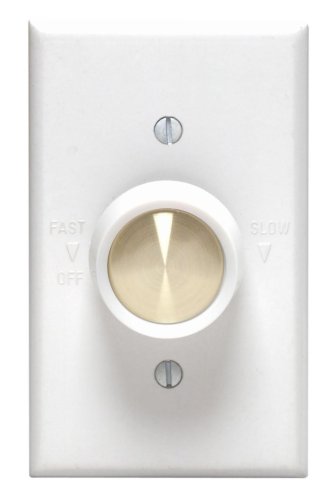
Leviton’s 612-6616-W offers a full-range rotary-style control with a compact profile, designed to fit in tight single-gang wall boxes. It operates on standard 120 VAC with a 5A rating, making it a common choice for home exhausts or inline fans. The model includes built-in filtering to minimize radio and TV interference, supporting stable performance in typical living environments. Its design emphasizes ease of installation and reliable speed adjustment across a broad range of fan sizes.
Fantech WC 15 Speed Control

The Fantech WC 15 is a rotary-type speed controller with an integrated On/Off switch. It is designed to fit a standard single-gang box and supports 120V at up to 5 amps. This model is well-suited for those seeking a straightforward, compact control solution for exhaust fans or inline duct applications where a simple speed range is adequate. The on/off feature adds practical convenience for quick power cycling without changing wiring arrangements.
BN-LINK Variable Fan Speed Controller

BN-LINK’s plug-in speed controller provides a simple user experience with a single knob to adjust three fan speeds. It is a grounded outlet plug-in design intended for inline or duct fans, with a 125V rating and up to 4.8A. The unit emphasizes safety and durability with a grounded plug and a robust housing. Its three-speed options can help balance noise, airflow, and energy usage across a variety of ventilation scenarios, including exhaust and portable fans.
CDMALL AC Motor Speed Controller

The CDMALL AC Motor Speed Controller is designed for 110-120V AC circuits with a 15A maximum rating, making it capable of handling higher-power inline fans and certain duct fans. It includes overload protection and an independent on/off switch, which helps prevent accidental motor startup and protects connected equipment. The controller supports a three-position switch (off, low, high) to tailor airflow without requiring motor rewiring. It is advertised for use with brushed motors and should not be used with brushless motors, ensuring proper motor compatibility.
Buying Guide: Key Considerations For Choosing A Variable Speed Fan Switch
- Motor compatibility: Check whether the controller works with brushed DC or AC motors, and confirm whether capacitor-start or capacitor-run motors are supported. Some models specify “do not use with capacitor-start or capacitor-run motors,” to avoid failure or unsafe operation.
- Voltage and current ratings: Ensure the device matches the fan’s voltage (commonly 120V in the U.S.) and current draw. Exceeding ratings can cause overheating or tripping.
- Installation footprint: For wall-mounted controls, verify the wall box size (single-gang vs. 2″ x 4″ boxes) to ensure a clean, code-compliant installation. Compact designs help in tight spaces.
- Control type and range: Rotary knobs offer intuitive, continuous adjustment, while fixed 3-speed switches provide set points. Consider the desired granularity of control and noise reduction.
- Safety and protection features: Look for overload protection, surge/spike protection, and RC damping, which help protect both the controller and the fan.
- Interference considerations: Some models include radio/TV interference filters, which can be important in living rooms or media rooms where electronics share outlets.
- Physical durability and installation environment: If the unit will be mounted in humid or dusty areas, choose models with robust insulation and protective housings.
- Warranty and certifications: UL and CSA approvals indicate compliance with safety standards, which can influence long-term reliability and insurer considerations.
- Future-proofing: If you anticipate upgrading fans or expanding a ventilation system, selecting a controller with a higher current rating or broader compatibility can reduce future replacements.
When selecting a variable speed switch for a fan, balance compatibility with your specific fan motor type, installation space, and desired level of control. The products reviewed here provide a range of options from compact, single-gang fits to plug-in adapters, each with distinct strengths in safety, ease of use, and adaptability to common residential setups.