As an Amazon Associate I earn from qualifying purchases. These links may earn this site a commission when you buy, at no extra cost to you.
Upgrade your home lighting with timer switches that automate LEDs, fans, and other devices. This guide highlights five top options, focusing on reliability, ease of use, and energy savings. Each product includes key features to help you compare at a glance and choose the right timer switch for single-pole or multi-location setups.
| Product | Brand | Key Feature | Where to Buy |
|---|---|---|---|
| BN-LINK 7 Day Programmable In-Wall Timer (Blue Backlight) | BN-LINK | 18 on/off programs, 7-day scheduling, backup battery | Amazon |
| myTouchSmart 33861 LE In-Wall Timer | myTouchSmart | SunSmart sunset/sunrise, 8 custom times, countdown | Amazon |
| Lutron Maestro LED+ Dual Dimmer & Timer | Lutron | 2-in-1 dimmer and timer, 75W LED, 2.5A fan load | Amazon |
| Honeywell ECONOswitch 7-Day Solar Programmable | Honeywell Home | 7-day programming, solar mode, energy savings | Amazon |
| Leviton Decora Programmable & Astronomical Timer | Leviton | 49 on/off events, astronomical clock, weekday options | Amazon |
Below is a detailed look at each option to help you pick the right timer switch for LED lighting and other loads around the home.
BN-LINK 7 Day Programmable In-Wall Timer (Blue Backlight)

The BN-LINK digital timer switch offers 7-day scheduling with 18 On/Off programs and a blue backlight for easy visibility. It supports timers with intervals as short as one minute and allows selective day selection or preset day combinations. This makes it suitable for lighting, fans, and other motor loads. Additional features include daylight saving time, a manual override mode, and a built-in rechargeable backup battery to preserve settings during outages. Random vacation mode helps maintain a lived-in look while you are away. Compatible with single-pole and 3-way installations (SPDT).
myTouchSmart 33861 LE In-Wall Timer

This timer offers eight customizable On/Off times and a built-in SunSmart feature that adjusts to local sunset and sunrise times. It supports a countdown mode, daily/weekly scheduling, and override buttons for manual control outside of programmed times. The push-door design conceals buttons and features a blue backlit LED screen for clear visibility in low-light areas. It is well-suited for indoor and outdoor lighting, fans, and related devices requiring precise scheduling.
Lutron Maestro LED+ Dual Dimmer And Timer Switch

This 2-in-1 device combines a stacked dimmer with a countdown timer. The top dimmer adjusts the light level, while the bottom timer controls a separate load for a light or fan. It supports both LED/CFL and incandescent loads, with dimming compatibility up to 75W for LEDs and up to 300W for other bulbs. The timer function provides on/off control with flexible fade timing for smooth transitions, and it supports single-pole use with potential multi-location setups when paired with compatible Maestro accessories.
Honeywell ECONOswitch 7-Day Solar Programmable

The ECONOswitch provides 7-day programming with a solar mode designed to automatically adjust timing, helping save energy for lights and motors. It supports multiple devices with one switch per installation. The unit is suitable for both indoor and outdoor use on a 120V circuit, and it helps streamline scheduling for recurring loads like ceiling fans, pumps, and outdoor lighting. The solar clock feature simplifies daily usage without manual adjustments, contributing to consistent energy savings.
Leviton Decora Programmable & Astronomical Timer
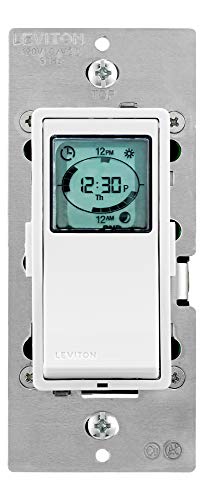
Leviton’s VPT24-1PZ provides up to 49 ON/OFF events and includes an astronomical clock that automatically adjusts for your location. It offers flexible weekly scheduling with multiple day combinations and is compatible with neutral wire installations for stable performance. Daylight-saving adjustments are built in to simplify long-term usage, making it a strong choice for homes seeking precise automation for both lights and fan loads.
DEWENWILS Indoor In-Wall Timer Switch
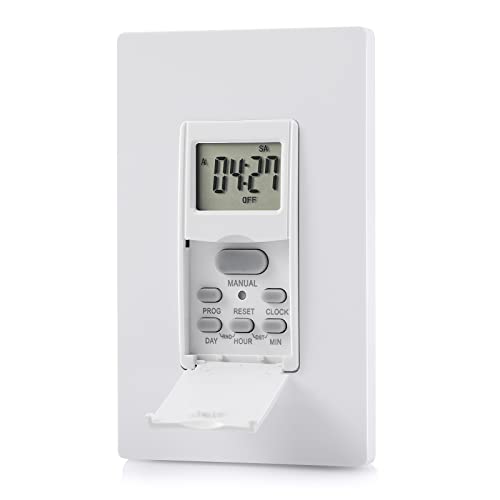
DEWENWILS offers a 7-day timer with seven ON/OFF settings and a 1-minute interval. It includes a DST option and a random mode to mimic occupancy, enhancing security while saving energy. A backup battery keeps settings during power outages, and a 4-wire configuration supports robust in-wall installations. This model is designed for lights, fans, and motors and emphasizes straightforward setup and reliable weekly repetition of programs.
Buying Guide: Key Purchase Considerations
When selecting a timer switch for LED lighting and related loads, consider these dimensions to ensure the best fit for your home:
- Load type and compatibility: LED bulbs, CFLs, incandescent lamps, and fans require different load ratings. Check the timer’s maximum wattage and whether it supports motor loads if you’re powering fans.
- Programming capability: Decide how many on/off events you need per day and whether you want 7-day weekly schedules, astronomical clocks, or sunset/sunrise adjustments. More programs offer finer control but may increase complexity.
- Power source and backup: Look for a unit with a built-in backup battery or memory to preserve settings during outages. Neutral-wire requirement affects wiring compatibility in existing boxes.
- Security features: Random vacation mode helps deter intruders by simulating occupancy. Consider whether this feature is important for your home.
- Interface and ease of use: Backlit displays, push-door controls, and intuitive programming interfaces reduce setup time and improve reliability in daily use.
- Multi-location versus single-pole: If you need control from more than one location, ensure the timer supports 3-way (or multi-location) configurations and compatible companion switches.
- Smarthome integration: Some timers offer smart features or advanced scheduling compatible with broader home automation ecosystems—evaluate compatibility if you plan future integration.
- Durability and certification: Look for ETL or UL listings for electrical safety, especially for indoor/outdoor installations and damp environments.
Bottom-line considerations include balancing programming depth with wiring constraints (neutral requirement), ensuring compatibility with LED loads, and assessing whether extra features (astronomical clock, random mode) justify any added cost. For most LED-focused uses, a timer with reliable standby memory, clear scheduling, and a straightforward interface tends to deliver the best overall value.