
Best Timer Controlled Light Switches for Smart Scheduling and Energy Savings
Looking for a timer controlled light switch to automate lighting, save energy, and improve home security? This guide highlights five top options that fit common American electrical setups. Each pick is suited for different needs—from single-pole setups and three-way circuits to astronomical and daylight-synced controls. Read on to find the best match for your lights, fans, and fans or fixtures, with clear reasons to choose or avoid each option.
| Product | Best For |
|---|---|
| BN-LINK 7 Day Programmable In-Wall Digital Timer Switch (Blue Backlight) | Blue-backlit scheduling, frequent manual toggling, and DST shifts |
| BN-LINK 7 Day Programmable In-Wall Digital Timer Switch (No Backlight) | Discreet timer control without backlight, best for bedrooms or low-light areas |
| GE 7-Day In-Wall Digital Timer Switch | Sunrise/Sunset auto-adjust and weekly programming |
| Leviton Countdown Timer Switch | Countdown control for bathrooms, fans, and motor loads |
| BN-LINK 7 Day Astronomical In-Wall Timer | Sunrise/Sunset based automation with DST and Random mode |
BN-LINK 7 Day Programmable In-Wall Digital Timer Switch with Blue Backlight

This timer switch offers 18 on/off programs and a full 7-day schedule. The blue backlight makes programming easy in dim rooms, and the unit supports both single-pole and 3-way configurations with a 15A/1875W capacity. It’s designed for lights and fans, with a DST mode for seasonal time changes. Best for households that need frequent scheduling with quick DST adjustments and occasional manual overrides.
- Best for users who want clear visibility during setup and routine changes.
- Backed by a rechargeable backup battery to preserve settings during outages.
- Random vacation mode helps simulate occupancy when you’re away.
Caution: Uses neutral wiring; ensure your wall box supports the required wiring configuration.
BN-LINK 7 Day Programmable In-Wall Digital Timer Switch (No Backlight)
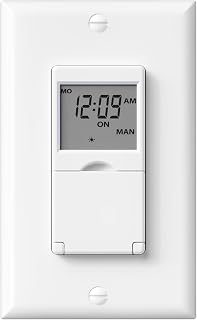
This variant mirrors the feature set of the blue-backlight model with 18 on/off programs and 7-day scheduling. It also supports DST adjustments and a backup battery for preserving settings. It’s well suited for living spaces where backlight might be distracting or unnecessary while still offering robust automation for lights and fans.
- Better for bedrooms or media rooms where low-light visibility is preferred.
- Offers the same automation depth, including random mode for occupancy illusion.
Limitation: No backlight means less convenient viewing in very dark installations.
GE 7-Day In-Wall Digital Timer Switch

GE’s timer adds SunSmart technology that automatically adjusts to sunrise and sunset times for your location. It supports weekly programming with up to seven ON/OFF programs and a random security feature to create a lived-in appearance. It replaces single-pole or three-way switches and is suitable for LED, CFL, and traditional bulbs with a neutral wire.
- Best for energy-conscious homes in regions with significant daylight variation.
- Random mode helps deter intruders when you’re away.
Limitation: Requires neutral wiring; not ideal for older homes without neutral at the switch.
Leviton Countdown Timer Switch

The Leviton countdown timer is ideal for controlling bathroom fans and other motor loads. It offers pre-set time options (10-20-30-60 minutes) and works with a variety of ballast types. It’s a no-neutral solution in some configurations, and its focus on fixed countdown durations makes it a strong pick for timed ventilation and lighting tasks.
- Best for timed ventilation and bathroom fan control.
- Shallow housing design can simplify installation in tight wall boxes.
Caution: Ensure compatibility with your specific fan or load type and verify the neutral requirement for your box.
BN-LINK 7 Day Astronomical In-Wall Timer

This option uses automatic sunrise and sunset control for lighting schedules, reducing manual adjustments. It supports 18 ON/OFF programs and seven-day scheduling with a DST mode and Random mode to enhance security and efficiency. It’s a strong choice for homes that want natural-light-aligned automation and easy time-zone setup.
- Best for energy-aware households that want daylight-based automation.
- Includes six preset time zones and automatic DST handling.
Caution: Ensure you operate in the correct time zone during setup to maintain accurate timing.
Buying Guide: How To Choose Your Timer Switch
What type of wiring do you have?
Most timers require a neutral wire. If your wall box lacks a neutral, you’ll need a model designed for no-neutral operation or consider a different installation approach.
Do you need single-pole or multi-way control?
For a standard light switch, a single-pole timer suffices. If you share control across multiple switches, a 3-way compatible timer is essential.
Is sunrise/sunset adjustment important for you?
Astronomical timers automatically sync with local daylight times, great for outdoor lighting and exterior fixtures. If your location changes frequently or you prefer manual precision, a standard 7-day timer may be better.
Do you want backlight or a discreet display?
Backlit models provide easier programming in dark rooms, while non-backlit options offer a cleaner look in living spaces.
What about security features?
Look for Random/Vacation modes that simulate occupancy to deter intruders. DST mode ensures your schedule remains accurate through seasonal time changes.
What load are you controlling?
Verify the timer’s wattage and load rating match your fixtures, especially for fans, motorized loads, or high-wattage lights. Some timers list 15A or higher capacities and may specify LED/CFL compatibility.
FAQ
- What is a timer switch? A timer switch automates powering lights or fans on and off according to a programmed schedule, saving energy and improving convenience.
- Can I use these with 3-way switches? Yes, some models are designed for single-pole or 3-way configurations. Check the product listing to confirm compatibility with your wiring setup.
- Do these require a neutral wire? Many do require a neutral wire, but some no-neutral options exist. Verify your wall box wiring before installation.
- What is DST mode? DST mode automatically adjusts the clock for Daylight Saving Time, preventing manual changes twice a year.
- Is sunrise/sunset automation better? For exterior or landscape lighting, sunrise/sunset scheduling aligns with natural light, reducing energy use and manual tweaks.
- Can these improve home security? Yes. Features like Random/Vacation mode create the appearance of occupancy while you’re away.