
Best Time Delay Push Button Options for Access Control and Exit Ready Systems
When choosing a time delay push button, select a model that matches your access-control setup, mounting space, and environmental needs. This guide highlights five reliable pushbutton options with adjustable delays, durable housings, and clear LED indicators. Ideal buyers include security installers seeking easy-to-integrate exit devices, facility managers needing reliable off-delay signaling, and DIY enthusiasts building access-controlled doors. Below is a quick summary of top picks to help you compare at a glance.
| Product | Best For | Key Delay Feature |
|---|---|---|
| Visionis VIS-7013 | Indoor access with stainless steel finish | 0.5–22 seconds |
| Visionis VIS-7100 | Single-gang, wall-mounted exits with LED feedback | Adjustable timer |
| Briidea Push to Exit Button | Durable stainless steel with flexible wiring | Delay module compatible (not included) |
| Camden CM-5085RPTE | Vandal-resistant, simple large-button design | 1–60 seconds pneumatic delay |
| 991E-PTD X 32D | Compact 1-gang pneumatic timing | 1–45 seconds |
Visionis VIS-7013 No Touch Exit Button

Best for indoor door applications requiring a steel, no-contact design with a built-in LED status indicator. The Visionis VIS-7013 supports NO/NC/COM outputs, enabling flexible wiring with access-control systems. The device operates on 12–24VDC and offers a time delay range from 0.5 to 22 seconds. The blue LED remains visible in standby, while the green LED confirms the door is open or active. This unit suits installations where space is tight and touchless entry is preferred.
Who it’s best for: installers needing a compact, steel-body exit button with adjustable timing and multiple output options. Why selected: robust material, small form factor, and clear LED feedback improve reliability in controlled-entry scenarios.
Caution: The actual delay range depends on the connected power source and control panel; verify compatibility with your existing access controller prior to installation.
Visionis VIS-7100 Green LED Exit Button with Timer
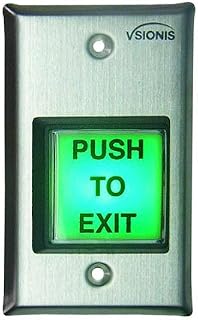
This option is ideal for single-gang wall installations with a prominent green LED. It features a timer delay function and NO/NC/COM outputs for compatibility with most access systems. The switch materials include plastic housing with a stainless steel switch plate, and it ships with bilingual inserts reading “PUSH TO EXIT / PRESIONE PARA SALIR.” Best for: facilities prioritizing visible status cues and straightforward single-gang mounting. Why chosen: clear LED status, simple wiring, and ready-to-use packaging.
Caution: Plastic housing can be less durable in high-traffic environments; consider additional protection in high-use doors.
Briidea Stainless Steel Push to Exit Button

The Briidea unit emphasizes durability with a stainless steel body and is marketed for indoor use. It offers versatile connections to exit input lines on access devices or directly to electromagnetic locks or shock devices. A delay module can be added to customize the exit delay. This model is best for users needing a tough, adaptable push button that can fit into varied wiring schemes. Why selected: strong metal construction and adaptable connections. Caution: A delay module is not included, so plan for additional components if you require extended timing control.
Camden CM-5085RPTE Pneumatic Time Delay

The Camden CM-5085RPTE uses a pneumatic time-delay mechanism with a large red push button and a durable aluminum faceplate, suitable for indoor or outdoor applications depending on enclosure. It features a DPST configuration with a 1-60 second pneumatic delay. Best for: environments requiring a very visible, vandal-resistant control with a simple to operate action. Why chosen: rugged build and clear labeling support quick recognition by users. Limitation: pneumatic timing components may require periodic maintenance to ensure consistent delay behavior.
991E-PTD X 32D Pneumatic Time Delay Exit Button
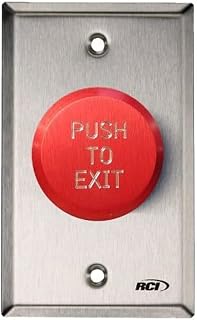
The 991E-PTD X 32D presents a compact 1-gang pneumatic solution with a 1NO/1NC configuration and a 5A rating at 125 VAC. It provides a 1–45 second delay and uses a brushed stainless steel faceplate for a clean, professional look. Best for: users needing a slim profile with a robust timing mechanism and a straightforward 2-pole output. Why chosen: reliable pneumatic timing and compact installation. Caution: Brushed stainless steel faceplate may show fingerprints; regular cleaning helps maintain appearance.
Buying Guide
What should you consider before buying a time delay push button?
- Output configuration: Make sure the unit offers NO/NC/COM outputs to match your controller wiring.
- Delay range and type: Choose a device with a timing range that fits your security workflow, whether purely electrical or pneumatic delay.
- Mounting and enclosure: Consider single-gang or larger enclosures and whether the housing is metal or plastic to suit your environment.
- LED feedback: LED color and behavior help operators understand system state at a glance.
- Durability: Stainless steel bodies are preferred for durability; consider vandal resistance for high-traffic doors.
- Maintenance needs: Pneumatic delays may require periodic checks; plan for upkeep in busy facilities.
How do you select among quick-deploy vs. long-term installations?
- For rapid deployment, choose models with straightforward wiring and standard mounting footprints (single-gang boxes).
- For long-term installation, prioritize rugged housings, reliable delay mechanisms, and compatibility with your access-control panel.
FAQ
- What is a time delay push button used for? It controls how long a door remains unlocked after a user presses the exit button, aiding controlled egress.
- Can these buttons work with any access-control system? Most support NO/NC/COM wiring, but always verify your controller’s input requirements.
- Are pneumatic delay buttons more durable than electronic ones? Pneumatic systems are robust in some environments but may require occasional maintenance.
- Is a touchless button necessary for security? It reduces contact but must be compatible with your access-control setup for proper signaling.
- Should I choose a stainless steel model? Stainless steel offers durability and easier cleaning, suitable for high-traffic areas.
- Do these devices come with a warranty? Warranty terms vary by manufacturer; check the product listing for specifics before purchase.