As an Amazon Associate I earn from qualifying purchases. These links may earn this site a commission when you buy, at no extra cost to you.
Choosing the right thick table saw blade involves balancing durability, cut quality, and compatibility with common materials like hardwoods and plywood. The following blades are selected for versatility and performance on American miter and table saws. Use the buying guide below to compare options based on tooth count, kerf, arbor size, and carbide quality.
| Product | Tooth Count | Arbor | Kerf | Material | Best For |
|---|---|---|---|---|---|
| DEWALT Table Saw Blade, 10″, 80 Tooth (DWA11080) | 80 | 5/8 in | 0.098 in | Carbide | Fine finish, general purpose |
| DEWALT Table Saw Blade, 10″, 40 Tooth (DWA11040) | 40 | 5/8 in | 0.098 in | Carbide | Rough to intermediate cuts, faster material removal |
| WEN BL1080 10-Inch 80-Tooth Ultra-Fine Finish | 80 | 5/8 in | 0.040 in (approx. 0.1 in kerf variant) | Carbide | Ultra-fine finish on soft/hardwoods |
| WEN BL1040 10-Inch 40-Tooth Carbide-Tipped | 40 | 5/8 in | 0.098 in | Carbide | Coarse to medium finish |
| FOXBC 10-Inch 80-Tooth Ultra Finish | 80 | 5/8 in | 0.098 in | Tungsten Carbide | Premium finish on fine woodworking |
WEN BL1080 80-Tooth Ultra-Fine Finish Blade

Designed for precise, chip-free finishes, this blade features a 10-inch diameter with a 5/8-inch arbor and a high RPM rating up to 6000. Its ultra-thin kerf minimizes material loss while delivering clean, smooth cuts in hardwoods and softwoods alike. The 80-tooth count is optimized for fine finishing tasks in cabinetry and trim work.
WEN BL1060 60-Tooth Fine-Finish Blade
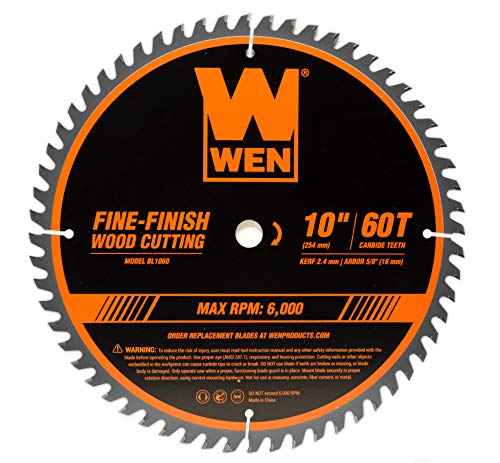
This finish-oriented blade merges efficiency with clean edges, featuring a 10-inch diameter and 5/8-inch arbor. With a robust 60-tooth configuration, it excels at fine finish work on both softwoods and hardwoods, balancing speed and quality for miscuts or assembly work. Suitable for miter and table saws up to 6000 RPM.
DEWALT Table Saw Blade 10″ 40-Tooth (DWA11040)

With up to three times the life of standard blades, this DEWALT blade prioritizes accuracy and endurance. Its optimized tooth geometry supports clean, precise cuts, making it suitable for finishing tasks where a smooth surface is important. The 10-inch diameter and 5/8-inch arbor match most standard saws.
FOXBC 10-Inch 80-Tooth Ultra Finish Blade

FOXBC offers a high-density tungsten carbide blade designed for high finish quality with minimal tear-out. The 80-tooth configuration provides excellent results on fine woodworking projects, including cabinet doors and trim, while maintaining a 5/8-inch arbor for compatibility with most saws. The blade emphasizes durability and low vibration for smoother operations.
DEWALT Table Saw Blade 10 Inch 80-Tooth (DWA11080)

Combining precision and durability, this blade specializes in producing high-quality finishes on a range of woods. The 80-tooth design minimizes chipping and produces smoother surfaces, ideal for face frames, panel edges, and cabinetry work. Its carbide teeth offer long life even with frequent use in busy workshops.
Buying Guide
Key considerations when selecting a thick table saw blade for American workshops:
- Tooth count and finish quality: Higher tooth counts (60–80T) excel at fine finishes, while lower counts (32–40T) remove material faster for rough cuts.
- Kerf width: Ultra-thin kerfs reduce waste and require less power, but thicker kerfs can add stability for heavy stock; match kerf to your material and saw power.
- Arbor compatibility: Most 10-inch blades use a 5/8-inch arbor. Confirm your saw’s arbor size and the blade’s mounting style before purchase.
- Material and coating: Carbide-tipped or carbide blades offer longer life and cleaner cuts; consider TCG/ATB tooth geometry for specific materials.
- Cut quality vs. durability: For cabinetry and fine furniture, prioritize finish quality; for framing or rough carpentry, durability and lifespan may take precedence.
- Vibration and stability: Some designs minimize vibration through body slot design or tooth geometry, improving accuracy on long cross-cuts.
- Dust and noise considerations: Blades with smoother finishes often generate less tear-out and noise, aiding cleaner work environments.
- Maintenance and replacement: Blades wear unevenly; rotate blades or replace when cutting quality drops to ensure consistent results.
When choosing among the listed options, align the blade’s tooth count and kerf with your typical projects. For ultra-fine finishes on cabinetry or furniture, blades like the 80-tooth variants tend to yield the smoothest surfaces. For quick, clean cross-cuts on softwood or plywood, a 40-tooth blade can strike a balance between speed and finish. Always ensure proper alignment, blade height, and safety practices.