As an Amazon Associate I earn from qualifying purchases. These links may earn this site a commission when you buy, at no extra cost to you.
Finding the right blade for demanding cuts can improve finish quality and extend blade life. This guide highlights five highly capable blades that excel in thick or dense wood applications, with attention to tracking, vibration control, and material efficiency. While many modern blades use ultra-thin kerfs, these selections emphasize robust performance, durability, and clean results across framing, ripping, and finish cuts. Review their key features to choose the blade that best fits your saw, load, and worksite needs.
| Product | Brand | Kerf Type | Diameter / Teeth | Notable Feature |
|---|---|---|---|---|
| Diablo Framing Saw Blade | Diablo | Thin Kerf | 7-1/4″ / 24 | Tracking Point design, anti-vibration, long life |
| Freud LU87R010 | Freud | Thin Kerf | 10″ / 24 | Hi-Density TiCo carbide, low-power compatibility |
| Freud LU88R010 | Freud | Thin Kerf | 10″ / 60 | Positive hook angle, crosscut optimization |
| Diablo D0760A | Diablo | Thin Kerf | 7-1/4″ / 60 | Hi-Density TiCo carbide, Perma-SHIELD coating |
| FOXBC Ultra Fine Finish | FOXBC | Thin Kerf | 6-1/2″ / 60 | Ultra-thin kerf, smooth finish, 5/8″ arbor |
Note: Kerf descriptions reflect manufacturer materials. When sizing blades to a thick wood job, consider motor power, feed rate, and the intended cut quality to optimize performance and blade life.
Diablo Framing Saw Blade For Wood

Diablo D0724A features a Precision Tracking cut design that guides straight, controlled cuts and delivers extended life in framing, plywood, and pressure-treated wood. Its anti-vibration stability reduces blade warping, while the laser-cut stabilizer vents contribute to smoother operation and improved accuracy. This 7-1/4″ blade is optimized for cordless tools, enabling up to 30% more cuts per battery charge—especially valuable for high-output framing tasks. The combination of tracking performance and anti-vibration design helps maintain cut quality under load.
Freud LU87R010 Thin Kerf Rip Blade

Freud LU87R010 is engineered for underpowered saws and radial arm saws, using a thin kerf to reduce horsepower demands while maintaining cutting efficiency. The blade employs a Premium TiCo carbide blend for strong edge retention and durability, delivering consistent ripping performance. Its 0.071″ plate and flat grind optimize feed rates, enabling smoother operation with tougher woods and reduced waste on ripping tasks.
Freud LU88R010 Thin Kerf Crosscut Blade

Freud LU88R010 uses a Positive Hook Angle to promote faster feed rates and smoother crosscuts, ideal for efficient ripping and general-purpose woodworking. Its Premium TiCo Hi-Density carbide blend enhances cutting performance and durability, with a think kerf design that removes less material than standard blades, reducing horsepower requirements while delivering clean crosscuts on tough woods and plywood.
Diablo D0760A Ultra Finish Carbide Blade

Diablo D0760A is built for high-precision finish cuts and fast ripping, featuring a Hi-Density TiCo carbide and a Perma-SHIELD non-stick coating. Its super-thin laser-cut kerf supports quick, durable cuts in wood, plywood, and melamine. A 5/8″ arbor and 8000 max RPM make it compatible with a wide range of 6-1/2″ and 7-1/4″ saws, enabling smoother operation with less heat buildup during prolonged sessions.
FOXBC Ultra Fine Finish 6-1/2″ Blade
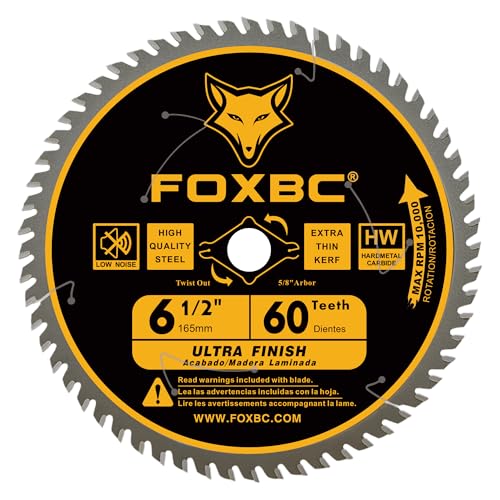
FOXBC’s Ultra Fine Finish blade offers a 60-tooth configuration with a thin kerf and 5/8″ arbor, designed for ultra-smooth crosscuts and precise framing. Its thin kerf reduces material waste while delivering clean finishes on softwood, hardwood, plywood, and laminated panels. The blade’s design supports both corded and cordless circular saws, making it versatile for a range of shop setups.
Buying Guide: Key Purchase Considerations
- Application type: Choose blades optimized for framing, ripping, finish cuts, or crosscuts. Blades with TiCo carbide blends generally offer long life and consistent results across dense woods.
- Kerf width: Ultra-thin kerfs reduce waste and improve feed rate but may demand more precise setup on older or less powerful saws. For demanding jobs, consider a blade with a balanced kerf that matches tool horsepower.
- Tooth geometry: Positive hook vs. flat grind affects feed rate and aggressiveness. For fast cuts in softwoods, a blade with a positive hook angle helps; crosscut blades benefit from ATB or finely spaced teeth for smoother finishes.
- Coatings and coatings resistance: Perma-SHIELD or similar non-stick coatings reduce gum buildup and heat, extending blade life in challenging materials like plywood or melamine.
- Arbor compatibility and RPM: Ensure the blade’s arbor size (commonly 5/8″ or 1″) and maximum RPM match your saw’s specifications to prevent unsafe operation.
- Maintenance: Regular cleaning and proper storage extend blade life. If cutting pressure-treated or resin-rich wood, consider blades with anti-vibration features to maintain accuracy.
- Power considerations: For underpowered saws, a blade with a thinner kerf can reduce load, but ensure the blade’s performance suits the material width and thickness you work with.
In worksite scenarios where finish quality and blade longevity matter, evaluating these blades against your saw’s horsepower, feed rate, and typical material list will help identify the best fit. Consider small test cuts on scrap material to verify tracking, vibration control, and cut quality before committing to a full project.