
Best PCB Terminal Block Connectors for Smooth Wiring and Quick Assembly
This guide helps buyers choose the right terminal block for PCB projects, from hobby breadboards to small enclosures. The top five options below are selected for reliable electrical performance, wire compatibility, and practical PCB mounting. They are best for hobbyists assembling DIY circuits, students building prototypes, and engineers needing compact, secure wire terminations on standard PCBs. The buying table compares key specs at a glance to streamline decisions.
Product Comparison Table
| Product | Pitch | Pins | Voltage / Current | Wire Range |
|---|---|---|---|---|
| Minidodoca 52P | 2.54 mm | 2–5 | 150V / 6A | 18–26 AWG |
| Tugermoola 72P (Blue) | 5 mm | 2–4 | 300V / 10A | 26–14 AWG |
| SynHHergyx 20P | 5 mm | 2 | 300V / 10A | 26–18 AWG |
| QSYZAIL 85P | 2.54 mm / 5.08 mm | 2–5 | Not specified | Not specified |
| JSZAAHZ 46Pcs | 2.54 mm | 2–8 | 150V / 6A | 26–18 AWG |
Minidodoca 52P 2.54mm PCB Terminal Block Kit
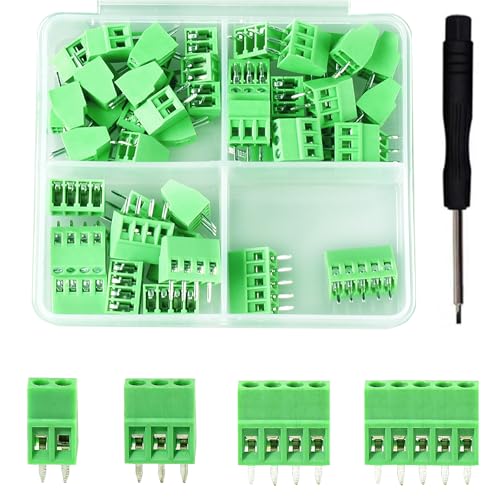
The Minidodoca kit includes 52 terminal blocks in 2P, 3P, 4P, and 5P configurations, plus a special screwdriver. It is rated for up to 150V and 6A, accommodating 18–26 AWG wires. This kit suits small to medium PCB projects where space efficiency and a variety of pin counts are needed. Best for compact prototypes and learners who want a broad selection in one package.
Best for learners and small projects where diverse pin counts are helpful. The included screwdriver supports quick term tightening. Limitations include a fixed 150V rating which may not cover higher-voltage experiments.
Tugermoola 72P 5mm Pitch PCB Terminals (Blue)

This 72-piece set provides 2P, 3P, and 4P options with a larger 5 mm pitch. Rated up to 300V and 10A, it accepts 26–14 AWG wire and tolerates -40°C to 105°C. It is suitable for rapid wiring on PCBs and breadboards with a compact, plug-and-play approach. Best for projects requiring higher current capacity and easy field wiring.
Aim for quick, reliable connections; the larger pitch helps with bulkier wires, but it may occupy more board space than 2.54 mm options. Consider spacing when designing tight layouts.
SynHHergyx 20P 5mm Pitch Terminal Blocks

These 20 terminals cover 2P, 3P, and 4P configurations with a 5 mm pitch, rated for 300V and 10A. They fit 26–18 AWG wire and provide compact, durable connections for compact PCBs and breadboard projects. Best for basic electronics builds and quick, easy hardware porting. A limitation is that the data does not specify a 2.54 mm variant, which may be needed for breadboard compatibility in some projects.
QSYZAIL 85P Screw Terminal Kit

The QSYZAIL set includes both 2.54 mm and 5.08 mm pitch terminals, plus straight and angled header pins and screwdrivers. It supports PCB perf boards, breadboards, and DIY development boards with 2.0 mm and 3.0 mm screwdriver options. Best for versatile wiring across different pitch requirements. Consider confirming exact pin counts per kit to match your design needs.
JSZAAHZ 46Pcs Mini Terminal Set

The JSZAAHZ kit offers 2P, 3P, 4P, 5P, 6P, and 8P options at 2.54 mm pitch. Rated for 150V and 6A with 26–18 AWG compatibility, this set is designed for compact projects and multi-branch wiring. Best for electronics laboratories and students who need a mix of pin counts in one package. A caveat is that some users may want a higher current rating for power-heavy projects; verify suitability for your load.
Buying Guide
What pitch should I choose?
2.54 mm (0.1 inch) pitch is common for standard breadboards and compact PCBs. 5 mm pitch provides more space for thicker wires and easier manipulation, but takes more board footprint. For tight layouts, 2.54 mm is usually preferable; for higher current or bulkier leads, 5 mm is better.
What current and voltage ratings matter?
Most listed options handle up to 6–10A and up to 150–300V. Choose a rating above your project’s supply and anticipated load. If you expect higher voltages, confirm the supplier’s data beyond generic claims.
Wire compatibility considerations
Common wire sizes range from 18 AWG to 26 AWG. Ensure the terminal’s screw clamp range accommodates your wire gauge. For mixed projects, a kit offering multiple sizes can simplify inventory and assembly.
Mounting and space requirements
Consider whether you need PCB through-hole mounting, vertical mounting, or surface-level clearance. Some kits are designed for breadboards or perf boards, while others suit compact PCBs with limited side clearance.
Which kit is best for education vs. production?
Educational and hobby kits prioritize variety and value, typically with a screwdriver and multiple pin counts. Production-focused use tends toward higher current ratings, tighter tolerances, and robust mechanicals. Match your selection to the project scale and environment.
Practical tips for installation
Prep wires by trimming to the correct length and stripping just enough insulation. Insert wires firmly under the clamp screw and tighten incrementally to avoid over-tightening, which can damage wires. Check each connection for secure, strain-relieved seating before powering the circuit.
Frequently Asked Questions
- What is the typical PCB terminal block pitch? The most common pitches are 2.54 mm and 5.08 mm, with 5 mm also widely used in hobby kits.
- How many amps do these blocks usually support? Most listed sets support 6–10A per channel; verify per-terminal ratings for high-current projects.
- Can I mix different pin counts in one project? Yes, many kits offer 2P, 3P, 4P, and higher configurations for flexible wiring layouts.
- Are screw terminals suitable for high-frequency signals? They are generally used for DC and low-frequency signaling. For high-speed or sensitive analog signals, consider shielding and layout best practices.
- Do these kits include mounting hardware? Most listed kits focus on terminal blocks and screwdrivers; additional mounting hardware may be required for your enclosure or board.
- Is there a risk of wire slippage? Secure clamp connections and ensure wires are fully inserted before tightening to avoid loosening under vibration.