As an Amazon Associate I earn from qualifying purchases. These links may earn this site a commission when you buy, at no extra cost to you.
Woodworkers seeking consistent thin strips and safe, repetitive rip cuts will benefit from purpose-built rip sleds and related jig systems. The following selections focus on precision, ease of use, and compatibility with common miter slots and T-slots found on American table saws. Each option below is designed to improve accuracy while reducing the risk of kickback during narrow-width ripping tasks.
| Product | Brand | Key Benefit |
|---|---|---|
| Preciva Thin Rip Table Saw Jig | Preciva | 3-pulley design for stable, repeatable narrow cuts |
| GOINGMAKE Thin Rip Jig Table Saw Jig Guide | goingmake | One-way roller for forward feed and safety |
| POWERTEC 71403 Table Saw Crosscut Sled | POWERTEC | Complete sled kit with precise crosscuts and zero clearance |
| Peachtree Woodworking Supply Thin Rip Jig | Peachtree Woodworking Supply | Guided strip cuts with adjustable locking |
| Fulton MDF Crosscut Sled | Fulton | Adjustable rails and a durable, stable platform |
Preciva Thin Rip Table Saw Jig

Designed to slide into a table saw’s U-track slot, the Preciva jig locks in front of the blade for accurate narrow cuts. The clamp extends up to eight inches from the slot, accommodating 3/8″ x 3/4″ U-slots and 1/4″ x 3/8″ T-slots. The three-pulley system provides a stable, guided path for the workpiece, reducing vibration and improving repeatability. A one-way pulley helps feed the stock toward the blade to minimize rebound, increasing safety during thin rip operations. Laser-engraved imperial and metric scales offer precise setup and consistent results across multiple pieces.
In practice, setup involves aligning the pulley position with the scale indicator to match the desired thickness. The scale can be reused for identical pieces, enabling a repeatable workflow for batch ripping. When paired with a sturdy fence, the Preciva jig becomes a reliable companion for narrow strip work, such as trim stock or decorative vectors, especially in custom cabinetry or woodworking projects where uniform width is essential.
GOINGMAKE Thin Rip Jig Table Saw Jig Guide

The GOINGMAKE thin rip jig is positioned by sliding the guide into the table saw’s miter slot and locking it in front of the blade. It supports 3/8″ x 3/4″ T-slot, 3/8″ x 3/4″ U-slot, and 1/4″ x 3/8″ T-slot configurations, with an eight-inch reach from the center to the blade. A one-way roller bearing ensures forward motion and reduces kickback, promoting safer, repeatable narrow strip ripping. The jig includes laser-engraved metric and imperial scales and a zero-clearance design to minimize tear-out and help achieve consistent strip widths across cuts.
For dependable results, set the scale to the target width, bring the bearing toward the blade, and lock down the fence so that the stock touches the guide wheel. Reposition the stock behind the blade for each new cut, ensuring the same alignment for identical pieces. This approach makes it practical to produce a series of narrow strips with uniform thickness, which is particularly useful for parquet, inlays, or cabinetry trim work.
POWERTEC 71403 Table Saw Crosscut Sled

The POWERTEC crosscut sled combines a durable MDF base with a robust aluminum fence, delivering repeatable crosscuts with clean edges and reliable 90-degree accuracy. The included miter bar and flip stop assist with precise setups, while the base is engineered to reduce tear-out—thanks to a dedicated zero-clearance configuration that’s tailored to the blade being used. With easy-to-read graduations, this sled is designed for projects that demand square, precise cuts, such as cabinet components, picture frames, and aligned stair parts.
Users benefit from the kit’s comprehensive hardware and clear instructions that streamline installation on compatible table saws. The design supports accurate stop settings, enabling repeated cuts of the same length. Although it is primarily a crosscut sled, its stability and precision features complement rip work by providing a reliable platform for finishing passages where square corners and clean edges are critical. It is also a practical option for workshops upgrading from basic fences to more advanced sled-based workflows.
Woodpeckers Auxiliary Rip Fence

The Woodpeckers 36-inch auxiliary rip fence extends the reach of a table saw fence, providing infeed or outfeed support for longer stock and more complex ripping tasks. Built with built-in T-track slots and clamping blocks, this extension offers precise alignment and repeatable adjustments for accurate widths. The 3-1/2″ height and 36″ length are well-suited for job-site table saws, band saws, vintage contractor saws, router tables, and other setups where additional support improves accuracy and safety. It’s designed for quick installation without modifying the existing fence.
In practical use, the auxiliary rip fence helps maintain stock alignment during longer rips and supports delicate pieces that require careful handling. For shop owners who frequently build panels, shelves, or long boards, this extension reduces the need to reset the main fence repeatedly. While it does not replace a dedicated ripping jig, the Woodpeckers accessory enhances overall ripping precision by improving stock stability and alignment along the outfeed or infeed path.
Peachtree Woodworking Supply Thin Rip Jig

The Peachtree Thin Rip Jig is designed for repetitive narrow cuts on table saws with 3/4″ x 3/8″ miter slots, and it works with many router tables and band saws as well. This jig acts as a third hand behind the blade, enabling safe, repeatable adjustments. After the first cut, you simply reset the stock behind the blade and move the fence over so the stock touches the guide roller. Lock the stock, then repeat. The result is consistent thin rips without risking fingers near the blade. It’s especially helpful for cabinet doors, decorative moldings, and inlay work where uniform thickness matters.
Proper use involves unplugging the saw during setup and using the guide roller to establish the same offset for each cut. The unit’s design minimizes hands-on interference while maintaining accuracy, allowing open-ended projects that require multiple identical strips. For precision-oriented projects, this jig provides a practical, safe method to achieve uniform thin rips across a batch of boards.
Fulton MDF Crosscut Sled
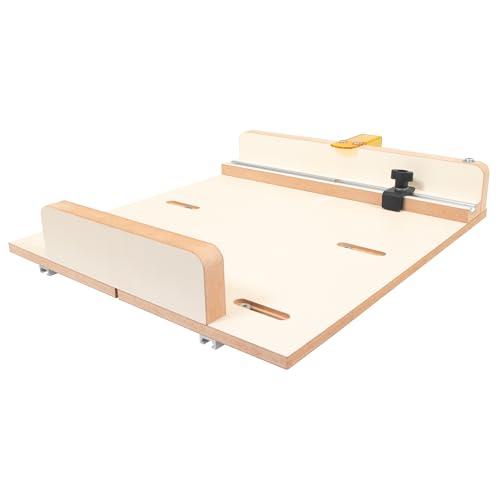
The Fulton MDF crosscut sled features aluminum miter slot runners and adjustable rails, delivering stable stops and accurate miters on a standard table saw. The kit includes a transparent guard, stop blocks, and an integrated measurement scale, making it suitable for repeatable crosscuts and precise lengths. A notable point is its compatibility with common 3/4″ x 3/8″ miter slots and its compact footprint, which makes it a good choice for smaller shop setups. The sled is designed to handle various stock sizes with dependable repeatability, especially where precise miters and clean edges are essential.
The Fulton sled is a practical option for projects requiring precise miter cuts, such as picture frames and cabinetry components. Its straightforward setup and sturdy construction minimize blade chatter and offer consistent results across multiple stock pieces. While primarily a crosscut tool, its stability supports a range of ripping-related tasks when used in conjunction with a separate ripping jig or fence extension.
Buying Guide: Key Purchase Considerations And Comparisons
When choosing a rip sled or related jig, consider the following factors to ensure compatibility with your table saw and the type of projects you undertake:
- Slot compatibility: Confirm your saw’s miter slot sizes (3/8″ x 3/4″ or 1/4″ x 3/8″ variants) and whether the jig supports U-slots or T-slots to ensure a secure fit.
- Reach and clearance: A longer reach from the slot to the blade enables wider strips but may affect maneuverability. Balance reach with ease of setup and control for your typical workpieces.
- Stability and restraint: Look for jigs with multiple contact points, rollers or bearings, and non-slip components that minimize kickback and maintain consistent cut thickness.
- Scales and precision: Laser-engraved imperial and metric scales help with repeatable setup. Zero-clearance designs reduce tear-out and improve edge quality.
- Versatility: Some jigs work only with specific slot configurations, while others support multiple slot types and even router tables. Consider future projects and potential tool upgrades.
- Safety features: Features such as one-way rollers, positive locking mechanisms, and clear guards contribute to safer operation, especially during repetitive thin rip cuts.
- Storage and maintenance: A compact, durable jig is easier to store, while rust-resistant hardware and simple maintenance extend life in a shop setting.
In practice, the best choice depends on your typical stock sizes, the frequency of thin rip tasks, and how much you value repeatability versus setup speed. If you frequently produce identical narrow strips, prioritize a jig with strong repeatable measurements and a secure clamping system. For occasional accuracy gains, a versatile crosscut sled with precise alignment can be a solid complement to a more focused rip-jig setup. Combining a high-quality crosscut sled with a dedicated thin rip jig often yields the most reliable results for a range of woodworking projects.