
Best Speed Control for Single-Phase Motors: Top 5 AC Controllers for Home &Amp; Workshop
When shopping for single-phase motor speed control, choose devices designed for brushed AC motors, with clear voltage or frequency readouts and built-in protection. This guide highlights five reliable options, each best suited for different needs—from small tools to larger fans and drills. The list helps buyers decide who benefits most from each model, whether you’re a DIY enthusiast, a professional contractor, or just upgrading a workshop duct fan.
| Product | Best For | Key Benefit |
|---|---|---|
| CDMALL AC Motor Speed Controller | Brushed AC motors like fans and drills | Real-time LED voltage display and overload protection |
| Luney 4000W Speed Controller | High-power applications | High capacity with safe overload and surge protection |
| ATO Single Phase VFD 2HP | Precision frequency control for motors | Variable frequency drive with keypad control |
| Industrial and home use | Wide compatibility and 20A capacity | |
| VXIVXIV 120W Gear Motor Controller | Small, low-voltage gear motors | Reversible and adjustable speed for gear motors |
CDMALL AC Motor Speed Controller for Brushed Motors
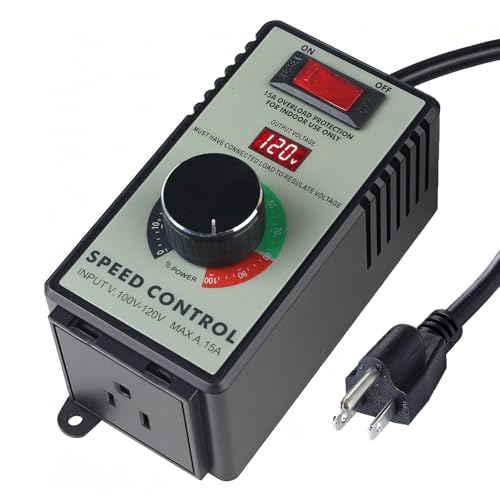
Best for inline duct fans, exhaust fans, routers, and drills that use brushed AC motors. This controller reduces voltage to slow speed and integrates a real-time LED voltage display for precise settings. It includes an electronic overload protection with a resettable 15A circuit breaker. Use caution: not compatible with brushless DC motors or appliances with onboard control boards. Recommended working current is within 10A for extended use.
JIAWANSHUN 30W Small Concrete Vibrator Motor With Speed Controller

Best for small vibration tasks such as sand shaking tables and similar single-phase 110V equipment. This model features a 30W motor with a built-in speed governor. It runs at 3600 RPM, with IP65 waterproofing, and comes with a standard American plug. It is best for users who need a simple, plug-and-play solution and can operate at medium to high gear settings. Note that it uses a governor instead of a truly stepless control, so very low-speed operation may be limited.
Luney 4000W AC Motor Speed Controller

Best for high-power fans and power tools requiring robust speed regulation. It supports resistive loads up to 4000W and inductive loads up to 1500W, with a bright LED display for precise speed control. Integrated safety features include overload protection and surge protection, housed in a flame-retardant shell. Choose this if you need strong performance in demanding environments, but be mindful of its bulk and wiring requirements for larger installations.
ATO Single Phase VFD 2HP
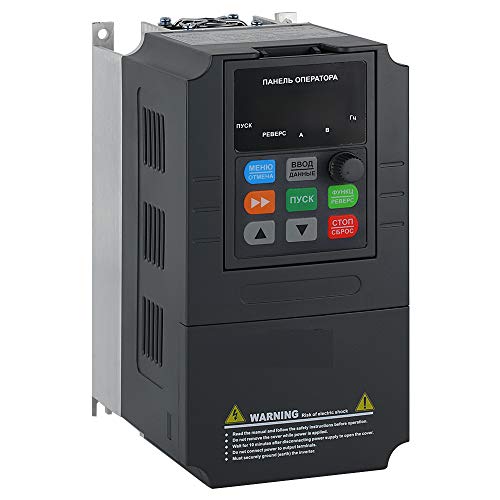
Best for motor speed orchestration with precise frequency control. This 2HP, 1.5 kW VFD handles single-phase 220V input and output, offering a wide 0–1000 Hz range and keypad/serial control. It is suitable for applications needing tight speed regulation and reversible operation. Potential limitation: installation and programming can be more complex than basic voltage controllers, so it’s best for users comfortable with VFD setups.
Boxyouping Adjustable 4000W Speed Controller
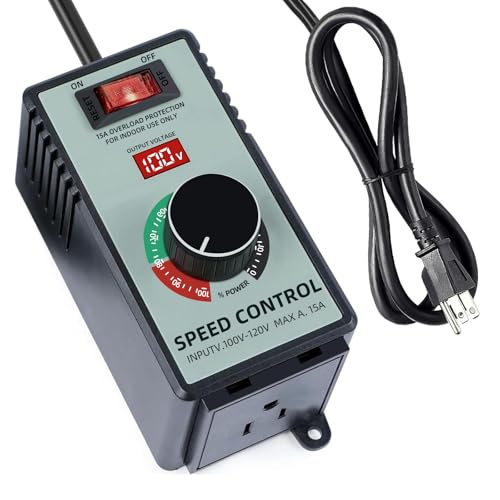
Best for versatile, heavy-duty use with single-phase motors. This controller supports 110V-120V input and up to 20A, suitable for routers, fans, grinders, and other home or light industrial tools. It features advanced electronic regulation for stable output and surge protection. Consider this when your project spans multiple tools or you require a higher current rating, and ensure compatible wiring and enclosure for safety.
VXIVXIV 120W Gear Motor Controller

Best for small single-phase gear motors that need a compact speed range (0–270 RPM). This controller includes a governor and a reversible output with a simple potentiometer for infinite control within the motor’s range. It is ideal for precision gear-driven applications where space is limited. A limitation is that it targets specific low-speed gear motors and not high-speed or high-power devices.
Buying Guide: Key Purchase Considerations
- Motor type and compatibility: Verify brushed AC motors vs. brushless DC or motors with electronic boards. Only use controllers matched to your motor type to avoid damage.
- Voltage and current rating: Match the controller’s input/output voltage and maximum current to your device. Higher loads require higher-capacity controllers with proper overload protection.
- Control method: Choose between voltage-based speed control, frequency-based VFDs, or gear-motor-specific governors depending on your precision needs and application (faster, cleaner control vs. simple on/off or slow ramp).
- Protection features: Look for overload protection, surge protection, and thermal or flame-retardant housings for safety and equipment protection.
- Display and usability: Real-time voltage or speed readouts help calibrate settings. Consider whether you need a keypad or dial-based interface for ease of use in a workshop.
- Wiring and enclosure: Ensure the device fits your space and wiring setup. Some controllers are plug-and-play, while others require professional installation or enclosure for electrical codes.
Frequently Asked Questions
- What is the difference between a speed controller and a VFD?
– A speed controller generally adjusts voltage to a brushed AC motor, while a VFD varies both voltage and frequency to control motor speed, often providing more precise control and broader speed ranges for single-phase motors. - Can I use a 120V controller on a 110V circuit?
– In most cases, yes, because 110V and 120V are within tolerance for common AC controllers, but check manufacturer specifications for exact input ranges. - Is overload protection always necessary?
– Yes, overload protection helps prevent damage to motors and controllers when loads spike or devices stall unexpectedly. - Do all controllers work with all duct fans or drills?
– No. Brushed AC motors are required for most of these controllers. Avoid units with brushless DC motors or boards that require electronics inside the appliance. - Should I choose a high-power controller for small tools?
– If your tool never draws more than a small fraction of the controller’s rating, a smaller unit may suffice, but oversizing can offer safer margin and longer life for peak loads.