
Best Speed Control for Motor Performance and Safety
Finding the right speed control for motors requires balancing voltage, current, load type, and safety features. This guide highlights top-speed controllers suitable for common American applications, including AC brushed motors and lower-voltage DC motors. Each selection emphasizes reliable protection, ease of use, and clear monitoring to help you optimize performance while maintaining safety.
| Product | Brand | Voltage Range | Current Capacity | Key Features |
|---|---|---|---|---|
| CavalliFun AC Motor Speed Controller | CavalliFun | 110-120V | 15A max | Overload & surge protection; LED display; flame-retardant shell |
| CDMALL AC Motor Speed Controller 120V | CDMALL | 110-120V | 15A max | Overload protection; LED voltage meter; three-speed option |
| RioRand 7-70V PWM DC Motor Controller | RioRand | 7-70V DC | 30A | Wide VAC/DC range; run/stop/brake function; soft-line potentiometer |
| CDMALL AC Motor Speed Controller (6′ Cord) | CDMALL | 110-120V | 15A max | Overload/short-circuit protection; 3-speed switch |
| ZOWZEA AC Motor Variable Speed Controller | ZOWZEA | 110-120V | 15A max | Overload protection; LED display; compact back-clip design |
CavalliFun AC Motor Speed Controller 120V 15A

The CavalliFun speed controller is designed for 110-120V AC inputs with a maximum current of 15A. It supports resistive loads up to 2000W and inductive loads up to 1000W. Key protections include surge and spike protection, with a flame-retardant insulation shell for safety in high-temperature environments. An independent overload protection switch helps safeguard both equipment and users by shutting off when instantaneous current exceeds 15A. A clear LED display provides precise voltage or speed readings for reliable operation.
CDMALL AC Motor Speed Controller 120V 15A
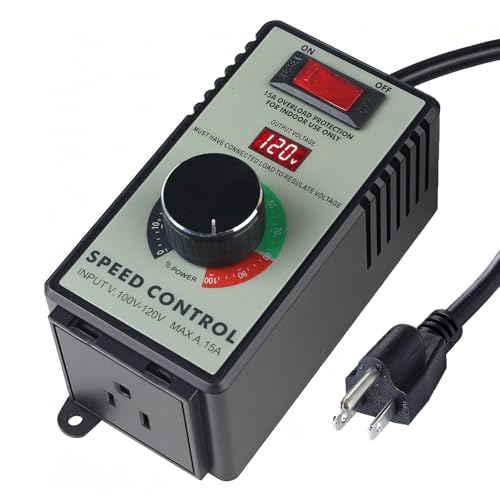
CDMALL’s 120V AC speed controller offers 15A maximum current with resistive loads up to 2000W and inductive loads up to 1500W. It includes a fan speed controller with a three-foot grounded cord and an independent overload protection switch that cuts power if current exceeds 15A. The unit features a high-precision LED voltage meter for at-a-glance monitoring. It is intended for AC brushed motors and should not be used with brushless motors.
RioRand 7-70V PWM DC Motor Speed Controller

This RioRand device is a PWM DC speed controller suitable for 7-70V DC with a 30A capacity. It includes an on-board run/stop/brake functionality and a separable potentiometer with switch. It is designed for DC brush motors and must be powered by a dedicated DC source; it cannot be connected directly to 220V AC power and is not intended for brushless motors. The design emphasizes smooth motor operation and minimal vibration, with a power-indication feature for status checks.
CDMALL AC Motor Speed Controller 120V 15A (6′ Cord)

Equipped with a 6ft grounded power cord, this CDMALL model provides 15A maximum current and supports resistive loads up to 2000W and inductive loads up to 1500W. Features include an independent overload fuse protection that automatically blows if instantaneous current exceeds 15A, safeguarding equipment and users. The unit offers three settings: low, mid, and full, simplifying speed adjustments for inline or duct fans. Appropriate for AC brushed motors; brushless motors require a different controller.
ZOWZEA AC Motor Variable Speed Controller

With an input range of 110-120V and a 15A maximum current (9A typical), ZOWZEA’s controller supports a 4000W resistive load and 1500W inductive load. It includes an overload cut-off and a flame-retardant casing for safety. A back-clip design and a precise rotary knob with an LED display assist in accurate voltage control, making it suitable for belts, fans, and other inline motors where stable operation and visibility matter.
Buying Guide
Key purchase considerations:
- Voltage and current ratings: Match the controller’s voltage range and current capacity to your motor’s specification. Over-specing can waste energy; under-specing can cause overheating or protection trips.
- Load type compatibility: Resistive vs inductive loads behave differently. Ensure the controller supports your motor type (AC brushed vs DC). Some models specify suitability only for brushed motors; brushless motors require different drivers.
- Protection features: Look for overload protection, short-circuit protection, surge/spike protection, and flame-retardant casings for safety in hot environments. Independent switches for protection are a plus.
- Monitoring and display: LED voltage meters or displays help monitor operating voltage and speed. This is especially helpful in maintenance and troubleshooting.
- Physical design and wiring: Cord length, grounding, and mounting options impact installation. Some units include longer cords or back-clip designs for hands-free positioning.
- DC vs AC compatibility: DC controllers require a dedicated DC power source and are not suitable for AC mains. Verify the motor type and required power supply before purchasing.
- Settings and adjustment: Some controllers offer multi-speed switches (low/mid/full) for quick adjustments, while others use a continuous potentiometer. Consider your use case to pick the preferred control scheme.
- Safety and compliance: Check for UL/CSA approvals where applicable, and ensure the unit’s construction adheres to local electrical codes.
Comparative considerations:
- AC motor controllers (120V): Best for fans, pumps, and inline duct systems with brushed motors. Prioritize overload protection and clear displays for reliability in continuous operation.
- DC motor controllers (low voltage): Suitable for robotics, small gear motors, and battery-powered applications. Ensure a matched DC power source and watch for brush vs brushless compatibility.
- Protection emphasis: Controllers with automatic shutdown on overload reduce risk to equipment and users, especially in industrial or workshop settings.
- Display and ease of use: A visible voltage/current readout simplifies troubleshooting and tuning during setup and maintenance.
In selecting the right device, align the controller with your motor’s electrical characteristics, select a model with robust protective features, and verify compatibility with your installation environment. The choices above cover a range of common needs—from high-current, mains-powered AC controllers to flexible DC options—helping you achieve precise speed control while maintaining safety and reliability.