
Best Solar Panels for Marine Use: Reliable RV and Boat Power Solutions
For boaters and RV enthusiasts, dependable solar power means extended adventures without shore power. This guide highlights top marine-ready solar panels designed to withstand outdoor conditions, deliver stable output, and fit tight onboard spaces. Explore performance features, durability, and versatility across off-grid and on-grid applications to help you choose the right kit for marine use.
style=”display:none;”>Summary Table
| Product | Brand | Rated Power | Key Feature | Amazon Link |
|---|---|---|---|---|
| Renogy 400W ShadowFlux Panel (2x 200W) | Renogy | 400W | ShadowFlux anti-shading tech, N-Type 16BB cells | https://www.amazon.com/dp/B0DTHT8XMM?tag=tbridgepower-20 |
| Renogy 200W 24V Panel | Renogy | 200W | High efficiency 16BB N-Type, durable build | https://www.amazon.com/dp/B08CRJYJ22?tag=tbridgepower-20 |
| RENOGY REGO 200W Portable Solar Panel | RENOGY REGO | 200W | Compact foldable blanket, portable and Versatile | https://www.amazon.com/dp/B0FB3NC1JM?tag=tbridgepower-20 |
| Rvpozwer 400W Solar Panel (4x100W) | Rvpozwer | 400W | 18BB N-Type cells, sturdy offshore-ready design | https://www.amazon.com/dp/B0FFGWK16Z?tag=tbridgepower-20 |
| ECO-WORTHY 200W Kit | ECO-WORTHY | 200W | Complete kit with 30A PWM controller, marine-ready | https://www.amazon.com/dp/B09RZZHHHM?tag=tbridgepower-20 |
Renogy 400W ShadowFlux Panel (2x 200W)

The Renogy pair uses ShadowFlux anti-shading technology to maintain power output in partially shaded marine environments, such as near docks, decks, or tree lines. Its N-Type cells with 16BB technology offer up to 25% efficiency, helping maximize energy capture aboard boats and RVs. The panels are designed to be more compact and lighter than traditional PERC units, making installation on limited marina rooftops or vessel awnings easier.
In marine contexts, higher efficiency and reduced hot-spot risk translate into steadier charging for batteries, radios, lights, and essential gear. The 400W configuration can scale well for RV or vessel installations where roof space is available, while still fitting snugly in tight compartments. Durable construction supports salt air exposure and outdoor use.
Renogy Solar Panel 200W 24V

This 200W module uses advanced encapsulation, multi-layer laminations, and EL testing to minimize hot spots and ensure longevity. It includes bypass diodes to reduce power loss from shade and a corrosion-resistant frame for saltwater environments. The panel’s rugged build and high transparency tempered glass help it endure marine conditions while maintaining performance in varying light. Its versatility suits RV roofs and small vessels needing reliable 12–24V charging capabilities.
RENOGY REGO 200W Portable Solar Panel

Renogy REGO is a foldable 200W solar blanket that packs compact efficiency into a portable form, ideal for limited deck space or emergency charging aboard boats and RVs. Its design emphasizes reduced weight and bulk while offering strong solar conversion from N-Type cells with 16BB technology. The blanket unfolds to a size comparable to a vehicle front and can be positioned for optimal sun exposure, including temporary sunshade use on the windshield of a parked boat or RV.
Rvpozwer 400W Solar Panel Kit
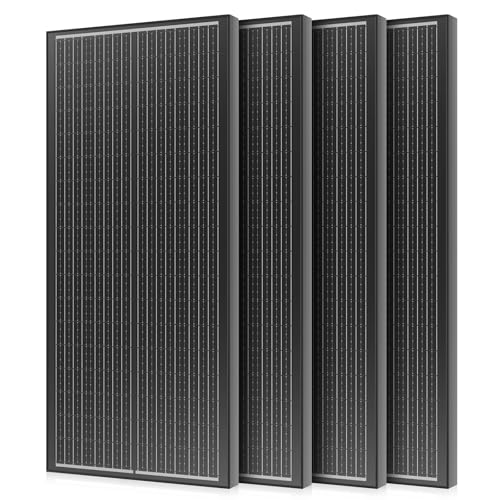
The RVPOZWER panel set uses 18BB N-Type cells to deliver up to 25% conversion efficiency, balancing performance with reduced hot spots. The 400W arrangement, supported by a robust 12V or higher configuration, is suitable for RVs and boats that demand steady daily energy, including refrigeration, lighting, and electronics. Its corrosion-resistant frame and tempered glass contribute to longevity in coastal and offshore environments, while the design accommodates marine mounting options.
ECO-WORTHY 200W Solar Kit

This 200W kit combines monocrystalline solar panels with a PWM charge controller, designed for RV, marine, and off-grid applications. The kit emphasizes broad compatibility and straightforward setup, with a corrosion-resistant frame and IP65-rated junction box for environmental protection. The system aims to deliver reliable daily output in moderate sun, making it a practical option for boats and campers that need an easy upgrade to solar charging on board.
Buying Guide: What to Consider When Choosing Marine Solar Panels
- Power needs and space: Assess daily energy usage and roof or deck area to determine whether a single high-watt panel or a modular array best fits your vessel or RV.
- Cell technology and efficiency: N-Type cells (e.g., 16BB/18BB) typically offer higher efficiency and reduced hot spots, which is valuable in shade-prone marine settings.
- Anti-shading and hot-spot protection: Technologies like ShadowFlux or bypass diodes help maintain power when some panels are partially shaded by masts, sails, or superstructures.
- Durability and saltwater resistance: Look for corrosion-resistant frames, tempered glass, and sealed junction boxes to withstand salt spray and humidity.
- Weight and portability: Portable or foldable panels (like REGO blankets) are ideal for limited deck space or temporary setups on boats and RVs.
- Mounting compatibility: Ensure mounting options align with your vessel’s roof curvature or RV roof design, with appropriate mounting hardware.
- System compatibility: Verify compatibility with your existing charge controller and inverter (PWM vs MPPT) for optimal charging efficiency.
- Certification and safety: EL testing, IP ratings, and weatherproofing contribute to long-term reliability in marine environments.
Across different marine scenarios, the right solar setup balances efficiency, durability, and form factor. High-efficiency panels paired with robust mounting and proper controllers can sustain marine electronics, refrigeration, and lighting for extended voyages. For compact decks or emergency readiness, portable 200W to 400W kits offer flexible power without heavy installation work. When selecting, consider not just peak power but daily energy yield under typical sailing or boating conditions to ensure consistent performance.