
Best Solar Panel Storage Systems for Off-Grid Reliability
Exploring solar panel storage systems helps families and businesses stay powered during outages or remote living. This guide highlights five practical options that combine solar panels, storage, and in some cases inverters for a complete off-grid setup. Each pick emphasizes durability, expandability, and integration with common 12V/24V systems so you can compare performance and capacity for your needs.
| Product | |||
|---|---|---|---|
| ECO-WORTHY 10000W Complete Off-Grid Solar Panel Kit | All-in-One Kit | ~20.48kWh Lithium Battery pack | High output with monitoring app |
| ECO-WORTHY 200 Watts 12V/24V Panel Kit | Panel Kit | Depends on battery choice | Compact, versatile for RVs and cabins |
| ECO-WORTHY 200 Watt 12V Complete Starter Kit | Starter Kit | Depends on battery and inverter | Beginner-friendly with included components |
| Loenel Solar Panel Storage Bag | Storage Solution | Not applicable | Protective, portable storage for panels |
| [Ultra] ECO-WORTHY 1200W 24V System | Off-Grid System | ~7.168kWh Li-ion storage | Dual-pack batteries for long life |
Note: Product features vary by model and may be expanded with additional batteries or inverters. Always verify compatibility with your preferred battery chemistry and local electrical codes.
ECO-WORTHY 10000W Complete Off-Grid Kit
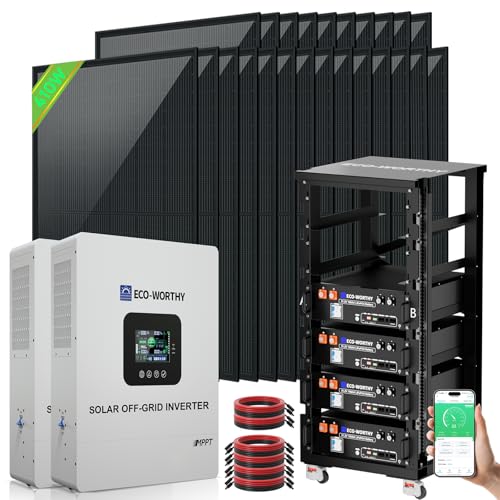
The ECO-WORTHY 10KW complete kit targets larger off-grid needs, delivering a 9840W solar array coupled with a 20.48kWh Lithium Battery rack. It includes two 5000W inverters and a 80A MPPT controller, enabling 120V/240V split-phase output. The system supports remote monitoring via a dedicated app, helping track performance and battery status. It is designed for homes, cabins, farms, or workshops that require substantial, reliable energy storage and rapid solar charging under sunny conditions.
Key features include the ability to average about 40kWh per day under four hours of full sun, powering common 110V appliances such as air conditioners, TVs, refrigerators, coffee makers, and microwaves. The battery pack is built to fit into a compact server rack, simplifying installation in limited spaces. The modular design supports expansion to meet growing energy demands, and the system is optimized for all-weather use with grid-tied charging when sun is scarce.
Performance considerations: ensure your location provides adequate sun exposure and that the site can accommodate multiple high-current connections. The kit’s robust inverter pairing and CAN/RS485 communication make it suitable for users seeking a scalable, monitored, off-grid power solution.
ECO-WORTHY 200 Watts Panel Kit For RV and Off-Grid

This 200W panel kit targets off-grid and mobile use cases like RVs, campers, and boats. It features high-efficiency monocrystalline cells and a 30A PWM charge controller. The panel size and aluminum frame support durable outdoor operation under wind and snow loads, with IP65-rated junction protection for weather resistance. The kit’s energy output is typically around 800Wh per day in optimal sunny conditions, making it a practical starter for supplemental power or small cabins.
Performance notes: the system relies on a suitable battery and inverter to store and deliver energy, and the 21% higher efficiency claim reflects modern monocrystalline technology. The compact dimensions and durable construction suit portable and semi-permanent installations, while the MCP controller ensures straightforward operation for new solar users.
ECO-WORTHY 200 Watt 12V Complete Starter Kit
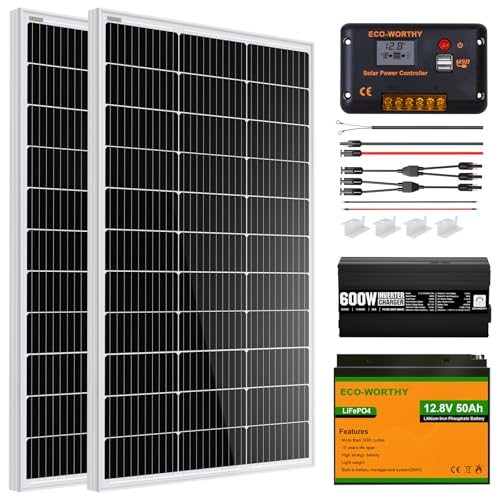
This beginner-friendly starter kit includes a complete set of essentials: 200W solar panels, a 30A charge controller, a 50Ah Li-ion or LiFePO4 battery, and a 600W inverter. It targets RVs, cabins, boats, and small off-grid spaces where a modest, reliable power supply is valued. The kit emphasizes an easy, plug-and-play setup with balanced protection features and a compact footprint for limited spaces.
Performance notes: with four hours of sun, it can deliver roughly 800Wh daily, making it a practical entry point for users building toward full independence. The inclusion of a robust frame, weather protection, and simple wiring helps reduce planning friction for first-time solar installers.
[Ultra] ECO-WORTHY 1200W 24V System Off Grid Kit
![[Ultra] ECO-WORTHY 1200W 24V System Off Grid Kit](https://m.media-amazon.com/images/I/511dZ9S3EPL._SL500_.jpg)
This kit pairs six 195W panels with a 24V 5.52kWh Li-ion storage bank, a 60A MPPT controller, and a 3,000W pure sine wave inverter. The dual-pack battery setup increases usable capacity and supports deeper cycles, making it suitable for longer outages or higher energy needs in cabins, tiny homes, or RV sites. The dual-axis tracker option can boost energy harvest by more than 40%, enhancing daily output in optimal conditions.
Performance notes: this system emphasizes long-term reliability with a UL-aligned battery and enhanced cycle life. It is ideal for users who want greater autonomy and a scalable path to larger off-grid configurations, especially when combined with a capable inverter and monitoring tools.
Buying Guide: Key Purchase Considerations
- System size and energy needs: Estimate daily energy consumption and plan for extra capacity to cover peak usage, outages, and future expansion. Larger kits offer greater resilience but require more space and a stronger installation site.
- Storage chemistry and lifespan: LiFePO4 batteries provide long cycle life and stable performance, but cost is higher. Compare cycle life, depth of discharge, and safety certifications (UL standards) when choosing packs.
- Inverter type and capacity: Pure sine wave inverters support sensitive electronics; match inverter wattage to anticipated loads. For grid-tied or hybrid needs, ensure compatibility with the selected controller and battery setup.
- Expansion potential: If you plan to grow capacity, choose modular kits with scalable inverters and battery racks. Check if additional panels or batteries can be added without major rewiring.
- Durability and weather resistance: Look for IP ratings, rugged frames, and secure mounting options for outdoor installations. Consider wind and snow load ratings for your climate.
- Monitoring and connectivity: Apps and remote monitoring help track energy production, battery health, and alerts. Ensure the system supports reliable telemetry without requiring complex setup.
- Installation site constraints: Evaluate space for solar array, battery racks, and wiring paths. Ensure compliance with local electrical codes and safety guidelines, possibly involving licensed professionals.
- Cost of ownership and maintenance: Compare up-front costs with long-term savings. Battery replacement cycles, inverter warranties, and panel degradation impact long-term value.
- Portability vs. permanence: Some kits are designed for RVs or temporary setups, while others suit stationary homes. Decide based on how permanent you want the system to be.
- Warranty and support: Favor products with clear warranties, responsive customer support, and readily available replacement parts to reduce ownership risk.