
Best Solar Panel for a Home: Top Home-Ready Systems and Kits
If you’re seeking reliable, scalable solar power for a home, these five options cover grid-tied and off-grid setups, from all-in-one home kits to portable panels for on-the-go energy. These picks suit different buyers: whole-home backup needs, RV-ready off-grid enthusiasts, and modular expandability for future power needs. Below is a quick snapshot of recommended products and what makes them stand out.
| Product | Best For | Key Benefit |
|---|---|---|
| ECO-WORTHY 10kW All-In-One Home Kit | Whole-home backup | High continuous power with integrated inverter and large storage |
| Callsun 400W Bifacial Panels (2 x 200W) | Compact off-grid or RV setups | Bifacial design increases daily energy with dual-module setup |
| ECO-WORTHY 400W N-Type Panels (4 × 100W) | Small off-grid kits | N-Type efficiency and modular 100W units for easy expansion |
| ECO-WORTHY 200W 12/24V Panel Kit | 12V/24V systems and small-scale charging | Versatile 12/24V compatibility with solid durability |
| Renogy 400W Premium Kit | Ready-to-install 12V systems | Pre-wired, MPPT efficiency, and solid warranty framework |
The following sections explain each selection, including who it’s best for, why it was chosen, and practical considerations to help you decide which system fits your home and lifestyle.
ECO-WORTHY 10kW All-In-One Home Kit

Best for: Homeowners seeking a complete, scalable solution with integrated power generation and storage. This kit delivers up to 10kW output with 120V/240V split-phase support, suitable for running common household appliances during outages or off-grid use. It includes five 590W solar panels (total PV 2,950W) and a 48V 314Ah LiFePO4 battery with 16.1 kWh storage. The package also comes with necessary cables for straightforward setup and a system designed for reliable home power support.
Why selected: Its all-in-one approach reduces the need to source separate components. The 10kW inverter and sizeable storage provide meaningful backup capacity, while built-in monitoring via WiFi/PC connectivity improves operation visibility. The upgraded battery and parallel capability add scalability for future energy demands.
Best for: Buyers who want a strong, turnkey solution that can support daily loads and offer backup during grid interruptions. Caution: The system relies on proper installation and safe handling of high-capacity storage; ensure professional wiring adherence for split-phase operation and battery safety.
Callsun N-Type 400W Bifacial Panels (2 Pack)

Best for: Off-grid or RV setups where space is limited but daily energy is still needed. This twin-pack provides 400W with bifacial technology that captures sunlight from both sides, potentially boosting total output by up to 30%.
Why selected: The N-type with 16BB busbars improves efficiency and durability, reducing hot spots and micro-cracks for longer panel life. The bifacial design helps maximize energy capture in sunny conditions, a practical benefit for portable or shaded installs where every watt matters.
Best for: Choose this if you value higher efficiency in a compact footprint and you want a shading-tolerant design. Caution: Bifacial gains depend on reflective surfaces and mounting angles; actual gains vary with installation environment.
ECO-WORTHY 400W N-Type Four-Piece Panel Set

Best for: Small to mid-size off-grid installations where modular expansion is advantageous. This four-panel kit uses N-Type cells to deliver up to 25% efficiency per panel, supporting off-grid PV power for home, camping, or remote sheds.
Why selected: The 25% cell efficiency and robust build provide reliable performance, especially in low-light conditions. The kit’s modular design supports easy growth if more capacity is needed later. Caution: Requires a compatible battery and inverter to form a complete system.
ECO-WORTHY 200W 12/24V Panel Kit
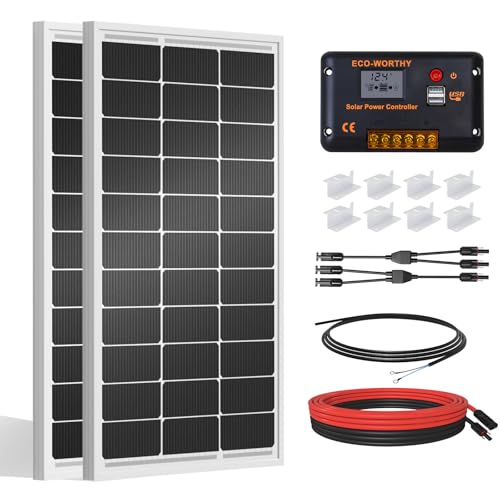
Best for: Individuals building small, flexible charging setups or RV/camper applications that require 12V or 24V systems. The kit is designed for portable, off-grid charging and backup power with a durable build.
Why selected: It supports both 12V and 24V configurations, enabling broader compatibility with different battery types (AGM, LiFePO4, deep-cycle). The panel’s corrosion-resistant frame and IP65-rated junction box add resilience for outdoor use. Caution: Output is lower than larger kits; plan for longer charging times if you need significant daily energy.
Renogy 400W Premium Kit

Best for: Homeowners seeking a complete 12V solar power system with ready-to-install components. This premium kit includes four 100W panels, a 40A MPPT controller, and mounting hardware, designed for reliable, long-term use.
Why selected: The kit emphasizes MPPT efficiency and a straightforward installation path, backed by a reasonable warranty framework. It’s a solid balance of performance and expandability for a typical home off-grid or backup power project. Caution: Wires and mounting should be installed with care to maintain peak performance and weather resistance.
Buying Guide
What size system do I need for home use?
Assess your daily energy consumption and peak loads. For backup power, prioritize higher inverter capacity and battery storage. For daily home use, a larger PV array and reliable MPPT controller improve performance in varied weather.
What are key components to consider?
- Inverter: Determines whether you can run heavy appliances and whether you need split-phase output for 120/240V.
- Battery: LiFePO4 offers safety and long life; ensure compatible charging parameters with the inverter.
- Solar panels: Efficiency, temperature tolerance, and panel type (N-Type vs. P-Type) influence long-term output.
- Monitoring: WiFi or Bluetooth monitoring helps track performance and maintenance needs.
What about installation and expansion?
Modular kits allow future growth. Ensure mounting hardware, cabling, and protection devices (fuses, breakers) match local electrical codes. If you’re connecting to the home grid, consult a licensed professional to handle interconnection and safety requirements.
How do I compare efficiency and output?
Look for panel efficiency (percentage), inverter efficiency, and system voltage compatibility (12V/24V/48V). Consider real-world factors like shading, orientation, and temperature, which affect daily output.
What are common trade-offs?
- Higher upfront cost for complete home kits vs. modular growth later.
- Portable panels offer flexibility but often lower sustained output than fixed roof installations.
- Bifacial panels can boost output, but gains require reflective mounting surfaces and correct placement.
FAQ
- What is a split-phase inverter good for at home?
It provides 120V and 240V outputs to power typical household appliances and maintain safe operation for larger electrical loads.
- Can these kits be expanded later?
Yes, many kits support parallel connections or additional panels and batteries, depending on inverter and controller limits.
- Are LiFePO4 batteries better than other chemistries?
LiFePO4 offers safer chemistry, longer life, and stable performance essential for home storage.
- Do panel types matter for winter performance?
Yes. N-Type panels and higher-efficiency cells typically perform better in low-light conditions and high temperatures.
- Is professional installation required for home solar kits?
For grid-tied or higher-capacity systems, professional installation is advised to meet safety and code requirements.