
Best Solar Energy Complete System Kits for Home Power Independence
Ready to power your home with a complete solar energy system? This guide highlights five practical ECO-WORTHY and related complete kits that suit different needs—from full-house off-grid setups to portable RV-ready solutions. Each option targets a specific buyer: homeowners seeking mains-independent backup, RV travelers needing portable energy, or hobbyists building a scalable solar array. The table below compares key aspects to help you decide quickly before diving into full product details.
| Product | System Type | PV Capacity | Battery Type & Capacity | Target Use |
|---|---|---|---|---|
| ECO-WORTHY 10KW Off Grid Complete Kit | Large Off-Grid | 2340W | 2× 48V 100Ah Li Batteries | Home, cabin, shed backup |
| [Ultra] ECO-WORTHY 1200W System | Mid-Size Off-Grid | 6× 195W | 2× 12.8V 280Ah Li Batteries | Travel trailer, RV, cabin |
| ECO-WORTHY 5KW Off Grid Kit | Mid-Range Off-Grid | 2340W PV (12×195W panels in series) | 51.2V 100Ah Li Battery | Whole-house backup |
| ECO-WORTHY 200W Starter Kit | Starter RV Kit | 200W | 100Ah Li Battery | RV trips, light off-grid |
| ECO-WORTHY 10kW All-In-One | High-Power Home System | 2360W PV | Two 48V 100Ah LiFePO4 | Reliable home power, large loads |
ECO-WORTHY 10KW Output Off Grid Complete Kit

The ECO-WORTHY 10KW Off Grid Complete Kit is designed for substantial home backup and energy resilience. It includes a 2340W solar panel array and a 10KW 120V/240V inverter, paired with two 48V 100Ah Li batteries. Best for homeowners who need reliable daytime generation and strong evening storage, this setup supports high-power appliances via a 120V/240V split-phase output. The system emphasizes safety with UL 1741 and UL 1973/9540A certifications and integrated Wi-Fi monitoring for real-time status.
Best for: households needing dependable, scalable power with strong daytime production and parallel-ready inverter capability. Choose this for high energy demand during outages and a straightforward, code-compliant install. Caution: Parallel expansion requires careful setup to maintain balanced loads across units.
[Ultra] ECO-WORTHY 1200W Solar System
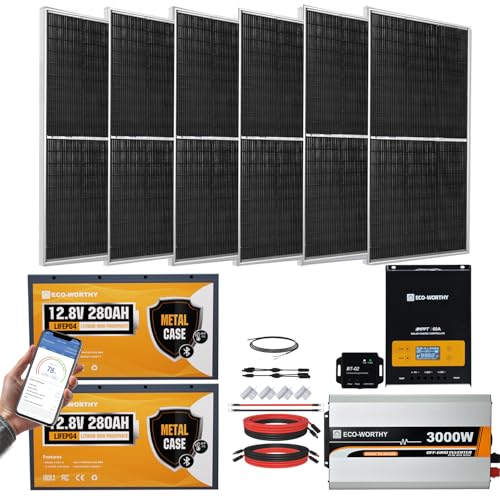
This compact, portable kit pairs six 195W panels with a 60A MPPT controller and a 3000W pure sine wave inverter. It also includes two 12.8V 280Ah Li batteries for extended storage. It is best for RV owners, cabins, or small homes needing reliable off-grid power without a large footprint. The dual-axis tracker in some configurations can boost daily energy output by more than 40%, improving efficiency in limited sun, but it adds mechanical complexity to installation.
Best for: travelers and small households seeking a balanced mix of portability and performance. Better for: RVs and tiny homes where space and weight matter. Avoid if: permanent, full-home backup is the primary goal, since larger setups offer more headroom for appliances.
ECO-WORTHY 5KW Off Grid Solar System Complete Kit

The 5KW Off Grid Kit combines 12×195W panels, a 5KW split-phase inverter, and a 51.2V 100Ah LiFePO4 battery bank. It’s designed for complete independence from the grid with straightforward parallel operation for larger capacity. The kit emphasizes safety, compliance with UL standards, and practical wiring, making it a strong all-in-one option for mid-sized homes or remote cabins.
Best for: homes needing substantial off-grid capability with scalable battery storage. Choose this if you want a modular, easy-to-wire solution that can be expanded by adding more inverters in parallel. Limitation: the single inverter path may limit peak-surge handling for very large loads unless properly managed.
ECO-WORTHY 200 Watt Starter Kit
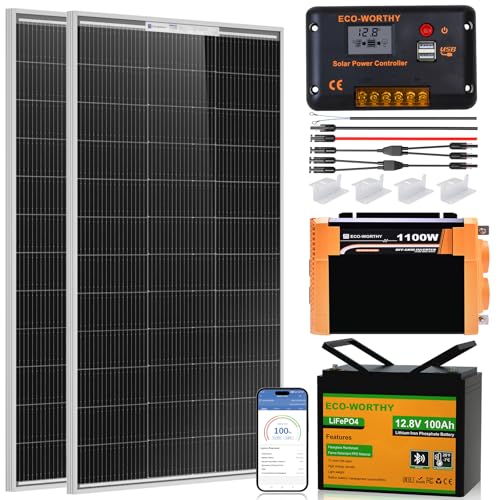
The 200W Starter Kit provides a compact off-grid solution ideal for RVs or small cabins. It includes two 100W panels, a 100Ah Li battery, a 1100W inverter, and a 30A PWM controller. It’s designed for 800Wh daily generation and 1.28KWh storage, sufficient for essential devices. The kit’s simplicity makes it attractive for beginners or hobbyists seeking a quick, low-cost entry into solar power.
Best for: beginners and RV users wanting a simple, ready-to-go system. Better for: small loads and initial experimentation with solar power. Avoid if: you need to power multiple heavy appliances simultaneously, as capacity is limited.
ECO-WORTHY 10kW All-In-One Home System

This high-capacity system pairs a 10kW inverter with 4×590W solar panels and dual LiFePO4 batteries to deliver robust power for everyday home loads. It targets households seeking reliable daytime generation and substantial storage for outages. The configuration supports various flexible charging and output modes, Wi-Fi monitoring, and parallel operation with other units for future expansion.
Best for: homes needing substantial, reliable off-grid power with scalable expansion. Better for: longer outages or homes with high-energy demands. Limitation: installation may require professional assistance to ensure proper wiring and safety compliance.
Buying Guide
Choosing a complete solar system requires aligning capacity with your daily energy needs and available space. Consider the following questions:
- What is my daily energy consumption in kilowatt-hours (kWh)? Choose systems with a daily output that comfortably covers this amount, plus a margin for cloudy days.
- Do I need grid-tied or off-grid operation? Off-grid kits include battery storage and inverters designed for independence, while grid-tied setups may rely on the utility and offer cheaper deployment.
- Is battery chemistry important? Li-ion (LiFePO4) cells provide longer life and better safety than traditional lead-acid, but come at a higher upfront cost.
- What is the acceptable footprint and installation type? Wall-mount, floor-standing, or portable options determine panel count and mounting hardware requirements.
- How scalable should the system be? If future expansion is likely, choose a kit that supports parallel units or modular inverters.
- What certifications matter? Look for UL 1741/UL 1973/UL 9540A compliance for safety and market access.
FAQ
- What does kW versus kWh mean in solar kits? Power (kW) is the rate at which equipment consumes energy; energy (kWh) is the total amount used or generated over time.
- Can I run a full-home load off a solar kit? Larger systems with enough PV capacity and battery storage can support a substantial portion of home loads, but may require additional components for heavy usage.
- What is MPPT and why does it matter? Maximum Power Point Tracking optimizes solar charging by adjusting for sunlight conditions, increasing efficiency compared with PWM controllers.
- Is parallel powering safe? Parallel configurations allow higher total capacity but require proper balance and professional setup to manage voltages and safety features.
- Do these kits require professional installation? For many off-grid and high-power configurations, professional electrical work is recommended to ensure safety and code compliance.
- Will these systems work during winter or low-light days? Energy generation declines with less sun, but larger battery storage and higher panel efficiency help maintain supply; plan for seasonal variance.