
Best Single Phase Digital Energy Meters for Accurate Power Tracking
Need a reliable single-phase digital energy meter for sub-metering, RV setups, or home projects? This guide compares five well-suited options, highlighting who each product is best for and why. All selections support 120/240V single-phase systems and provide clear kWh readings for billing, monitoring, or solar integration. Ideal buyers include landlords managing multi-tenant units, DIY enthusiasts upgrading electrical panels, and cabin or RV owners tracking energy use.
Product snapshot (quick reference):
| Product | Best For | Key Benefit | Limitation |
|---|---|---|---|
| Digital Electric Sub Meters for Landlords | Rental properties, multi-tenant spaces | Sub-metering with Modbus and EEPROM memory | May require professional wiring for complex systems |
| KETOTEK Single Phase Energy Meter | General home use, small offices | 6-in-1 measurements; data retention during power loss | Basic non-WiFi model; external CTs may be needed for high current |
| BAOMAIN DDS238-4-R Submeter | Precise, budget-conscious monitoring | Wide current range; clear LCD | External CTs required for continuous high current |
| Walfront Single Phase Energy Meter | Budget projects with basic needs | Compact, microelectronics-based reading | Limited feature set; clarity may vary by environment |
| QWORK 6-in-1 DIN Rail Meter | Solar, RVs, and distribution boxes | Color LCD, data storage during outages | Non-WiFi; readings depend on proper installation |
Digital Electric Sub Meters for Landlords
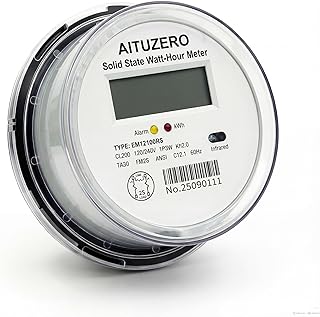
Best for: landlords and property managers needing fair billing across tenants. Why: supports sub-metering on a 120/240V single-phase system with a 4-jaw ANSI 2S fit for quick install. Features include pulse output, reverse LED indicators, and EEPROM memory to retain data during outages. This meter is designed to snap into standard form 2S bases, making it suitable for RV pads, garages, and rental units. Caution: ensure the sub-panel wiring remains within code and that correct line/load/neutral connections are made to avoid inaccurate readings.
KETOTEK Single Phase Energy Meter
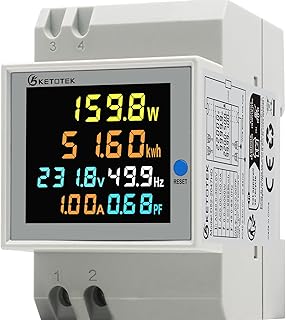
Best for: general home use or light commercial monitoring. Why: it offers six capabilities in one device, including voltage (40-300V) and current (0-100A) measurements, active power, energy, frequency, and PF. It stores data during power loss and has a reset function. Limitation: data accuracy and reliability depend on proper wiring; external CTs may be needed for higher currents beyond built-in range.
BAOMAIN DDS238-4-R Submeter

Best for: precise home energy monitoring with 110V/220V split-phase compatibility. Why: this DIN-rail meter supports 10(100)A ranges, 60Hz operation, and a clear LCD display with pulse output for straightforward tracking. It’s a solid pick for sub-metering in residential or light-commercial settings. Caution: no built-in WiFi or smart features; consider external solutions for remote data access. External CTs are required for high-current continuous loads beyond the base rating.
Walfront Single Phase Energy Meter

Best for: budget-conscious buyers seeking basic digital readouts. Why: emphasizes microelectronics and digital processing for accurate measuring in a compact DIN-rail package. Limitation: the feature set is more limited compared to higher-end meters, so advanced data logging or remote monitoring may require additional hardware or software integration. Ensure proper installation to avoid electromagnetic interference issues.
QWORK Digital DIN Rail 6-in-1 Meter

Best for: solar, RV, and home distribution box setups requiring multi-parameter monitoring. Why: provides simultaneous tracking of voltage, current, active power, energy, frequency, and power factor on a vivid color LCD. It includes automatic data storage during outages and uses a flame-retardant ABS shell for safety. Limitation: non-WiFi, so remote data access requires an ancillary solution; installation quality strongly affects LCD readability in tight panels.
Buying Guide
What should guide your choice when shopping for a single-phase digital energy meter?
- Measurement scope: Do you need voltage, current, power, energy, frequency, and power factor in one device? Look for 6-in-1 or similar capabilities for comprehensive tracking.
- Wiring and form factor: If you’re upgrading in a sub-panel or RV site, choose meters with DIN rail mounting or ANSI 2S compatibility for simple integration.
- Data retention and logging: Some meters store data during outages (EEPROM or internal memory). This is crucial for accurate post-event billing and usage history.
- Connectivity: WiFi or Modbus options enable remote monitoring. If you don’t need remote access, a non-smart meter reduces complexity and cost.
- Current range and CT needs: Verify the meter’s current rating and whether external current transformers are required for your loads.
- Display clarity: A bright LCD or color display helps readability in tight electrical boxes or dim cabinets.
- Safety and certification: Ensure flame-retardant housing and proper electrical ratings align with your installation environment.
Common Scenarios And Recommendations
- Rental properties with multiple tenants: The Digital Electric Sub Meters for Landlords provides sub-metering with clear billing data and is designed for easy tenant-specific usage tracking.
- Residential homes and small offices: KETOTEK and BAOMAIN meters cover core monitoring needs with reliable readings, though some models lack wireless connectivity.
- Solar or off-grid setups: QWORK’s 6-in-1 meter suits mixed-use systems where tracking power flow and energy exchange is essential, even without built-in wireless.
FAQ
- What is a single-phase digital energy meter used for?
It measures electrical parameters like voltage, current, and energy to monitor power usage in 120/240V systems. - Do these meters require professional installation?
Many are designed for standard form bases or DIN rail mounting; professional wiring is advised for safety and accuracy. - Can I monitor energy remotely with these meters?
Some models offer Modbus or other data interfaces; others are non-smart and store data locally only. - What is sub-metering and who should use it?
Sub-metering allocates power usage to individual tenants or circuits, useful for fair billing in multi-unit buildings. - Are there limits on current for these meters?
Most meters specify a maximum current (often 10A to 100A); exceeding the rating requires external CTs or a higher-capacity meter. - Do these meters work with solar systems?
Some meters track solar input and export; verify model capabilities like reverse-flow indicators or feed-through options.