
Best Self Testing Emergency Lights for Safer Buildings
Self-testing emergency lights simplify life safety compliance by automating monthly and annual checks. This article reviews five highly regarded models that self-test, remain UL listed, and offer durable construction for indoor commercial use. We compare features, power options, and installation considerations to help facility managers choose the right solution for stairways, hallways, and egress paths.
| Product | Power & Heads | Test & Compliance | ideal Use |
|---|---|---|---|
| LFI EL-2-W-ST | Two adjustable LED square heads; hardwired with battery backup | UL924; NFPA 101; NEC; OSHA | |
| LFI EL2WST | Adjustable LED heads; battery backup | UL924; NFPA 101; auto self-test | |
| Lithonia EU2C CP4 | Dual adjustable heads; 120/277V | 90-minute backup; damp rated | |
| FREELICHT Exit Sign Combo | Two LED heads; exit sign integration | UL listed; 90-minute backup | |
| FREELICHT 4 Pack | Two-head emergency lighting; hard wired | UL 924; 120/277V |
LFI Lights Self Testing Emergency Light, White, Two LED Heads

The LFI EL-2-W-ST combines a white housing with two adjustable LED heads for versatile coverage. It is designed for indoor installation by qualified electricians and features a lightweight, fire-retardant thermoplastic housing. The unit is UL listed and engineered to meet or exceed key life-safety standards including UL924, NEC, OSHA, and NFPA 101. Its self-testing capability helps ensure compliance without manual checks, supporting reliable emergency illumination during outages.
Key features
- UL 924 listed; NFPA 101, NEC, OSHA compliant
- Indoor use only; requires professional installation
- 5VA flame retardant housing; lightweight construction
LFI Lights Self Testing LED Emergency Light, Hardwired with Battery Backup

This LFI model offers UL 924 listing and meets essential life-safety codes, while being damp location rated for varied indoor environments. It operates on 120/277VAC and features a long-life 3.6V NiCd battery with a self-test function that flags failures and automatically rechecks. The dual-head LED design delivers 80.9 lumens per head, providing clear coverage along key egress routes.
Key features
- 120/277VAC 60Hz operation; low power consumption
- Self-test with failure indication; automatic NFPA testing
- Durable thermoplastic housing; damp location suitability
Lithonia Basics LED Emergency Light, Dual Heads, Damp Rated

The Lithonia Basics unit is ideal for stairways and hallways, providing 90 minutes of backup power with a built-in test switch and status indicator. Dual adjustable LED heads (5000K-9000K CCT) deliver bright, focused illumination along 3–6 foot paths. With a 10-year LED lifespan and durable construction, this damp-rated fixture is designed for reliable long-term operation and straightforward installation.
Key features
- Dual adjustable heads; 90-minute backup
- Doors or walls: wall-mountable; damp rated
- High-quality optics and long LED life
FREELICHT 6 Pack Red Exit Signs With Emergency Lights
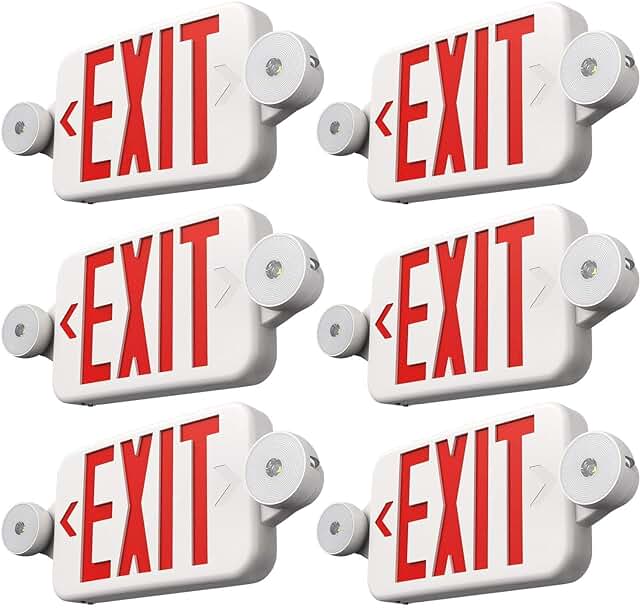
This 6-pack combines exit signs with emergency lighting, offering two LED adjustable heads and a battery backup. The housing is injection-molded and 5VA flame retardant, designed to withstand demanding environments and power outages. It is UL listed and supports flexible installation, suitable for ceiling or back mounting in various commercial spaces.
FREELICHT Emergency Lights for Business, Two-Head, Battery Backup

The FREELICHT four-pack emphasizes safety and ease of installation, featuring two adjustable LED heads for broad coverage. The units are UL 924 compliant and hard-wired for reliable performance during outages. The back plate is compatible with standard junction boxes, enabling streamlined installation across multiple commercial areas such as hallways and stairwells. A built-in battery backup supports essential lighting during power failures.
Buying Guide: Key Considerations For Self-Testing Emergency Lights
- Compliance and testing: Look for UL 924 listing and NFPA 101 compatibility. Self-testing functionality reduces manual maintenance and ensures timely alerts for failures.
- Power options: Choose between battery backup (NiCd or similar) and hardwired AC input (120/277V). Consider whether a damp location rating is needed for indoor environments such as basements or stairwells.
- Light distribution: Dual adjustable LED heads offer flexible coverage. Check lumen output per head and color temperature to ensure adequate visibility along egress paths.
- Durability and installation: Seek flame-retardant, impact-resistant housings with straightforward installation. Verify compatibility with standard junction boxes and mounting surfaces.
- Location planning: Match the number of heads and placement with hallway length, stair width, and occupancy to optimize emergency illumination.
- Maintenance features: Self-test indicators and remote monitoring capabilities simplify ongoing upkeep and reduce downtime during inspections.
- Energy efficiency: Units with low wattage consumption help reduce operating costs while preserving battery life for longer outages.
- Backup duration: Most units provide around 90 minutes of backup; verify that the total capacity meets your building’s egress requirements and local codes.