
Best Schedule 40 PVC Conduit Fittings for DIY Electrical Projects
If you’re planning a project involving Schedule 40 PVC conduit fittings, this guide helps you pick reliable options for indoor or outdoor wiring runs. The focus is on practical, code-aligned choices suited for DIYers, contractors, and property managers seeking durable and easy-to-install fittings. Each top pick is explained with its best-use scenario, so you can decide quickly which product fits your task. The table below highlights the five selected items and their primary uses to simplify your comparison.
| Product | ||
|---|---|---|
| CKVIHAV 6Pcs 1/2 Inch Conduit | 1/2″ Schedule 40, 17″ length | Garage or garden wiring, easy DIY runs |
| Carlon UA9AHB-CTN 1-1/2″ Elbow | 1-1/2″, 90° Schedule 40 | Corner wiring turns with Bell End |
| LB2 2″ PVC Type LB Conduit Body | 2″ Type LB, Gray | Conduit runs needing rear access for wires |
| 1-1/4″ Schedule 40 PVC Conduit Pipe | 1-1/4″ (OD 1.66″, ID 1.335″), 12″ long | Rigid, UV-resistant outdoor or burial applications |
| 45 Degree PVC Conduit Sweep Elbow 1-1/4″ | 1-1/4″ diameter, 45° bend | Smooth directional change for easy wire pulling |
CKVIHAV 6Pcs 1/2 Inch Grey Electrical Conduit PVC Pipe

The 1/2 inch Schedule 40 PVC conduit pipe has an outer diameter of 0.84 inches and an inner diameter of 0.64 inches. It is suitable for DIY projects and cable sleeves. This conduit offers good electrical insulation and is easy to install with primer and solvent cement. Best for small-scale DIY wiring runs in home workshops or gardens. Caution: confirm exact length and fit before cutting to avoid waste.
Carlon UA9AHB-CTN 1-1/2″ 90° Schedule 40 Elbow With Bell End

Best for turning a conduit run 90 degrees with a bell end for a secure, smooth pull. The 1-1/2″ elbow is suitable for mid-sized wiring paths in garages or basements. Selected for its standard Schedule 40 compatibility and ease of installation. Caution: ensure the bell end and coupling match your conduit diameter for a tight seal.
LB2 (RSLB60S) 2″ PVC Type LB Conduit Body

Best for conduit runs needing a 90° turn with rear access for pulling and maintenance. Made from durable PVC, it resists corrosion and moisture, and is weatherproof for outdoor installations. Choose this if you need accessible wiring and a robust, non-metallic fit. Limitation: ensure space around the rear access for wire routing in tight installations.
1-1/4 Inch Schedule 40 PVC Conduit Pipe
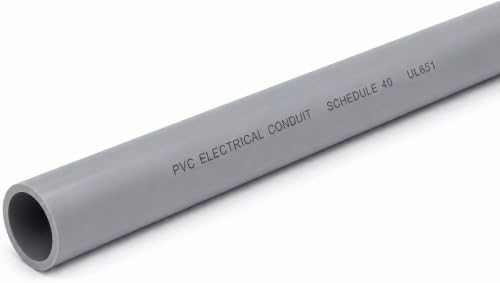
Best for professional-grade rigidity and protection. This RNC is ETL listed, UL 651 compliant, and UV resistant, suitable for direct burial or concrete encasement. Suitable for outdoor runs or moisture-prone areas. Limitation: ensure 90°C conductor compatibility and code compliance for your installation environment.
45 Degree PVC Conduit Sweep Elbow 1 1/4 in (5 Pack)

Best for a smooth 45° bend in 1-1/4″ conduit runs to reduce wire pulling resistance. Constructed from durable PVC with resistance to corrosion and moisture. Choose this pack when multiple bends are needed in outdoor or underground installations. Limitation: not suitable for very tight spaces where longer bends are required.
Buying Guide: Key Purchase Considerations
What size do you need? Select conduit and fittings to match your wiring gauge and installed conduit diameter. For buried or outdoor runs, UV resistance, weatherproofing, and compliance with UL/NEMA standards matter. How will you route wires? Consider fittings that offer easy access for pulling and maintenance, such as conduit bodies with rear access. Are you replacing metal with PVC? PVC is corrosion-resistant and non-conductive, but confirm that it meets local codes and conductor temperature ratings. Do you require fittings with bells or threaded ends? Bells aid secure connections, while threadless designs rely on solvent cement for a seal. What is your installation environment? Coastal or chemical-rich areas benefit from higher chemical resistance in PVC.
FAQ
- What is Schedule 40 PVC conduit used for? Schedule 40 PVC conduit provides rigid, corrosion-resistant protection for electrical wires in indoor and outdoor applications, including underground burial when rated.
- Is PVC conduit suitable for outdoor use? Yes, PVC conduit with UV inhibitors resists direct sunlight and moisture, making it suitable for outdoor installations.
- Do I need a conduit body? Conduit bodies with access (like Type LB or LL) are helpful for pulling wires through turns and for maintenance access in long runs.
- Which size should I choose for residential wiring? Common residential sizes include 1/2″, 3/4″, 1″, 1-1/4″, and 2″ depending on wire count and future expansion; match to conductor capacity and local code.
- Can I mix fittings from different brands? Yes, if the fittings share the same Schedule 40 PVC standard and diameter, but ensure compatibility to maintain a secure, code-compliant system.
- What installation method is recommended? For PVC conduit, use primer and solvent cement for a secure joint, and follow local code for burial or outdoor installation.