
Best RV Solar System Kit for Off-Grid Power and Convenience
Finding the right RV solar system kit can simplify off‑grid camping, reduce generator use, and keep essential appliances running reliably. This article reviews five top kits that pair solar panels with controllers, inverters, and batteries for diverse RV setups. Each section includes a concise product overview, key features, and usage considerations to help you compare options—from compact portable kits to larger, more capable systems.
| Product | Brand |
|---|---|
| ECO-WORTHY 200 Watts 12V/24V Kit | ECO-WORTHY Store |
| ECO-WORTHY 7.168KWH 800W Kit | ECO-WORTHY Store |
| DOKIO 300W Portable Foldable Kit | DOKIO Store |
| ECO-WORTHY 200W Complete Starter Kit | ECO-WORTHY Store |
| Renogy 200W RV Kit | Renogy |
The following sections highlight five kits that fit a range of RV needs—from weekend trips to extended off‑grid stays. Consider panel wattage, battery type, inverter capacity, and ease of installation as you compare options for your RV lifestyle.
ECO-WORTHY 200W Kit With 30A PWM Controller

This compact 200W solar kit is designed for RVs, campers, and off‑grid vehicles. It includes a high‑efficiency mono panel and a 30A PWM charge controller, offering straightforward wiring for users new to solar power. The system is described as capable of daily outputs in favorable sun, with a focus on reliable charging for 12V systems. It’s well-suited for owners who want a simple, cost‑effective upgrade to reduce generator runs and provide steady lighting and small appliance charging in sunny conditions.
Key considerations: installation space, panel orientation, and environment (shaded areas can reduce output). The kit’s corrosion‑resistant frame and IP65‑rated junction box contribute to durability for seasonal RV use. If your power needs include a small fridge, modest lighting, and phone charging, this kit can cover daily essentials during peak sun hours.
800W Complete Off‑Grid RV Solar System Kit

This comprehensive 800W kit targets RV owners seeking a robust off‑grid solution. It features four 200W bifacial panels, a 3000W inverter/charger, lithium storage, and a 60A MPPT controller with Bluetooth. The design emphasizes rapid power conversion, the option to charge from mains, and a broad load-ready capacity for RV appliances, including larger refrigeration and climate systems. It is positioned as a novice‑friendly, all‑in‑one solution that minimizes DIY complexity while delivering substantial energy storage.
Key considerations: installation space and weight, warranty coverage, and whether your typical trips justify the larger solar footprint. The lithium storage helps with longer camping seasons where daily energy needs exceed basic charging, but initial setup and weight should be planned to ensure RV payload limits are not exceeded.
DOKIO 300W Portable Foldable Kit
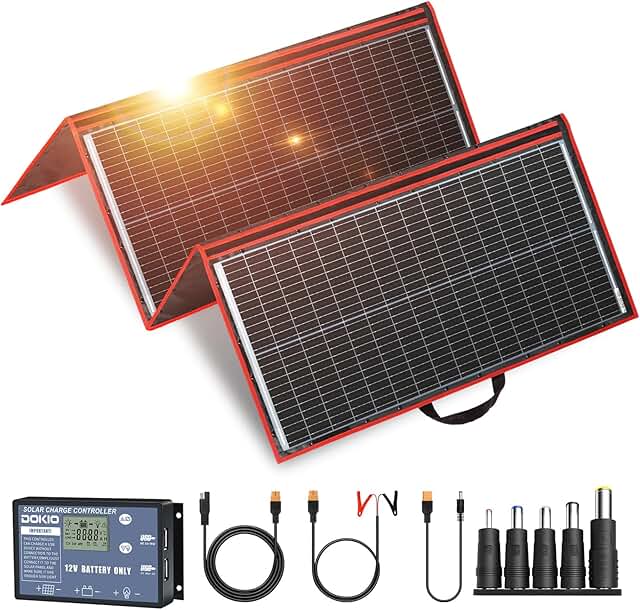
This portable 300W kit prioritizes travel flexibility. Its foldable design and light weight (around 15.2 lb) make it easy to transport and set up on an RV, van, or boat. It includes a standalone PWM controller, which helps protect a 12V system from reverse polarity and other fault conditions. A long 9.85 ft cable allows the panel to bask in maximum sun while the controller stays shaded for safer operation. This setup is ideal for campers who need quick deployment and the option to move the panel between sunlit and shaded areas.
Key considerations: whether you require battery storage integration or simply supplementary solar to top up a battery. The standalone controller is a safety feature, but you’ll still need to manage storage and loads to prevent overdischarge during extended cloudy periods.
ECO-WORTHY 200W Complete Starter Solar Kit

This starter kit provides a one‑stop solution for RVers seeking an all‑in‑one package. It includes two 100W panels, a 12.8V 100Ah lithium battery, an 1100W inverter, a 30A PWM controller, and necessary cabling. The package is pitched as novice‑friendly with a straightforward four‑step installation process designed to reduce DIY friction. The 800Wh of daily potential and 1.28KWh storage offer practical off‑grid operation for weekend trips or extended stays with minimal grid access.
Key considerations: storage capacity relative to your energy profile (refrigeration, hot water, and climate control). Battery type and capacity influence cycle life and weight. Verify compatibility with your RV’s electrical system and ensure you have adequate space for safe battery placement and ventilation.
Renogy 200W Kit With Adventurer Controller

The Renogy kit is a recognized option for RVs seeking higher reliability with a proven track record. This kit typically includes a 200W monocrystalline panel and a 30A LCD PWM charge controller, along with mounting brackets and accessories. The Adventurer controller adds a user-friendly interface for monitoring charge status and battery health. It is well suited for RVers who want a balanced setup that is easy to install, offers solid performance, and integrates neatly with common RV electrical configurations.
Key considerations: expected sun exposure, panel tilt, and the compatibility of the included hardware with your RV roof mounting. A PWM controller is simple and reliable but may be outperformed by MPPT controllers in partial‑sun conditions. If your trips involve long days of driving and variable sun, pairing this kit with a suitable battery bank will maximize daily energy usage.
Buying Guide: Key Purchase Considerations

When selecting an RV solar kit, evaluate energy needs, space, and weight. Consider panel wattage relative to roof area and typical sunlight in your cruising regions. Battery technology (lithium vs. lead-acid) affects weight, cycle life, and maintenance. Inverter capacity should align with high‑draw appliances like air conditioners and microwaves. MPPT controllers optimize energy harvest in variable conditions, but PWM controllers remain a solid choice for simpler, lower‑cost setups. Plan for expansion by leaving room for additional panels or a larger battery bank if trips intensify or refrigeration needs grow.
Durability features are important: weatherproof enclosures, corrosion‑resistant frames, and secure mounting hardware help RV setups withstand road use and varying climates. If you travel in northern or mountainous regions where sun intensity changes with seasons, a robust energy storage option (such as lithium) and proper battery management are essential for reliability. Assess service and warranty terms to protect your investment during remote excursions.
What to compare across kits
- Panel wattage and type (monocrystalline vs polycrystalline)
- Battery type and capacity (lithium vs AGM/Lead‑Acid)
- Inverter rating and continuous power output
- Charge controller type (PWM vs MPPT)
- Weight, dimensions, and mounting considerations for RV roof space
Across these five options, you’ll find a spectrum—from compact, easy‑to‑install systems to larger, more feature‑rich configurations. The best choice depends on your typical travel style, climate, and how much you rely on RV appliances during off‑grid periods. Each kit aims to offer a practical balance of ease, performance, and durability to support steady, sustainable RV power.