
Best RV Inverter Chargers for Lithium Batteries
Choosing the right RV inverter charger is essential for reliable off-grid living or comfortable travel. This guide spotlights five top options designed to work with lithium batteries, offering smart charging, stable power, and compatibility with common RV electrical setups. Each unit converts 120V AC shore power to 12V DC while charging lithium batteries, and many also provide UPS-style backup and adjustable voltage control. Use the quick reference below to compare capacities, features, and suitability for your rig.
| Product | Brand | Amps | Key Feature |
|---|---|---|---|
| RecPro RV Power Converter 55 Amp | RecPro | 55 Amp | 4-stage smart charging; lithium-compatible |
| ECO-WORTHY 3000W 12V Inverter Charger | ECO-WORTHY | 25-100 A (adjustable) | 2-in-1 inverter and charger with UPS mode |
| VEVOR RV Converter 80 Amp | VEVOR | 80 Amp | 4-stage charging; Li-compatible modes |
| PowerMax 55 Amp RV Converter | PowerMax | 55 Amp | 4-stage smart charging; adjustable 13–16.5V |
| LATCH.IT 75 Amp RV Power Converter | LATCH.IT | 75 Amp | 3-stage charging with fixed voltage option for LiFePO4 |
RecPro 55 Amp RV Power Converter

RecPro’s 55 Amp model is designed to convert shore power to 12V DC while charging your RV battery. It supports a broad 13V to 16.5V operating range and powers low-voltage lights and appliances simultaneously. The unit comes in several capacities, including 55 Amp, offering flexible options for mid-sized RV systems. Its three- or four-stage charging approach helps optimize lithium battery health and longevity by regulating voltage and current during charging cycles. This versatility makes it a practical choice for RV owners seeking dependable lithium compatibility with a familiar form factor.
VEVOR RV Converter 80 Amp

VEVOR’s 80 Amp RV converter provides a robust power conversion from 120V AC to 12V DC with four-stage charging and an adjustable output range from 13.0V to 16.5V. It includes dedicated modes for different battery types, including LiFePO4, AGM, and lead-acid, enabling optimized charging curves for lithium batteries. The higher current capability supports larger battery banks and more demanding RV loads, making it suitable for longer trips or bigger rigs where lithium performance is critical. It aligns well with lithium systems that require precise voltage control and reliable backup power.
PowerMax 55 Amp RV Converter

PowerMax’s PM4 55A converter combines a 12V AC to DC power conversion with a built-in four-stage battery charging system. Its adjustable output from 13V to 16.5V ensures compatibility with lithium and other battery chemistries, while the smart charging stages help preserve battery life by controlling bulk, absorption, float, and equalization phases. This unit is marketed for RVs, boats, and off-grid setups, delivering reliable performance in compact spaces and serving as a practical option for lithium-ready systems that demand stable, regulated charging and supply.
LATCH.IT 75 Amp RV Power Converter
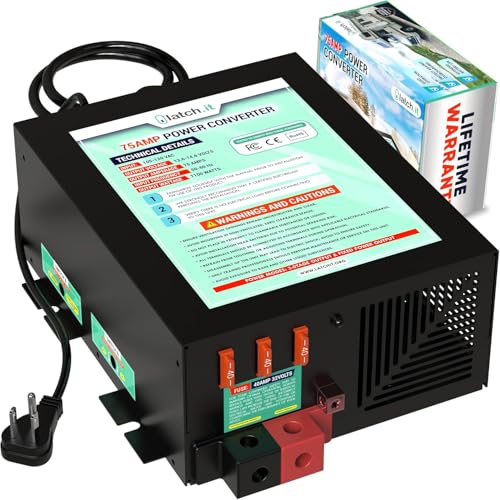
LATCH.IT’s 75 Amp converter focuses on flexibility for various battery chemistries, offering a three-stage charging mode for lead-acid and a fixed-voltage mode suitable for LiFePO4 lithium batteries. This dual approach enables users to adapt charging to their battery type while maintaining overall system safety. The unit provides 120V AC shore power to a clean 12V DC output and includes protections to safeguard against overheating and overloading. This model is a capable pick for RV setups that require a balance of adaptability and battery longevity, especially when lithium options are prioritized.
Buying Guide: Key Purchase Considerations
- Battery compatibility: Confirm lithium battery support (LiFePO4, Li-ion, or other lithium chemistries) and whether the charger has dedicated modes or fixed-voltage options for lithium packs.
- Charging stages and safety: Look for 3- or 4-stage charging (bulk, absorption, float, and possibly equalization) to optimize battery health and lifespan. Overcharge protection and temperature monitoring are valuable safety features.
- Voltage and current range: Ensure the unit’s output voltage (typically 13V–16.5V) matches your lithium battery requirements, and that the amperage (e.g., 55A, 75A, 80A) aligns with your battery bank size and expected load.
- UPS and pass-through features: Some models include UPS-like behavior, providing temporary power when grid power is interrupted. This is beneficial for essential loads in an RV living area.
- Size, installation, and wiring: Consider space constraints in your RV cabinet and ensure the unit’s wiring can handle the selected amperage. Some units are designed as drop-in replacements for existing converters.
- Warranty and service: A longer warranty, such as a 5-year coverage, can be an indicator of product reliability and post-purchase support.
- Brand ecosystem and support: Reputable brands with accessible customer service can simplify installation and troubleshooting in the field.
- Price-to-performance ratio: Compare total features (multiple battery types, adjustable voltage, safety protections) relative to the unit’s cost to determine the best value for your setup.
Choosing Between Models: Quick Perspective
For mid-sized lithium setups that need reliable charging with solid protection, the RecPro 55 Amp and PowerMax 55 Amp offer familiar form factors with robust charging logic. If you require higher current for larger battery banks or heavier RV loads, the VEVOR 80 Amp delivers more headroom and dedicated Li-ion modes. For flexible configurations, ECO-WORTHY’s 3000W 2-in-1 unit provides an all-in-one solution with UPS-style behavior, while LATCH.IT 75 Amp emphasizes adaptable voltage control for LiFePO4 batteries and safety protections. Each option balances compatibility, protection, and practical RV usability.