
Best RV Batteries for Solar: Top Choices for Reliable Power on the Road
If you rely on solar to power an RV, choosing a dependable battery is essential. The following selections are designed for off-grid living, boondocking, and mobile living, offering varied chemistries, capacities, and protections. This guide highlights 5 batteries well-suited for RV solar setups, compared on energy density, cycle life, and environmental tolerance to help you pick the right match for your system.
| Product | Brand | Chemistry | Capacity | Key Benefit |
|---|---|---|---|---|
| GRNOE 12V 100Ah LiFePO4 | GRNOE | LiFePO4 | 100Ah | Low-Temp Protection; long life |
| WEIZE 12V 100Ah AGM | WEIZE | AGM | 100Ah | Maintenance-free; low self-discharge |
| Renogy 12V 100Ah AGM | Renogy | AGM | 100Ah | Safety; versatile for series/parallel |
| ECO-WORTHY 3584Wh 280Ah LiFePO4 | ECO-WORTHY | LiFePO4 | 280Ah (3584Wh) | Smart monitoring; real-time data |
| Rvpozwer 12V 300Ah LiFePO4 | Rvpozwer | LiFePO4 | 300Ah | High cycle life; scalable |
Note: Product features are representative of the listed items and may include model-specific protections and monitoring capabilities. Always verify compatibility with your solar controller and inverter before purchase.
GRNOE 12V 100Ah LiFePO4 Battery

The GRNOE 12V 100Ah LiFePO4 battery offers a compact footprint with high energy density. Weighing about 22.5 pounds, it delivers a space-efficient option for RV solar setups where weight and space matter. A built-in BMS provides protection against overcharge, over-discharge, and short circuits, while low-temperature protection helps operate in cold environments. Note that a proper charger voltage (around 14.6V) is needed for full charging, and the unit ships as single batteries per box, which can affect multi-pack shipments if ordered together.
WEIZE Deep Cycle AGM 12V 100Ah Battery
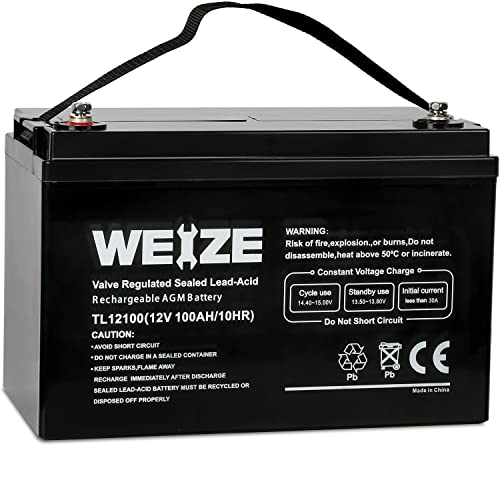
The WEIZE AGM 12V 100Ah battery provides maintenance-free operation with a low self-discharge rate. Its sealed design minimizes acid leakage and reduces upkeep, making it a practical option for RV solar systems. Suitable for stored energy in varied temperatures, it offers reliable performance for extended boondocking periods. Temperature ranges and discharge limits indicate solid all-around use, especially when paired with a compatible solar charge controller and inverter in RV installations.
Renogy Deep Cycle AGM 12V 100Ah Battery

Renogy’s AGM 12V 100Ah battery is a trusted option with high safety standards and a sealed design. It supports series and parallel configurations (up to four in parallel) to scale capacity for larger RV solar arrays. Its reputation and global presence come with robust safety features and straightforward maintenance, making it a dependable choice for off-grid power without the complexities often associated with other chemistries.
ECO-WORTHY 3584Wh 12V 280Ah LiFePO4 Battery

This ECO-WORTHY LiFePO4 battery combines a high capacity with a built-in 200A BMS and Bluetooth real-time monitoring. The system supports remote tracking of voltage, current, and remaining capacity via the ECO-WORTHY app, which can simplify management of larger RV solar setups. Features include a durable internal frame for shock protection and a protective low-temperature cutoff to prevent charging below critical temperatures, ensuring resilience in varied climates.
Yeagulch 12V 300Ah LiFePO4 Battery

The 12V 300Ah LiFePO4 battery from Yeagulch targets RVs seeking extended energy storage with high cycle life. With a built-in 200A BMS and protections against overcharge, over-discharge, and short circuits, this option supports scalable configurations for larger power needs. Its 300Ah capacity makes it suitable for longer off-grid trips where solar input is steady but sun exposure varies daily.
Rvpozwer 12V 300Ah LiFePO4 Battery

Rvpozwer’s 300Ah LiFePO4 battery emphasizes lifespan and reliability, offering up to 15,000 cycles at lower depths of discharge. The 200A smart BMS guards against common faults, and the design supports parallel and series configurations to reach higher voltages or capacities. This model is positioned for robust RV solar systems requiring long-term performance, especially in off-grid environments with varied loads.
Buying Guide: Key Considerations For RV Solar Battery Purchases
- Chemistry: LiFePO4 (lifepo4) batteries offer long cycle life, lighter weight, and stable performance, but typically cost more than AGM. Consider LiFePO4 for boondocking and extended trips, or AGM for budget-friendly, straightforward setups.
- Capacity and depth of discharge: Higher Ah ratings extend runtime between charges. Be mindful of the recommended depth of discharge (DoD) to maximize life; LiFePO4 generally allows deeper DoD safely than lead-acid.
- Battery management system (BMS): A capable BMS protects against overcharge, over-discharge, current spikes, and short circuits. Some BMS units include low-temperature cutoffs, auto-balancing, and smartphone monitoring.
- Temperature tolerance: Cold or hot climates can impact performance. Low-temperature protection ensures safe charging and helps prevent damage in winter months.
- Weight and size: RV space is finite. LiFePO4 offers good energy density, but verify dimensions and weight to fit existing compartments and weight limits.
- Charging compatibility: Check charger voltage requirements and solar controller compatibility. Some LiFePO4 packs require higher charge voltages (e.g., around 14.6V) for full capacity.
- System integration: Plan for parallel or series configurations to reach the desired system voltage and capacity. Ensure the chosen battery aligns with your inverter and solar array size.
- Maintenance: AGM batteries are maintenance-free, but LiFePO4 still requires proper charging practices and periodic system checks. Consider monitoring options (Bluetooth, app-based) if you value remote data access.
- Cost of ownership: Although LiFePO4 cells cost more upfront, longer cycle life can reduce total cost of ownership in the long run.