As an Amazon Associate I earn from qualifying purchases. These links may earn this site a commission when you buy, at no extra cost to you.
Choosing the right ripping blade can dramatically improve table saw performance, especially when working with hardwoods or dense plywood. The following selections emphasize high-density carbide, precise grind patterns, and kerf optimization to maximize feed rate, reduce waste, and deliver smooth, glue-ready edges every time.
| Product | Brand | Key Features |
|---|---|---|
| Freud Thin Kerf Rip Saw Blade | Freud | Low-power optimization, TiCo carbide, thin kerf for faster feeding |
| Freud Heavy-Duty Rip Saw Blade | Freud | Rigid body, TiCo carbide, extra-large flat teeth for smooth finishes |
| CMT ITK Ripping Blade | CMT Orange Tools | Thin kerf, 0.102 kerf, 10° hook, versatile for soft/hardwood |
| Freud Industrial Glue Line Ripping | Freud | Thick kerf, triple chip design, durable and glue-line ready |
| FOXBC Thin Kerf Ripping Blade | FOXBC | Thin kerf, 24-tooth FTG, high-density carbide for smooth cuts |
Freud Thin Kerf Rip Saw Blade

Freud’s LU87R010 thin kerf blade is optimized for underpowered saws, reducing horsepower needs while maintaining clean, consistent rip cuts. The Premium TiCo Carbide Blend delivers edge retention and durability for tough woods, and the ultra-thin 0.098″ kerf minimizes waste and speeds feeding. This blade suits smaller shop saws and radial arms where power may be limited, helping achieve smoother starts and fewer bogging incidents.
Freud Heavy-Duty Rip Saw Blade

The LM72M010 blade delivers “glue line” precision with a rigid body and razor-sharp flat top carbide teeth. Designed for materials ranging from 3/4″ to 2-3/4″ thick, it provides smooth, fast ripping in both softwoods and hardwoods. The Premium TiCo Carbide Blend ensures durable performance, and the extra-large flat teeth leave a finish-ready surface with minimal sanding.
CMT ITK Ripping Blade 10″x24x5/8″

The ITK ripping blade from CMT Orange Tools is engineered for fast cuts on both soft and hardwoods, with a thin kerf of 0.102″ and a 0.071″ plate thickness. Its 10° hook angle and alternate teeth grind provide efficient removal of material while maintaining clean edges, making it versatile for a range of table saw tasks including plywood cutting.
Freud Industrial Glue Line Ripping Blade
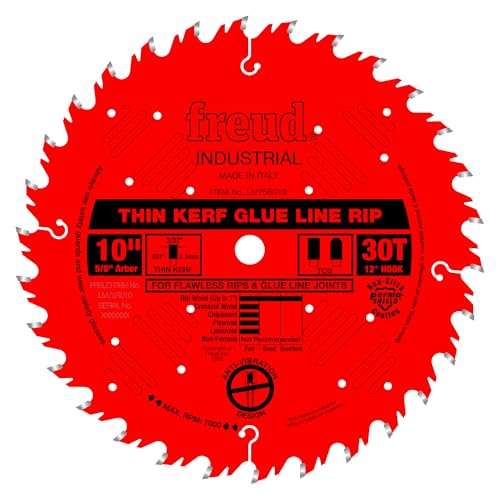
Designed for heavy-duty use, the LM75R010 features a triple chip tooth design that yields ultra-smooth, true surfaces suitable for glue-ready edges and fine finish work. Its thick kerf and reinforced plate ensure stability and flatness for demanding applications, while the Premium TiCo Carbide Blend maintains cutting performance and edge retention through tough woods.
FOXBC 10-Inch Thin Kerf Ripping Blade

The FOXBC 10-Inch Thin Kerf Ripping Blade uses a 24-Tooth FTG configuration with a .094″ kerf and 0.071″ plate thickness. It’s built for fast, durable cuts with a 5/8″ arbor, minimizing vibration and noise while delivering a quality finish. High-density tungsten carbide provides wear resistance for extended blade life in tough woods.
CMT 201.024.10 Industrial Ripping Blade

The 201.024.10 blade from CMT Orange Tools targets heavy ripping with a 20° hook angle and PTFE coating. It’s designed for fast, smooth cuts in soft and hardwoods, and is compatible with table saws, radial arms, and miter saws. The 0. attitudes kerf and plate geometry balance material removal with edge stability for glue-ready results.
Luckyway 10 Inch General Purpose Blades

This 2-pack includes 32T and 60T blades suitable for cross-cut and rip cutting on a range of materials, from softwood to plywood and MDF. Fully hardened steel blade bodies resist bending and deflection for true cuts, while the dual-tooth configurations support precise rip and cross-cut tasks in a single kit.
Buying Guide: Key Considerations For Choosing A Rip Blade
Blade selection depends on saw power, material type, and desired finish. Here are important factors to compare:
- Kerf width: Thin kerf blades reduce material waste and require less power, which helps on underpowered saws but may wear faster in hard woods. Thicker kerfs offer stability on heavy cuts and glue-line work.
- Tooth geometry: Flat-top grind (FTG) teeth provide a smoother surface on rip cuts; triple-chip teeth excel in glue-line and finish work. Consider alternating tooth configurations for mixed tasks.
- Arbor compatibility: Ensure the blade’s diameter and bore match your table saw’s arbor. Common sizes are 10″ with 5/8″ bore, but verify your equipment.
- Carbide blend: TiCo or premium carbide blends offer improved edge retention and toughness, especially on dense hardwoods or plywood edges.
- Coating and finish: PTFE or other coatings reduce friction and resin buildup; however, coatings should not be the sole factor in choosing a blade.
- Durability vs. finish quality: Heavier blades with thicker kerfs tend to stay truer in demanding jobs, while thinner kerfs excel in speed and heat management for lighter work.
- Intended tasks: Separate blades may be better for rough ripping, glue-line finishing, or precise cabinetry—often a trade-off between speed and finish quality.
When shopping, consider a blade set that covers primary tasks (rough ripping, glue-line finishing, and light cabinet work) to minimize blade changes and maximize accuracy in a small workshop.