
Best Rheostat Variable Speed Controllers for Brushed Motors in 2026
Finding the right rheostat-style variable speed controller for brushed motors can reduce wear, enhance precision, and extend tool life. This article highlights five reliable options that fit common 110-120V AC brushed motors such as routers, drills, duct fans, and small shop machines. Each pick is best for specific users—crafters, hobbyists, and small workshop professionals—who need built‑in overload protection, an LED readout, and straightforward dial-based speed control. A quick comparison table follows to help you decide at a glance.
| Product | Best For | Key Benefit |
|---|---|---|
| CDMall AC Motor Speed Controller | DIYers and hobbyists using duct/exhaust fans, routers, and drills | Real-time LED voltage display with 15A overload protection |
| ReeMoo AC Motor Speed Controller | Woodworking projects and small shop tools | Clear 0-120V LED readout and resettable overload |
| VXCICC AC Motor Controller | Bench testing and light industrial use | High peak power, robust overload protection |
| IGEYAPA AC Motor Speed Controller | Fans and simple motors with reliable safety features | LED display, 15A protection, solid ABS housing |
| Azucyzi Versatile Controller | General-purpose speed control for 110-120V devices | Visible LED readout and belt-clip handy design |
CDMall AC Motor Speed Controller for Brushed Motors
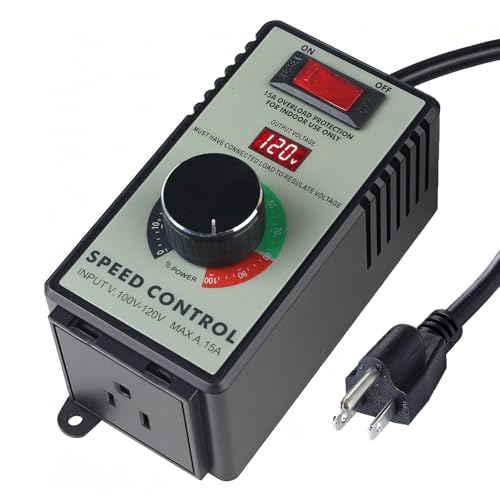
The CDMall controller is designed for brushed AC motors up to 120V and 15A. It provides real-time LED voltage display (0–120V) as you dial in speed, making it ideal for users who require precise speed settings in real time. It works with inline duct fans, exhaust fans, ceiling fans, angle grinders, electric drills, routers, incandescent lamps, and resistance heaters. Best for hobbyists who want immediate visibility of output voltage and straightforward adjustment. A notable caveat: it is not compatible with brushless or DC motors or devices with internal electronic circuitry. Recommended for continued use at about 10A to avoid stressing the unit.
Who it’s best for: DIYers and workshop operators needing precise dialed speed control with an LED readout for readily tuning speed. Why selected: strong real-time display and built-in overload protection suit common brushed-motor setups.
Caution: Do not use with brushless DC motors or appliances with circuit boards; ensure motor type matches the controller’s brushed AC design.
ReeMoo AC Motor Speed Controller 120V 15A

ReeMoo’s model supports 110–120V AC with peak 15A and continuous up to 8A for resistive loads. It’s intended for brushed motors and includes an LED voltage display so users can read the voltage output as they dial in speed. The unit uses a resettable 15A circuit breaker, removing the need for fuse replacements. Best for: routers, drills, small fans, and light woodworking tools where a reliable, resettable overload is important. Limitation: inductive loads or higher startup surges may trip the breaker if the current exceeds the rated threshold; plan lighter loads or staggered starts where possible.
Why chosen: clear LED feedback plus a resettable overload make it a practical, low-maintenance option for common workshop tools.
VXCICC AC Motor Variable Speed Controller

VXCICC offers a high-performance speed controller with a wide controllable range and low-noise operation. It’s designed for 120–220V input, adjustable output up to 0–220V, with a rated current around 9A and a maximum sustained 15A. It provides overload protection that shuts off above 15A for equipment safety. Best for: bench testing and general-purpose motor control in environments where slightly higher voltage flexibility is beneficial. Limitations: higher voltage compatibility may require care around insulation and wiring when integrating with mixed systems.
Why chosen: strong combination of adjustable voltage, overload protection, and relatively broad voltage compatibility makes it versatile for developers and hobbyists.
IGEYAPA AC Motor Speed Controller

IGEYAPA’s controller provides an electronic voltage regulator with an LED display that shows real-time voltage as you adjust the dial. It includes overload protection and a flame-retardant ABS housing for safety. It is suitable for electric motors and fans in 110–120V circuits. Best for: simple hobby projects and educational setups where visibility of voltage and straightforward operation matter. Better for: users prioritizing safety features and a compact, portable form factor. Caution: verify motor type—this unit targets brushed motors and may not suit brushless or non-resistive loads.
Azucyzi Versatile AC Motor Speed Controller

Azucyzi presents a versatile 100V-120V, 15A max controller with a back clip for easy belt attachment, a rotary knob for precise control, and an LED display for monitoring. It includes overload protection and uses a flame-retardant casing for safety. Best for: mobile setups or shop environments where quick access and visibility are important. Choose this if you want a compact, carry-friendly unit with a straightforward interface. Caution: ensure your load fits the 15A limit and matches a brushed-motor profile.
Buying Guide
What should you consider when selecting a rheostat variable speed controller?
- Motor type compatibility: These controllers are designed for brushed AC motors. Do not use with brushless DC, induction, or circuit-board-equipped devices unless explicitly stated.
- Voltage and current ratings: Match the controller’s input voltage (commonly 110–120V) and its continuous current rating to your load. Exceeding ratings can trigger protective features or damage equipment.
- Overload protection: Look for resettable breakers or protective circuits. Resettable protection avoids fuse replacement and reduces downtime.
- Display and usability: LED voltage/readout aids repeatable speed settings. A clear dial and indicators help with memorizing preferred speeds for specific tasks.
- Enclosure and safety: Flame-retardant housings and proper wiring standards minimize risk in shop environments.
- Inductive vs resistive loads: Motors are inductive; resistive loads (like heaters) behave differently. Ensure the controller tolerates the intended load type.
- Portability: If you need mobility, look for models with clip-on belts or compact form factors.
How to install and use safely
- Verify power is off before wiring. Use proper gauge wiring suitable for the current rating.
- Dial in a low setting first, then gradually increase to the desired speed while monitoring the load.
- Keep ventilation for heat-generating devices; avoid enclosing the controller in a tight space without airflow.
Common questions
- Can I use a rheostat controller with a brushless motor? No. These devices are designed for brushed motors only.
- What happens if I exceed the controller’s current rating? The controller’s overload protection may trip and require reset, or the device may shut down to prevent damage.
- Why is there an LED voltage display? It helps you remember the exact output voltage you found effective for a specific tool, aiding repeatability.
- Is it safe to use multiple controllers in a single project? If loads are independent and within each controller’s rating, it’s feasible; ensure proper wiring and safe separation of circuits.
- What type of load is safest for these controllers? Resistive and brushed motor loads within the specified current range are safest; avoid high inrush or inductive surges beyond the rated limits.
- Do these controllers require maintenance? Typically minimal—check for signs of wear, secure wiring, and ensure the overload protection resets correctly after trips.