
Best Rated Home Use Generators for Reliable Power
Home generators provide a resilient power solution during outages or when steady electricity is essential. This guide highlights five top-rated models that balance power, portability, and safety. Each selection is suitable for American households seeking dependable backup or off-grid capability. Read on to compare features like peak and running watts, dual-fuel options, CO sensors, and remote starts to determine which model best fits your home’s needs.
| Product | Power (Peak / Running) | Fuel Type | Notable Features |
|---|---|---|---|
| Westinghouse 14500 Peak Watt Tri-Fuel | 14,500 / 11,500 (Gas) | Gas / Propane / Natural Gas | Remote start, transfer switch ready, long runtime |
| Power Equipment 4400 Watts Inverter | 4,400 / 3,400 | Gas | Low noise, ECO mode, RV ready, long runtime |
| A-iPower 4600W RV-Ready | 4,600 / 3,600 | Gas | Ultra-lightweight, CO sensor, portable |
| Westinghouse 4000 Peak Watt Dual Fuel | 4,000 / 3,300 | Gas / Propane | Remote start, CO shutdown, parallel capable |
| Westinghouse 12500 Peak Watt Dual Fuel | 12,500 / 9,500–12,000 | Gas / Propane | Remote start, transfer switch ready, CO sensor |
Note: The table summarizes key specs to help you compare quickly. For detailed product information and exact configurations, refer to the individual sections below.
Westinghouse Tri-Fuel Backup Generator

This Westinghouse model provides robust power for larger homes with a 14,500 peak watt rating on gasoline and versatile tri-fuel capability (gas, propane, natural gas). Its heavy-duty 550cc 4-stroke OHV engine supports long runtimes—up to 19 hours on a full 9.5-gallon tank and up to seven hours on a 20-pound propane cylinder. It also includes a remote electric start and transfer switch readiness for seamless integration with home electrical systems.
Key considerations include fuel availability and preferred fuel type, runtime at typical loads, and the value of a remote start for convenience during storms. The unit’s three-fuel flexibility makes it adaptable to regions with propane or natural gas access, reducing refueling interruptions during outages.
Power Equipment 4400 Watts Inverter

This inverter generator delivers 4,400 peak watts and 3,400 running watts with quiet operation and ECO mode for efficiency. It features multiple outlets including 120V ports and an RV outlet, making it suitable for camping and emergency home backup. A notable strength is its long runtime—up to 14 hours at low loads with a 2-gallon tank and built-in fuel gauge for at-a-glance awareness.
Consider whether you need a compact, low-noise unit that can power essential devices during outages or while traveling. The inverter design ensures clean power suitable for sensitive electronics like laptops and smartphones, reducing the risk of damage from power irregularities.
A-iPower 4600W RV-Ready Inverter
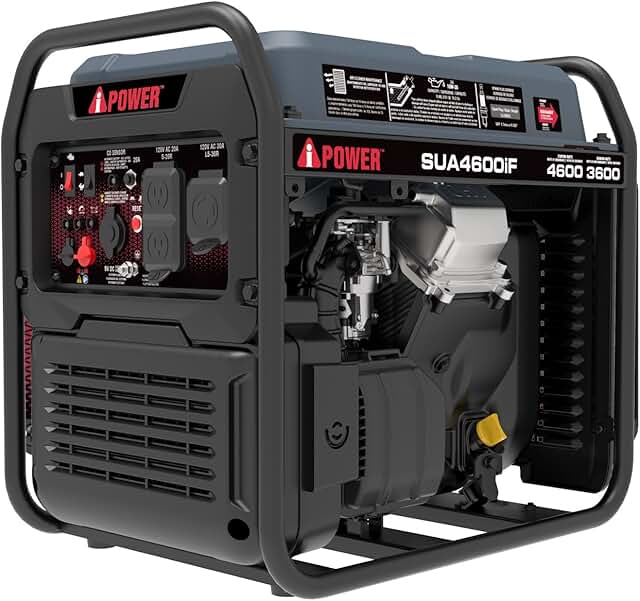
Powered by a 149cc engine, this generator produces 4,600 starting watts and 3,600 running watts. It weighs 56 pounds, prioritizing portability for camping or off-grid use. The unit delivers clean power with a low total harmonic distortion (THD) of about 3%, making it suitable for sensitive electronics. Its open-frame design facilitates easy maintenance and quick fuel access on the go.
Important considerations include overall weight, ease of transport, and the balance between power needs and portability. For tailgating or occasional home backup, this model offers a practical mix of power and mobility without compromising power quality.
Westinghouse 4000 Peak Dual Fuel Generator

This dual-fuel unit offers 4,000 peak watts and 3,300 running watts, with the flexibility of running on gas or propane. It includes a remote start with a key fob, electric and recoil start options, and multiple outlets including a 120V duplex and a TT-30R 30A RV outlet. It also emphasizes safety with automatic low-oil and CO shutdown and a digital display to monitor fuel levels, run time, and output.
Prospective buyers should weigh the utility of a dual-fuel option for fuel availability and cost, along with parallel capability for extending power when needed. The safety features and data display are valuable for monitoring generator health during prolonged outages.
Westinghouse 12500 Peak Dual Fuel Home Backup

With 12,500 peak watts and 9,500–12,000 running watts depending on fuel, this dual-fuel generator is designed for larger homes needing transfer switch readiness. It offers remote electric start, a long-run time on a 6.6-gallon tank with a fuel gauge, and multiple outlets including RV-ready and 120/240V configurations. Safety features include CO shutdown and rubber outlet covers to reduce exposure to weather or debris.
Key considerations include whether you need a higher power ceiling for whole-home backups, the value of a transfer switch-ready design, and CO monitoring for indoor use. The combination of remote start and multiple receptacles supports versatile home and recreational needs.
Buying Guide: Key Purchase Considerations and Comparisons
Power needs and use scenario are the primary drivers. Homes facing extended outages benefit from higher peak wattage and longer runtimes, while RV enthusiasts prioritize portability and RV-ready outlets. Dual-fuel capability adds fuel flexibility during shortages or price surges. Remote electric start and transfer switch compatibility reduce manual startup and ensure a safer connection to home circuits.
- Power Calculator: Estimate total running watts of essential appliances (refrigerator, sump pump, lights, HVAC). Include surge wattage to pick a unit with adequate peak power.
- Fuel Availability: Consider gas, propane, or natural gas access in your area. Tri-fuel and dual-fuel options offer resilience but may come at a higher upfront cost.
- Noise and Portability: Inverter generators are quieter and better for sensitive electronics but may offer less sustained power. Weigh the trade-offs against your space and proximity to living areas.
- Safety Features: CO sensors, automatic shutdown, and proper outlet covers protect your household during use. Remote start improves convenience during storms or cold mornings.
- Maintenance and Support: Look for models with readily available parts, clear service intervals, and reputable warranty coverage. Parallel capability can expand power when needed.
- Budget vs. Longevity: Higher-wue models offer longer runtimes and better fuel economy; balance upfront costs with expected use frequency and reliability.
Depth of features varies among models. For households needing robust, multi-fuel support and transfer switch readiness, the Westinghouse tri-fuel and the dual-fuel models provide strong options. If portability and clean power for electronics are priorities, inverter units like the 4400-watt and 4600-watt options offer practical benefits. RV compatibility and extended runtimes are evident in several entries, making them suitable for both home backup and recreational use.