
Best Power Supplies for PLC Systems and Industrial Control
Choosing the right power supply is critical for reliable PLC operation, precise analog signaling, and safe automation workflows. This guide reviews five versatile options that suit various PLC setups—from compact bench experiments to DIN-rail mounted control panels. Each pick balances voltage flexibility, protection features, and ease of integration with common PLC components.
| Product | Brand | Key Benefit | Voltage Range |
|---|---|---|---|
| NICE-POWER DC Power Supply | NICE-POWER | Precise readouts and safe output switching | 0-30V, 0-10A |
| FEARLIE 24V Industrial Power Supply | FEARLIE | DIN rail mounted, reliable 24V control power | 24V DC, 4.2A |
| Wefomey Universal 3-24V Adapter | Wefomey | Wide USB/DC tips, broad device compatibility | 3-24V DC, up to 6A |
| Amtake Universal 3-36V Adapter | Amtake | Large tip assortment, multiple safety protections | 3-36V DC, up to 4A |
| Rosewill VSB 650W ATX Power Supply | Rosewill | High wattage, PCIe 5.1 compatibility for complex labs | 650W |
Note: Each option in this list is chosen for PLC-oriented use cases, whether you’re powering a PLC input module, analog signal simulators, or a small control panel. Availability and compatibility depend on your specific PLC brand and I/O requirements.
NICE-POWER DC Power Supply For PLC Projects

The NICE-POWER DC Power Supply is a versatile bench regulator designed for precision and safety in laboratory and PLC environments. It features a 0.01V and 0.001A resolution with a high-contrast 4-digit LED display that shows voltage, current, and power in real time. An OUTPUT switch allows momentary de-energization without disconnecting or removing the load, which helps prevent accidental damage during experiments. This model emphasizes protective features including over-voltage, over-current, over-temperature, and short-circuit protection, making it well-suited for sensitive PLC input modules and sensor testers. It is CE & FCC certified, and the 110V US input aligns with common lab outlets. For PLC applications, its stable output and quick-access control fit well with digital I/O testing and analog simulations.
FEARLIE 24V Industrial Switching Power Supply

This DIN-rail mounted power supply delivers a stable 24V DC at up to 4.2A, making it an excellent choice for PLC control panels and industrial automation nodes. The 110-240V AC input range supports worldwide installations without extra adapters. Its compact form on DIN rails saves panel space while providing reliable regulation for PLC modules, motor drivers, and LED indicators. If your PLC setup requires a fixed 24V rail with minimal ripple and robust protection, FEARLIE’s design offers dependable performance for continuous operation.
Wefomey Universal 3-24V Power Supply
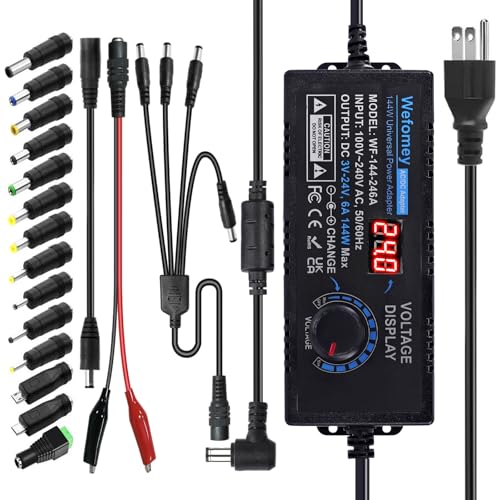
The Wefomey universal adapter provides adjustable DC output from 3V to 24V and up to 6A, with a bright LCD display showing the selected voltage. It ships with 14 DC tips to accommodate a wide range of PLC peripheral devices, sensors, and testers. This flexibility is beneficial when prototyping PLC signaling or powering different I/O modules from a single source. It also supports multiple safety features and a 6-foot cable length for flexible lab layouts, though the user should ensure the current and voltage stay within safe limits for each connected device.
Amtake Universal 3-36V Adjustable Power Supply
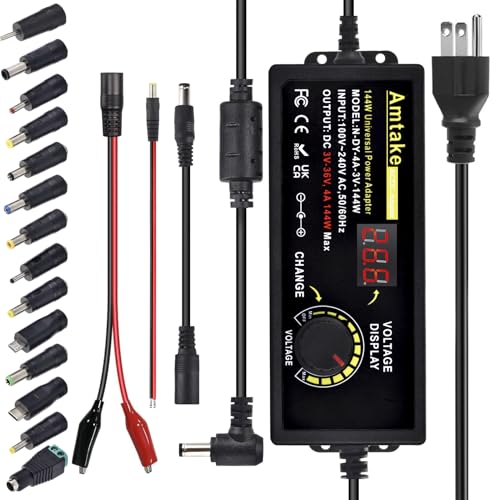
The Amtake unit supports an adjustable 3-36V DC output with up to 4A current, making it well-suited for PLC input modules, servo drives, and low-power industrial components. It includes 14 DC tips and a test lead, offering broad device compatibility. Built-in safety protections guard against over-voltage, over-current, and short circuits. A 6-foot cord adds flexibility when configuring a panel or a bench workstation. While powerful for compact PLC projects, users should verify current demands for larger I/O banks or high-current actuators before deployment.
Rosewill VSB 650W Power Supply

The Rosewill VSB 650W power supply offers higher wattage and a robust platform suitable for more demanding control cabinets or lab setups that also run onboard computing or data logging hardware. It is 80 Plus Bronze certified and supports modern PCIe 5.1 native wiring, which can be relevant for labs that combine PLCs with embedded PCs or visualization systems. While not a PLC-specific unit, its reliability, fan cooling, and modular design are useful for enthusiasts or small automation projects that require a steady 12V/5V rail with room for expansion.
Buying Guide: Key Considerations For PLC Power Supplies
- Voltage stability and range: PLCs often require stable 5V, 12V, or 24V rails. Choose supplies with tight regulation, low ripple, and adequate headroom for I/O modules, sensors, or drivers.
- Current capacity: Estimate the peak current of all connected modules, I/O cards, and actuators. Select a supply that provides more current than the combined load to avoid voltage dips during operation.
- Protection features: Look for over-voltage, over-current, short-circuit, and thermal protections. Safety interlocks and grounded cases reduce the risk of damage during maintenance or fault conditions.
- Form factor and mounting: DIN-rail mounted units save panel space in control cabinets. Benchtop supplies are handy for prototyping and testing PLC logic outside of a panel.
- Isolation and safety standards: Ensure the power supply meets relevant certifications (CE, FCC, UL) and offers galvanic isolation between input and output when precision signaling is critical.
- Efficiency and heat dissipation: Higher efficiency reduces heat in enclosed panels. Fans or low-noise designs help maintain safe temperatures in restricted spaces.
- Impedance and ripple: For analog PLC inputs, low ripple and stable voltage help ensure accurate readings and better noise margins for sensors and transducers.
- Compatibility with peripherals: If your PLC setup includes digital I/O modules, analog simulators, or embedded controllers, verify the supplied connectors, tip assortments, and voltage ranges align with your devices.
- Ease of use and monitoring: Units with clear LEDs, front displays, or quick-access output on/off controls simplify testing and debugging workflows in lab or field environments.
Altering one component of a PLC system can impact others. When selecting a power supply, consider not only the immediate voltage requirement but also future expandability, enclosure constraints, and the potential need for additional sensing or actuation hardware. By weighing the options above, you can choose a power supply that aligns with reliability, safety, and ease of integration for your specific PLC setup.