
Best Power Line Filters Single Phase for Clean Electrical Power
Direct answer: single-phase power line filters help reduce EMI and protect sensitive equipment, making them ideal for labs, hobbyist workbenches, and small electronics setups. This guide compares five reliable options, highlighting who benefits most from each and where to choose one over another.
Summary of selected products
| Product | Best For | Key Benefit |
|---|---|---|
| Uxcell AC 115/250V 20A CW4L2-20A-S | Mid‑level lab and workshop devices | Compact size; solid 20A rating |
| SHUATI Noise Suppressor CW2B-10A-T | Versatile equipment across environments | Wide temperature range and hi-pot testing |
| JIN RONG JRW1220-22 | Laboratories and automation gear | Single‑phase, 20A to 22A range |
| Uxcell CW4E-30A-S | Higher current single‑phase needs | 30A rating; larger footprint |
| JIN RONG JRW1230-44 | Heavy‑duty lab and medical equipment | 30A‑plus option with safety notes |
Uxcell AC 115/250V 20A CW4L2-20A-S Noise Suppressor

Best for compact setups needing reliable EMI suppression without extra bulk. The CW4L2-20A-S operates at 115/250V and supports up to 20A, making it suitable for small tools, benchtop gear, and consumer electronics builds. This model suits buyers who want a straightforward, plug‑and‑play filter with a modest footprint.
Who it’s best for: hobbyists and small workshops that run moderate current electrical devices and want a compact filter. Why chosen: strong balance of current rating and size in a single‑phase configuration. Caution: verify ground integrity for maximum effectiveness; results drop if grounding is poor.
SHUATI Noise Suppressor CW2B-10A-T

Best for versatile equipment across labs, automation, and power‑sensitive devices. This filter is designed for a wide operating range and includes a hi‑pot test history, indicating robust insulation under stress. It’s well‑suited for environments with variable equipment loads and temperature conditions.
Who it’s best for: technicians and engineers needing a robust, all‑around EMI solution for diverse gear. Why chosen: broad application scope and strong endurance tests. Caution: confirm compatibility with exact current draw; misestimating load may limit performance.
JIN RONG Noise Suppressor JRW1220-22
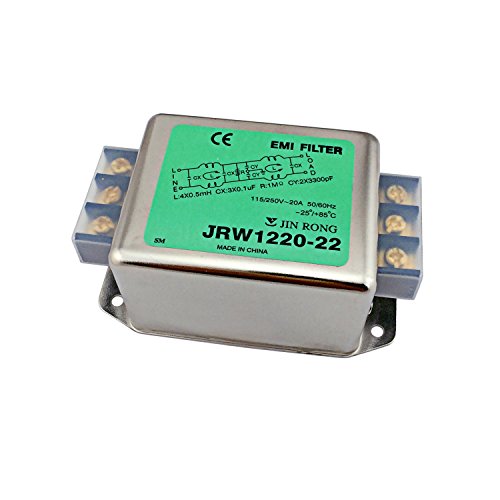
Best for laboratory and automation setups needing a single‑phase EMI filter with a 20A class. The JRW1220-22 line supports high‑demand equipment and precision machinery environments. It provides the balance of protection and current capacity for lab benches and automation consoles.
Who it’s best for: labs and automation stations with varied loads. Why chosen: solid current range and explicit mention of multiple suitable applications. Caution: ensure ground connections are solid to maintain peak filtering performance.
Uxcell CW4E-30A-S Noise Suppressor

Best for higher current single‑phase needs, this model supports up to 30A. It’s a practical choice when heavier equipment or multiple devices share a single line. The larger footprint may be a consideration for tight enclosures.
Who it’s best for: users with higher load requirements or power‑dense devices. Why chosen: higher current rating expands filtering for demanding setups. Caution: verify mounting space and clearance; higher amperage often means a larger unit.
JIN RONG JRW1230-44 Noise Suppressor

Best for heavy‑duty lab and medical equipment with strong safety considerations. The JRW1230-44 line indicates a 30A plus capability and a robust construction with high‑temperature and flame‑retardant features. It’s suitable for environments where reliability and protection are critical.
Who it’s best for: medical and precision equipment environments that demand solid protection and safe operation. Why chosen: higher amperage and safety design align with demanding use cases. Caution: ground wiring must be connected; otherwise, effectiveness may drop significantly.
Buying Guide: How to Choose a Single‑Phase Power Line Filter
- Current rating matters: Match the filter’s maximum amperage to your equipment’s draw. Choose a higher rating if devices may surge or share a circuit.
- Voltage range and frequency: Ensure compatibility with your mains voltage (commonly 115/250V in the US) and 50/60 Hz. Filters should support both for flexibility.
- Grounding requirements: Many filters require proper grounding to achieve full EMI suppression. Plan wiring and enclosure layouts accordingly.
- Environment and temperature: If used in harsh conditions, select models with wide temperature tolerance and robust insulation or hi‑pot test credentials.
- Size and mounting: Consider footprint and mounting options (screw holes, chassis space) when integrating into panels or workbenches.
- Applications: Lab equipment, automation gear, medical devices, and power supplies have different EMI profiles. Pick a model designed for your primary use case.
- Safety and compatibility notes: Some models emphasize ground connections and specific protection features. Verify any explicit installation notes before wiring.
Product Comparison Snapshot
| Product | Current Rating | Voltage | Best For | Notable Considerations |
|---|---|---|---|---|
| Uxcell CW4L2-20A-S | 20A | 115/250V | Compact labs and hobby setups | Ensure solid ground |
| SHUATI CW2B-10A-T | 10A | 115/250V | Versatile environments | Wide temp range; check current draw |
| JIN RONG JRW1220-22 | 20A | 115/250V | Laboratories and automation | Ground connection required |
| Uxcell CW4E-30A-S | 30A | 115/250V | Higher current needs | Larger footprint |
| JIN RONG JRW1230-44 | 30A+ | 115/250V | Heavy‑duty equipment | Ground wiring critical |
Frequently Asked Questions
- What is a power line EMI filter used for? It reduces electromagnetic interference from power lines, protecting sensitive equipment and reducing noise in signals and displays.
- Do I need grounding for EMI filters? Yes. Proper grounding improves effectiveness and safety; without it, performance can drop significantly.
- Can I use a higher current filter than my device requires? Generally yes, but consider space, heat, and wiring constraints; oversizing can be unnecessary but safe.
- How do I choose the right current rating? Add up the maximum current your devices draw and select a filter with a comfortable margin above that value.
- Are EMI filters compatible with medical equipment? Some are designed for medical or precision equipment; verify the model’s listed applications and temperature ratings before use.
- What should I check in installation? Ensure ground connections, secure mounting, and ensure the enclosure provides adequate ventilation and clearance.