
Best Power Cables for CPU: Essential EPS12V Cables for Your Motherboard
Choosing the right CPU power cable can improve motherboard stability and cable management in a modern PC build. This guide highlights five reliable EPS12V CPU power cables designed to fit common EVGA, Corsair, and other modular PSUs, with detachable 4+4 ends for flexible motherboard connections. Each option offers solid compatibility, robust construction, and clear labeling to help you pick the best match for your system.
| Product | Brand | Length | Compatibility |
|---|---|---|---|
| YEZriler CPU Cable | YEZriler | 33 inches (84 cm) | EVGA modular PSUs; CPU 8-pin to motherboard 8-pin (4+4 detachable) |
| OwlTree Braided ATX CPU Cable | OwlTree | 25 inches (63 cm) | Corsair RMx series; CPU 8-pin to 8-pin (4+4 detachable) |
| Certusfun CPU Cable for EVGA | Certusfun | 70 cm (27 inches) + 15 cm extension | EVGA G+ G2/G3/G5/G6; 70 cm total length |
| OwlTree EPS12V Cable Set | OwlTree | 10.6 inches (27 cm) | Motherboard ATX 4-pin/8-pin/8+4-pin ports |
| AsiaHorse Hydrus-8PIN CPU Cable | AsiaHorse | Set length up to 2000W rating, ARGB | CPU 8-pin (4+4) with ARGB; compatible with high-widelity builds |
Note: The cables listed here are designed for motherboard CPU power delivery (EPS12V). Some cables are specific to certain PSU models or brands; always verify your PSU compatibility before purchasing. The list excludes cables intended for GPUs or PCIe connections to avoid misapplication.
YEZriler CPU Cable for EVGA PSUs
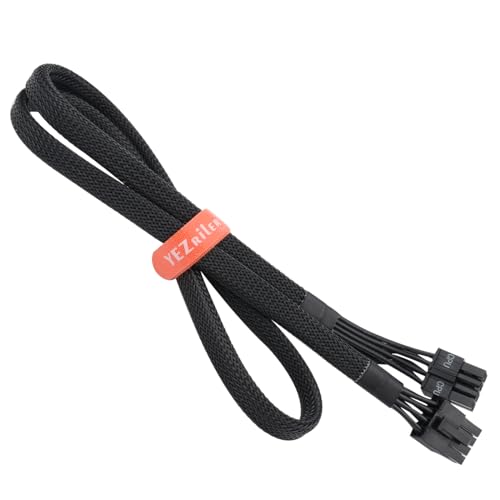
YEZriler’s CPU cable provides a detachable 4+4 EPS8 pin arrangement optimized for EVGA modular power supplies. The cable transitions from an 8-pin CPU plug to a motherboard connector with careful separation, preventing interchangeable use between 8-pin and 4+4 ends. This design suits EVGA PSUs such as 650GS, 750G2, 1000G1, and higher series listed in the product notes. It is essential to confirm the exact EVGA model compatibility before installation, as the cable is not intended for non-EVGA units. The sleeved 33-inch length helps with routing in mid-tower builds while maintaining a clean appearance.
OwlTree Braided ATX CPU Power Cable 8 Pin

This cable is designed for Corsair RMx series PSUs, featuring a 25-inch length and a 8-pin (4+4) detachable design. The 18 AWG copper conductors and 34*0.178TS tinned copper wire offer robust current handling while reducing resistance. The assembly emphasizes careful compatibility with Corsair modular units; attempting to use it with other brands or models not listed could risk damage. The braided sleeving improves durability and abrasion resistance, making it suitable for clean builds where cable management matters most.
Certusfun CPU Cable for EVGA

Certusfun’s 70 cm (27 inches) plus 15 cm extension cable targets EVGA Super Nova PSUs across G+, G2, G3, G5, G6, GA, GM, GT, P2, P3, P5, and P6 families. With UL1007 18 AWG tinned copper and a high-current terminal, this cable emphasizes compatibility within EVGA’s modular ecosystem. The package-length includes a 15 cm extension to accommodate longer builds or routing requirements in larger cases. It is not advertised as compatible with non-EVGA PSUs, so verify the exact model list before purchasing.
OwlTree 2 Pack EPS12V CPU Extension Cable

This OwlTree 2-pack provides EPS 12V extension cables with female CPU 8-pin and male ATX 8-pin 4+4 connectors. At 10.6 inches in length, these cables are suited for tighter builds or cases with limited routing space, offering a compact solution for extending motherboard power connections without bending. The cables emphasize compatibility with motherboards that use ATX 4-pin, 8-pin, or 8+4-pin ports, making them a flexible addition to builders who need extra slack for cable management and airflow.
AsiaHorse Hydrus-8PIN CPU Cable

AsiaHorse Hydrus-8PIN focuses on ARGB-enabled CPU power cabling with copper wire and a robust tin-plated terminal. The design emphasizes efficient current delivery for high-wattage builds and provides a clean, minimalist aesthetic with integrated ARGB lighting. While primarily marketed toward ARGB enthusiasts, the cable remains a functional option for EPS12V connections to motherboard CPUs when matched with compatible power supplies. Ensure your PSU supports the cable’s pin configuration and ARGB control if you plan to sync lighting effects with your system.
Buying Guide: Key Considerations For Choosing A CPU Power Cable
- Compatibility: Confirm your PSU model and motherboard socket. Some cables are designed for EVGA, Corsair, or specific series and may not work with other brands.
- End configuration: Look for 8-pin to 8-pin (4+4 detachable) arrangements if your motherboard requires a detachable 4+4 pin connector. Ensure the ends cannot be interchanged accidentally.
- Length and routing: Choose a length that suits your case size and cable management strategy. Longer cables help in larger builds, while shorter ones reduce clutter in compact builds.
- Conductor quality: Higher gauge (e.g., 18 AWG) and copper cores reduce resistance and improve current delivery, which supports stable CPU power delivery during high loads.
- Durability: Braided sleeving and reliable terminations increase longevity and protect against wear from PC airflow and movement.
- ARGB and aesthetics: If visual design matters, consider ARGB-enabled cables for synchronized lighting, but verify software compatibility and control hardware.
- Installation safety: Avoid using cables with mismatched pins or inappropriate PSUs to prevent damage to components. Always power down and unplug before routing.
- Future-proofing: If you plan to upgrade to higher-wattage PSUs, choose cables labeled for broader compatibility or with extra extension options.
When evaluating options, compare the specific compatibility notes provided by each product and consider your case dimensions, PSU model, and motherboard requirements. The goal is a secure, clean installation that preserves airflow and protects the motherboard power rails under load.