
Best Portable DC to AC Car Inverters for Travel
Answering the need for reliable on‑the‑road power, these portable DC to AC converters help keep devices running when you’re away from home. Ideal for road trips, camping, or work on the go, they power laptops, cameras, and small appliances from a vehicle’s 12V socket. This guide highlights five top options, explains who each is best for, and notes practical limitations to consider before buying. The table below compares key details at a glance to speed up your decision.
| Product | Best For | Output | USB Options | Notes |
|---|---|---|---|---|
| Pro Chaser 400W (First) | Road trips with laptops and small appliances | 400W continuous / 800W peak | USB-A QC 18W, USB-C PD 65W | Compact, 30″ cord |
| Pro Chaser 400W (Second) | Family travel with multiple USB devices | 400W continuous / 800W peak | Dual USB ports (3.1A each) | 2 AC sockets, long cord |
| PiSFAU 200W | Casual charging and light laptops on the go | 200W / 400W peak | Multiple USB ports | Quiet, compact, portable |
| ALITOVE 120W | Low wattage car electronics safely | 120W max | Not specified (USB ports unspecified) | Long power cord, strong protections |
| Wagan EL9903 60W | Car to home use with 12V fridge or small devices | 60W | Standard power-only model | ETL listed, long cord |
Pro Chaser 400W Power Inverters for Vehicles

Best for driving with laptops, cameras, and mid‑load appliances, this inverter provides 400 watts of continuous DC to AC power and up to 800 watts peak. It features two 110V AC outlets plus a USB-A QC 18W port and a USB-C PD 65W port for fast device charging. The dual AC outlets help run laptops or small DVD players while you charge phones or tablets via USB. A 30‑inch cord gives flexible placement inside a vehicle. Suitable for road trips, camping, and vacations where a steady battery supply is essential. Caution: avoid running devices beyond the continuous rating for extended periods.
Who this is best for: Road‑travelers who need reliable laptop charging and multiple USB ports in one compact unit. The long cord minimizes reach issues in crowded cabins. This model is well‑suited for families who use several USB devices at once and want a single high‑capacity inverter.
Pro Chaser 400W Inverter With Dual USB Ports
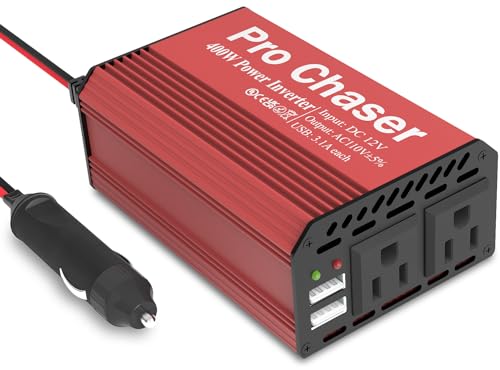
This second Pro Chaser model also delivers 400W continuous power with an 800W peak, but emphasizes a set of two high‑speed USB ports and two 110V AC sockets, which makes it a strong pick for families traveling with several devices. The 30‑inch cord remains a practical feature for backseat use. It’s best for users who want extra USB charging capacity alongside the AC outlets and are comfortable managing two AC sockets for simultaneous devices. Limitation: similar to other high‑load inverters, efficiency drops with higher draw and extended use.
Who this is best for: Families or groups who need quick USB charging alongside AC outlets, especially when laptops or tablets remain in heavy use during travel.
ALITOVE AC to DC Converter 110V to 12V 10A
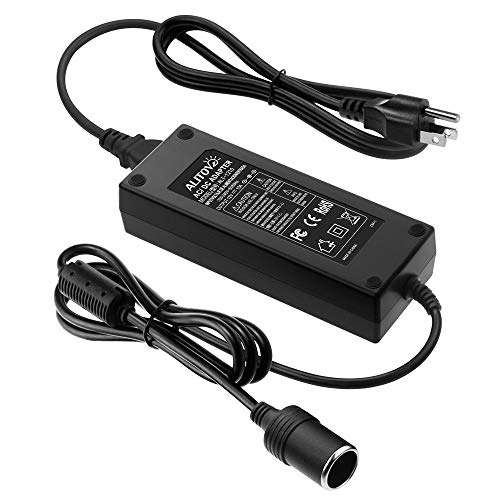
This unit converts 110–240V AC to 12V DC at up to 10A (120W max). It suits devices drawing up to 10A, such as car refrigerators, dash cameras, and small vacuums. It includes an 8‑ft cord to reach a wider area. Safety protections guard against overload, overvoltage, overheating, and short circuits. Best for folks needing a simple, dedicated 12V supply from home outlets for car devices that require stable 12V power. Avoid sustained use with devices exceeding 120W to prevent shortened lifespan.
Who this is best for: Users who need a reliable 12V supply from a home or hotel outlet for car devices under 120W. Great for keeping small coolers or vents powered when away from the car’s own power source.
Wagan EL9903 AC to DC Power Adapter

Designed to power car appliances at home or office, this 60W adapter uses 110V AC to 12V DC with a cigarette lighter socket output. It ships with a long 4.5‑foot cord for flexible placement, and carries certifications such as ETL, TUV, CE, and RCM. Best used for low‑wattage devices like small fridges or fans that don’t require high current. Limitation: output remains at 60W, so high‑demand devices should be avoided.
Who this is best for: Travelers who want a straightforward 12V supply from a wall outlet for very low wattage automotive accessories or small appliances when a car inverter isn’t convenient.
Buying Guide
Key considerations to choose the right portable DC to AC converter:
- Power needs: Match continuous wattage and peak ratings to the devices you plan to run. Laptops and small appliances typically require 300–400W peak, while chargers and phones draw far less.
- Number and type of outlets: Decide whether you need multiple AC outlets, USB‑A, USB‑C PD, or both. USB‑C PD ports enable faster charging for newer devices.
- Cord length and placement: A longer cord provides flexibility in vehicle layouts and seating arrangements; shorter cords save space but reduce mounting options.
- Safety features: Look for overload protection, overvoltage, overheating, and short‑circuit protection. ETL/UL listings add assurance for consumer use.
- Portability vs. capacity: Higher wattage units tend to be larger. If you mostly charge phones and tablets, a smaller unit may be preferable; for laptops and small appliances, a 400W model is often best.
- Cooling and efficiency: Some inverters include fan cooling or improved heat dissipation. Efficiency affects how long you can run devices on a single trip.
- Use case environment: For road trips, consider compact size and ease of installation. For camping or remote work, a longer cord and more USB ports can be advantageous.
FAQ
- What wattage should I look for for laptops? Choose an inverter that can sustain at least 300–400W with a higher peak rating to accommodate startup surges.
- Is it safe to run a fridge from an inverter? Some inverters support small 12V coolers; check the continuous wattage and the peak draw of the fridge to avoid overload.
- Do USB-C PD ports charge faster than USB-A? Yes, USB-C PD ports typically provide higher power levels (up to 65W or more in several models) for faster charging of compatible devices.
- Can I leave an inverter plugged in all day? Most models have protections, but prolonged high load can still stress the inverter. Use only as needed and monitor heat.
- Which is better, one powerful inverter or several small ones? For most setups, a single adequately powered inverter is simpler and more efficient; multiple units can complicate wiring and safety considerations.
- Are these inverters noisy? Some units include cooling fans; others are silent but may heat up under heavy load. Consider fanless designs if noise is a concern.