
Best Point of Use Tankless Water Heaters for Instant Hot Water
Answer: Point-of-use tankless water heaters deliver on-demand hot water at or near the faucet, helping save space and reduce energy waste for small spaces or single-tap needs. This guide highlights five reliable options, each suited to specific setups such as under-sink basins, bathrooms, or break rooms. Choose based on electrical requirements, flow rate, and temperature control. The top picks below are organized to help you compare best-for scenarios and practical limitations at-a-glance.
| Product | Best For | Main Advantage |
|---|---|---|
| Rheem 6.5kW 240V Point of Use | Medium flow, near sink or office | 1-degree precise temperature control |
| Rheem 3.5kW 120V Point of Use | Small spaces with low flow | Compact and easy wiring |
| EcoSmart POU 6T 6.5kW 240V | Higher demand point-of-use | Self-modulating efficiency |
| ThermoMate 6000W 240V | Under-sink or faucet use | Fast on-demand hot water |
| EcoSmart POU 4T 3.5kW 120V | Low-flow applications | Energy-saving, on-demand |
Rheem 6.5kW 240V Point of Use Tankless Electric

Best for: small-to-medium demand scenarios where precise temperature control matters. This model provides continuous hot water within 1 degree of the selected setting and is 90% smaller than a traditional tank heater, making it ideal for point-of-use installation in bathrooms or offices. It is best for users who need reliable comfort without a bulky unit.
Why selected: It combines stable temperature control with space-saving design, reducing the footprint of a typical water heater. It’s well suited for under-sink or nearby fixtures where instant hot water is desired. Caution: 6.5 kW at 240V requires a dedicated circuit and proper electrical planning.
Rheem 3.5kW 120V Point of Use Thermostatic Tankless Electric Water Heater
Best for: ultra-compact spaces with low hot water demand, such as a bathroom or small breakroom. Its 120V 30A circuit fits typical home wiring in apartments or offices. The unit provides easily adjustable temperature control for consistent on-demand hot water.
Why selected: Its size and wiring simplicity make it a practical upgrade where a traditional tank is impractical. Limitation: lower power output means reduced flow and temperature rise in high-demand scenarios.
EcoSmart POU 6T 6.5kW 240V Thermostatic

Best for: higher-demand point-of-use needs where constant supply is essential. The 6.5 kW system delivers on-demand hot water with self-modulating energy use, which can help reduce energy consumption compared to non-modulating units.
Why selected: It balances capacity and energy efficiency for kitchens, bathrooms, or small offices. Caution: electrical requirements should be matched to available circuit capacity to avoid tripping a breaker if the flow increases unexpectedly.
Tankless Water Heater For Sink – ThermoMate 6000W 240V

Best for: under-sink or over-sink installations where fast, on-demand hot water is needed for handwashing or kitchen tasks. It offers a self-modulating design and a compact wall-mounted form factor.
Why selected: Its 24-hour standby and precise 1-degree temperature control help maintain comfort. Limitation: 6 kW may be insufficient for simultaneous taps or higher flow demands.
LECLOC Mini Under Sink Tankless 3kW
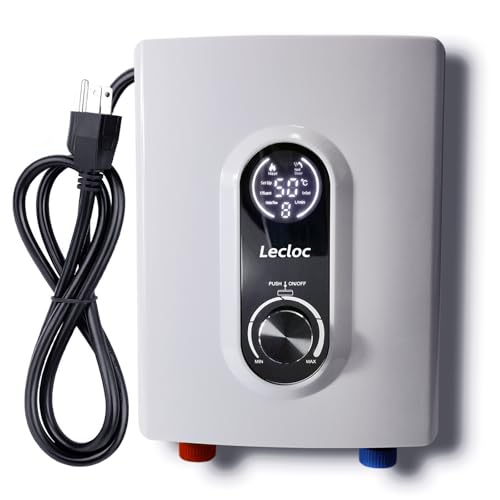
Best for: compact spaces and very low-flow needs, such as a small sink or office kitchenette. This plug-in unit runs on 120V and is accessible for quick upgrades where a full hard-wired system isn’t feasible.
Why selected: It provides accessible installation and ease of use, but it is designed for low-flow scenarios. Data caution: not suitable for showers or multiple taps at once; consider higher wattage models for fuller hot water needs.
CAMPLUX Tankless 6kW 240V Point Of Use

Best for: under-sink installations in apartments or offices that require quick access to hot water with a strong temperature rise. It supports energy-efficient self-modulating technology to reduce waste.
Why selected: The compact design and temperature display assist precise adjustments. Caution: Choose this if your electrical panel can support 6 kW; otherwise, scale to a lower wattage model.
Buying Guide: Key Considerations And Comparisons
What is point-of-use tankless water heating?
Point-of-use (POU) tankless water heaters supply hot water directly at or near a faucet or sink. They heat water on demand, eliminating storage loss and reducing space needs compared with traditional tanks.
How to choose the right unit?
- Flow rate: Determine the maximum gallons per minute (GPM) you need at your hottest setting. Higher GPM models support more simultaneous taps.
- Electrical requirements: Check voltage and amperage; some units demand hard-wired 240V circuits, while others operate at 120V with smaller breakers.
- Temperature rise: Consider the typical incoming water temperature in your area and desired outlet temperature to select a model with adequate rise capacity.
- Space and installation: Measure available space and ensure a suitable mounting location near the intended faucet.
- Energy efficiency: Self-modulating or demand-based heating reduces standby losses and total energy use.
When to avoid certain options?
- Very high demand: For multiple outlets or showers at once, a larger or separate unit may be required.
- Older electrical panels: Some 6 kW or higher models require panel upgrades or dedicated circuits.
- Extreme climates: In very cold supply water areas, ensure the unit has sufficient temperature rise capacity.
Installation and safety tips
- Use a licensed electrician or plumber for electrical and water connections to meet local codes.
- Verify compatible pipe materials and proper venting where applicable.
- Follow manufacturer maintenance guidance to prevent scale buildup and prolong life.
FAQ
- What is the main advantage of a point-of-use tankless heater?
It provides instant hot water at the tap and saves space compared with a traditional tank. - Can I install a POU unit myself?
Installation requirements vary; many units require electrical work and water connections. Check local codes and follow the manufacturer’s instructions. - Do POU heaters work with all faucets?
They are designed for specific flow rates and temperatures. Higher-flow fixtures may require a larger unit. - Is self-modulating technology better?
Self-modulating units adjust power based on demand, improving efficiency and reducing energy costs. - What size unit should I choose for a bathroom sink?
A compact 3.5 kW to 4T model is typically sufficient for single-use applications with low flow. - Do these units provide hot water for showers?
Some do, but many are intended for sinks or small spaces. For showers, consider higher capacity or multiple devices.