
Best Off Grid Solar Systems for Cabins: Reliable Tiny Home Power Solutions
Answering the question for cabin owners: you want a dependable, easy-to-install off-grid solar system that can power essential appliances during extended outages or in remote locations. This guide highlights five complete off-grid solar kits and systems well-suited for cabins, RVs, and other small living spaces. Each option is evaluated for who it suits best, its key strengths, and a practical caveat to consider before purchase.
| Product | Best For | Why It Stands Out |
|---|---|---|
| ECO-WORTHY 5KW Off Grid Solar System Complete Kit | Cabins seeking high storage and scalable inverters | High-capacity 5KW inverter with parallel capability; includes 12 panels and a UL-labeled battery |
| ECO-Worthy 7.168KWH 800W Solar Panel Kit for RV Off Grid | Families on the move or cabin near RV use, need mobility | UPS function for seamless power transfer and multiple charging options |
| SUNGOLDPOWER 6500W Off Grid System | Cabins needing robust daily output and scalable storage | High daily energy output with large LiFePO4 battery and parallel-ready inverters |
| ECO-Worthy 1.6KWH Complete Solar Panel Kit for RV | Small cabins or sheds with light energy needs | Compact, easy-to-deploy kit with clear expansion potential |
| The DIY Off Grid Solar Power Bible | Users who want a detailed planning resource and DIY guidance | Comprehensive design and maintenance guidance for various off-grid setups |
Choosing the right setup depends on anticipated daily energy use, climate, and whether you want plug-and-play convenience or deeper customization. The table above summarizes each option’s focus and why it may fit a cabin environment.
ECO-WORTHY 5KW Off Grid System Kit

Best for cabins needing substantial energy storage and flexible output. This kit includes 12 upgraded 195W monocrystalline panels, a 48V 100Ah LiFePO4 battery, and a 5KW all-in-one inverter with built-in charge controller. The system is designed for split-phase operation, allowing parallel inverters to reach 120V/208V/240V as power demands rise. It’s suitable for powering lighting, refrigeration, and essential appliances in off-grid cabins for extended periods. A potential caveat is the overall system complexity when expanding beyond a single inverter; ensure proper wiring and safety compliance for multi-inverter configurations.
ECO-Worthy 7.168KWH RV Off Grid Kit

Best for cabins near RV usage or for portable cabin setups needing a versatile UPS function. The 780W solar panel kit includes four 195W panels and a 3000W inverter charger with a 7.168 kWh battery storage capability. The system supports quick power transitions between solar and mains, ideal for seasonal cabins or weekend getaways where you want reliable power with minimal setup. Choose this if you want an easy, novice-friendly installation; avoid if you require higher continuous power for large HVAC systems in hot climates, as output and storage scale are fixed by the included components.
SUNGOLDPOWER 6500W Off Grid System

Best for cabins needing high daily energy and scalable storage. This kit delivers an 8,880 Wh daily output under four sun hours, with a 6500W all-in-one inverter and 51.2V 100Ah LiFePO4 battery. It supports parallel operation and multiple unit expansion, making it suitable for larger cabins or secondary outbuildings that require reliable, continuous power for refrigerators, climate control, and sensing equipment. A limitation is the higher initial investment and the need for proper system integration to maximize daily energy yield in less sunny seasons.
ECO-Worthy 1.6KWH Complete Solar Panel Kit for RV
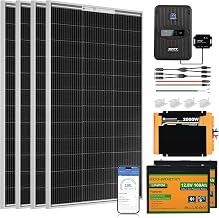
Best for small cabins or sheds with lighter energy needs. This compact kit includes four 100W panels, a 40A MPPT controller, two 12V 100Ah Li-ion (LiFePO4) batteries, and a 2000W inverter. It’s well-suited for basic lights, small fridges, and USB charging. The limitation is that higher power appliances may require additional panel and battery capacity to meet daily demand, especially in winter or overcast months.
The DIY Off Grid Solar Power Bible

Best for readers who want a detailed roadmap for planning, designing, installing, and maintaining off-grid solar systems. This guide provides comprehensive information applicable to cabins, tiny homes, RVs, and boats. Readers should view it as a practical reference to bolster DIY projects rather than a quick-install manual.
Buying Guide: Key Considerations For Cabin Off-Grid Power
How much daily energy do you need?
Estimate typical daily consumption for lighting, refrigeration, water pumps, and small appliances. Use a wattage calculator or create a month-long log to forecast seasonal variations. Aim for a system that can comfortably meet peak daytime loads and provide reserve capacity for cloudy days.
Do you need mobility or permanence?
For remote cabins with occasional stays, smaller, modular systems or RV-ready kits may be preferable. If you plan year-round occupancy, prioritize higher storage and parallel expansion capability to cover longer periods without sun.
What climate and sun exposure are typical?
Cabins in northern regions with shorter days benefit from higher-capacity batteries and efficient panels. Location and roof orientation influence panel output; consider bifacial panels or trackers if installation permits and budgets allow.
How important is installation simplicity?
Plug-and-play kits with built-in inverters and charge controllers offer quick setup, while custom systems provide greater scalability but require electrical knowledge and compliance with codes.
Is battery technology a priority?
LiFePO4 batteries are common for off-grid cabins due to cycle life and safety. Check cell quality, expected cycles, and warranty support when evaluating options. Battery depth of discharge and temperature tolerance affect usable capacity.
What about future expansion?
Choose systems that can add panels, inverters, or additional batteries without significant rewiring. Parallel-capable inverters and modular panel arrays enable gradual upgrades as energy needs grow.
Maintenance and safety considerations
Plan for occasional maintenance, battery health checks, and weatherproofing. Ensure safety clearance around inverters and battery banks, and verify compliance with local electrical codes for off-grid installations.
FAQ
- What is the best off-grid solar kit for a cabin with basic needs? A compact kit with a modest inverter and a couple of LiFePO4 batteries, like the 1.6KWH ECO-Worthy option, suits small cabins focusing on lighting and a fridge.
- Can I run a full-size fridge and air conditioner off-grid? Yes, with a larger daily output and storage—look for 6–8 kWh daily capacity and LiFePO4 storage, plus an inverter capable of 5 kW or more.
- Are parallel inverters better for cabins? They offer scalable power and redundancy, allowing growth as demands rise, but require careful wiring and system planning.
- What maintenance is required? Regularly inspect panels for dirt and shade, monitor battery health, and ensure connections remain tight and corrosion-free.
- Is off-grid solar suitable for winter months? Yes, with adequate battery storage and panel area to compensate for lower sun hours; consider higher-capacity batteries or supplementary power sources as needed.
- Do these kits require professional installation? Some kits are designed for DIY installation, while others may benefit from professional assessment to ensure code-compliant wiring and safe operation.