
Best MPPT Solar Panel Regulator for Efficient Battery Charging
Answering the need for efficient, reliable solar power management, this guide compares top MPPT solar panel regulators ideal for 12V and 24V systems, including lead-acid and some Li battery options. These regulators help maximize energy harvest, protect batteries, and simplify setup for homeowners, small off-grid enthusiasts, and DIY integrators. The top picks below are chosen for clear MPPT tracking, user-friendly interfaces, and safety protections.
| Product | Best For | Key Feature |
|---|---|---|
| ELUSH 100A MPPT | High-capacity systems; mixed battery chemistries | 99.5% tracking efficiency, dual USB, LCD |
| Fockety 200A MPPT | Larger setups requiring robust protection | 99.5% tracking, LCD status, multi-battery |
| TCEUMIK 30A MPPT | Small to medium off-grid projects | 99.9% MPPT, wide battery options |
| TCEUMIK 100A MPPT | Mid-to-large systems; USB charging | 99.9% MPPT, auto 12/24V, LCD |
| Depvko 60A MPPT | Home or light commercial use | 99%+ tracking, LCD, timer |
| Depvko 100A MPPT | Power users needing advanced control | 99%+ tracking, LCD, timer |
ELUSH 100A MPPT Solar Charge Controller

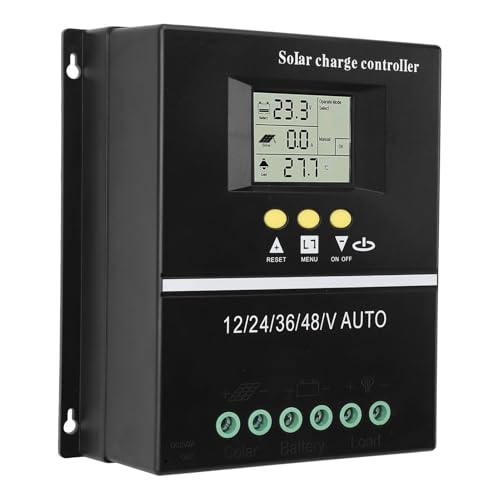
This 100A MPPT regulator supports 12V/24V/36V/48V systems with a large LCD display and dual USB 5V ports. It tracks the maximum power point with an efficiency no less than 99.5%, boosting energy capture in varied conditions. Best for medium to large installations needing versatile voltage support and convenient USB charging options.
Who it’s best for: Homeowners or small businesses deploying mixed battery chemistries (Lead-Acid, Li) and requiring a robust LCD interface. Why selected: strong MPPT performance and multi-voltage recognition reduce manual tuning. Caution: ensure correct parameter settings for Li batteries to avoid misconfiguration.
Fockety MPPT Solar Panel Regulator 200A
This 200A MPPT controller automatically recognizes 12V/24V and uses advanced MPPT algorithms to achieve 99.5%+ tracking efficiency. It features a dynamic LCD for live data and supports multiple battery types, including lead-acid variants and Li systems with proper parameter configuration. Best for: larger off-grid setups needing high current handling and robust protections. Limitation: lithium charging requires careful parameter setup to avoid improper charging.
[Upgraded] TCEUMIK 30A MPPT Solar Charger Controller
![[Upgraded] 30A MPPT Solar Charger Controller](https://m.media-amazon.com/images/I/41inuKuqC7L._SL500_.jpg)
Designed for 12V/24V systems, this 30A controller uses an industrial-grade chip to reach up to 99.9% MPPT efficiency, improving overall charging by 15–30% versus conventional controllers. It supports various lead-acid batteries and auto-recognizes voltage. Best for: small to medium off-grid builds with emphasis on high efficiency. Caution: lithium battery use requires user familiarity with battery characteristics and proper parameter setup.
TCEUMIK 100A MPPT Solar Panel Controller

Upgrade to 100A MPPT with auto 12V/24V recognition and dual USB ports. It tracks up to 99.9% efficiency and includes a backflow protection MOSFET. Works with lead-acid families; lithium usage requires proper parameter configuration. Best for: mid-to-large systems needing reliable auto-detection and a feature-rich LCD. Limitation: ensure battery voltage is sufficient during initial setup for correct recognition.
Depvko 60A MPPT Solar Charge Controller

With up to 99% tracking efficiency, this 60A regulator is a practical choice for home or light commercial use. It features an LCD display, timer setting, and dual USB port for charging devices. Best for: smaller to medium setups seeking plug-and-play operation and clear status readouts. Caution: designed primarily for lead-acid types; lithium applications require careful parameter adjustment.
Depvko 100A MPPT Solar Charge Controller

This is a high-output regulator featuring an LCD display and a timer setting to control ON/OFF hours. It tracks up to 99% efficiency and provides dual USB ports for charging. Best for: users needing precise control over larger solar arrays and scheduled operation. Limitation: ensure lithium charging parameters are properly set per battery specifications to prevent improper charging.
Buying Guide
What should I consider before buying an MPPT regulator?
Battery type compatibility matters: ensure the regulator supports lead-acid, GEL, AGM, or Li-ion as needed. Check voltage recognition: auto 12V/24V is common, but confirm it suits your system. Current rating should match your solar array and battery size; overrating provides margin but increases cost.
How important is MPPT tracking efficiency?
Higher MPPT efficiency means more usable energy, especially under shaded or variable conditions. Look for numbers near 99% or higher. The best regulators maintain high efficiency across a range of voltages.
What safety protections are essential?
Seek regulators with battery overvoltage, overcurrent, deep discharge, reverse connection, overheating, and power failure protections. These features help prevent damage during faults or miswiring.
Which features improve usability?
- Clear LCD or LED readouts for real-time data
- Dual USB ports for charging devices
- Multiple operating modes or timers for automation
- Easy plug-and-play setup with auto-recognition
How should I choose between 30A and 200A models?
Match the regulator to your solar array size and battery bank. Smaller systems benefit from 30A or 60A models for cost efficiency, while larger arrays and higher storage needs justify 100A–200A units for better current handling and future expansion.
Maintenance and setup tips
- Follow the manual for battery parameter settings, especially for Li systems.
- Connect the battery first during installation to help auto-detection.
- Periodically inspect wiring and connector integrity to prevent heat buildup.
FAQ
- What is MPPT? Answer: MPPT stands for maximum power point tracking; it optimizes the electrical load to harvest maximum solar power.
- Do all MPPT regulators work with Li batteries? Answer: Some do, but many require careful parameter configuration for Li batteries. Check battery compatibility in the product details.
- Is 12V/24V recognition automatic? Answer: Many models auto-recognize; ensure the battery voltage is adequate during setup.
- Why is efficiency important? Answer: Higher efficiency reduces energy loss, increasing usable power for charging and loads.
- Should I buy a larger amperage regulator than my system needs? Answer: It can provide room for expansion and reduce thermal stress, but it costs more and may be unnecessary for small setups.