
Best Marine Starting Batteries for Group 24 and 1000 MCA
When choosing a marine starting battery, reliability, cranking power, and deep-cycle capability matter most. The Group 24 size is a common fit for many boats, RVs, and marine applications, often paired with 1000 MCA ratings for strong engine starts. This guide highlights five top options that balance starting power, deep-cycle performance, and maintenance needs. Each product is evaluated for marine use, durability, and overall value to help you pick the right unit for on-water reliability and long-term performance.
| Product | Brand | Key Specs | Type |
|---|---|---|---|
| Mighty Max MM-G24M | Mighty Max Battery | 12V, 90Ah, 550 CCA, 700 MCA, Group 24M | |
| Interstate Marine/RV 24M AGM | Interstate Batteries | 24M-AGM, 12V, 70Ah, 750CCA | |
| UPLUS 24M Dual Purpose | UPLUS NEW TECHNOLOGY BATTERY | 12V, 79Ah, 550CCA | |
| Mighty Max MM-G24 Start & Stop | Mighty Max Battery | 12V, 70Ah, 710 CCA | |
| Interstate 24M LiFePO4 | Interstate Batteries | 12V, 100Ah, LiFePO4 |
Mighty Max Battery MM-G24M — 12V 90Ah Deep-Cycle AGM
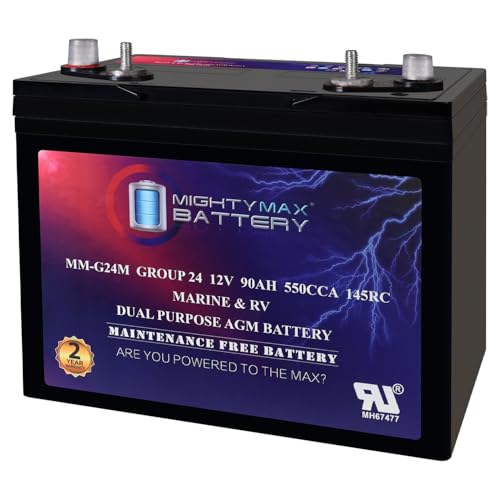
The Mighty Max MM-G24M is a dual-purpose battery designed for marine use with 90Ah capacity. It combines strong starting power with deep-cycle endurance, making it suitable for engines and onboard electronics alike. With 550 CCA and 700 MCA, it provides reliable ignition in varying climates. The AGM design offers maintenance-free operation and spill-proof performance, supporting extended electronics use and trolling motor scenarios. This unit targets boaters who want a single battery that handles starting duties while offering robust deep-cycle capability for long days on the water.
Interstate Batteries Marine/RV 24M AGM — 70Ah, 750CCA

Interstate’s 24M AGM dual-purpose battery blends starting power with deep-cycle capability for marine and RV applications. Its 750CCA provides strong engine starts, while the AGM design supports reliable deep cycling for electronics, trolling motors, and accessories. The battery is built for rugged marine conditions and long service life, with emphasis on load handling and quick recharges between trips. This model appeals to boaters who need a single, dependable battery for both engine starting and on-board power needs.
UPLUS 24M Dual Purpose Marine Battery — 79Ah, 550CCA

UPLUS’s 24M dual-purpose marine battery combines a space-saving footprint with mixed-cycle performance. It delivers 550CCA for solid engine starts and a 79Ah capacity for mid-length boating sessions. Designed to resist vibrations from waves and trailer transport, its AGM construction promotes spill-proof operation and reliable performance in rough seas. This option suits boats with compact electrical systems that still demand dependable start power and deep-cycle support.
Mighty Max MM-G24 Start & Stop — 70Ah, 710CCA

The MM-G24 Start & Stop specializes in vehicles and boats with start-stop systems. It offers 710CCA for strong engine starts and 120-minute reserve capacity, enabling longer runs between charges. The AGM construction provides spill-proof performance and a reliable deep-discharge recovery to keep critical electronics powered during longer trips, while maintaining a compact Group 24 fit. This choice is ideal for boats with demanding starting requirements and frequent engine restarts.
Interstate Batteries 24M LiFePO4 — 100Ah, Lightweight Marine Battery

Interstate’s LiFePO4 24M battery delivers high cycle life, weighing significantly less than traditional lead-acid units. With up to 10x longer cycle life and faster recharge, this lithium option reduces weight and increases boating flexibility for power-hungry systems. Suitable for boats with long weekends on the water, it provides a reliable high-density energy source for starting and deep-cycle needs without regular maintenance.
Buying Guide: Key Considerations For Group 24 Marine Batteries
- Battery chemistry: AGM vs lithium (LiFePO4) impacts weight, cycle life, recharge speed, and maintenance. AGM suits many marine setups with minimal maintenance, while LiFePO4 offers longer life and lighter weight but may require compatible charging infrastructure.
- Cranking amps and reserve capacity: A higher CCA ensures reliable starts in cold weather, while RC (reserve capacity) indicates how long the battery can run essential electronics if the engine is off. Match the figures to your boat’s engine size and electrical load.
- Deep-cycle capability: If you rely on trolling motors, fish finders, GPS, lights, or other electronics, a robust deep-cycle capacity helps extend run times between charges.
- Maintenance and sealing: AGM and lithium options are typically maintenance-free and spill-proof, reducing the risk of leaks and corrosion in rough waters. Consider a sealed unit for tight compartments.
- Physical fit and compatibility: Group Size 24 or 24M dimensions should align with your boat’s battery tray and terminals. Check positive and negative terminal positions to ensure proper fit and cable routing.
- Vibration and ruggedness: Marine environments demand vibration resistance due to waves and trails. AGM and lithium designs often incorporate robust construction to withstand rough conditions.
- Weight and installation: Lithium batteries offer significant weight savings but can be more expensive. Weigh the trade-off between weight savings and upfront cost against long-term performance.
- Maintenance requirements: Maintenance-free designs reduce on-deck labor and corrosion risk, a key consideration for frequent saltwater use.
- Charging compatibility: Ensure your boat’s charger and alternator are compatible with the chosen battery chemistry to maximize lifespan and performance.
- Warranty and support: Look for batteries with solid manufacturer warranties and accessible service networks, especially for marine use where reliability is critical.