
Best Lux Meter for LED Lights: Accurate Readings for Your Setup
Choosing the right lux meter helps ensure LED lighting meets design goals, plant needs, or stage requirements. This guide compares five reliable models, focusing on range, accuracy, ease of use, and features that matter for American readers. Each product section includes a clickable link to Amazon, a visual, and practical notes drawn from the listed features. Whether you’re optimizing a home studio, a grow room, or an office, these meters provide dependable illuminance data.
Summary table of selected products:
| Product | Brand | Lux Range | Key Features |
|---|---|---|---|
| Light Meter Digital Illuminance Meter | URCERI | 0–200,000 Lux | Ambient temp, 4-digit LCD, MIN/Max, data hold |
| TopTes TS-710 Light Meter | TOPTES | 0.1–200,000 Lux | 180° rotating sensor, backlit display, wide unit support |
| Dr.meter LX1330B Digital Illuminance Meter | Dr.meter | 0–200,000 Lux | FC/LUX toggle, fast readings, peak data |
| BTMETER BT-881D Digital Illuminance Meter | BTMETER | 0.01–400,000 Lux | Rotated sensor, high accuracy, fast sampling |
| Klein Tools ET130 Digital Light Meter | KLEIN TOOLS | 0–40,000 Lux | FC/Lux, auto/manual ranging |
URCERI Light Meter With Lux And Temperature
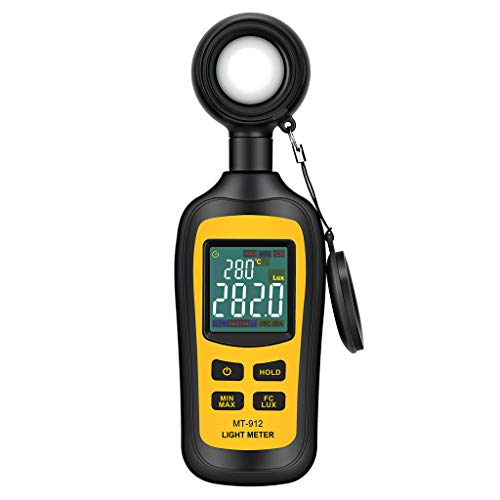
The URCERI device measures illuminance from 0 to 200,000 Lux and also provides ambient temperature data. Its 4-digit color LCD screen supports quick interpretation, and the unit offers MIN/Max readings and a data hold function for accurate record-keeping. Auto power off helps conserve battery life, while a low battery indicator signals when replacement is needed. This meter suits both indoor testing and field checks for LED installations where precise lux levels are essential.
TopTes TS-710 Light Meter With Rotating Sensor

The TS-710 features a 180° rotating sensor and a large backlit display. It records in lux or foot-candles across a broad range (0.1 to 200,000 Lux, 0.1 to 20,000 FC). With a fast response every 0.5 seconds, users can monitor lighting variations quickly. Its versatility makes it suitable for plant growth setups, automotive lighting checks, and general home or office lighting analysis. The instrument supports multiple environments with clear readings that adapt to user needs.
Dr.meter LX1330B Digital Illuminance Meter

The Dr.meter LX1330B offers fast readings up to 200,000 Lux and supports a FC/LUX toggle to match user preference. It emphasizes ease of use with a simple interface and provides peak data recording to capture brief high-light events. This is helpful when evaluating pulse lights or intermittent LED sources, ensuring you don’t miss peak intensities that influence plant growth or visual tasks. The device is suitable for indoor and outdoor use where reliable illuminance data matters.
BTMETER BT-881D Illuminance Meter
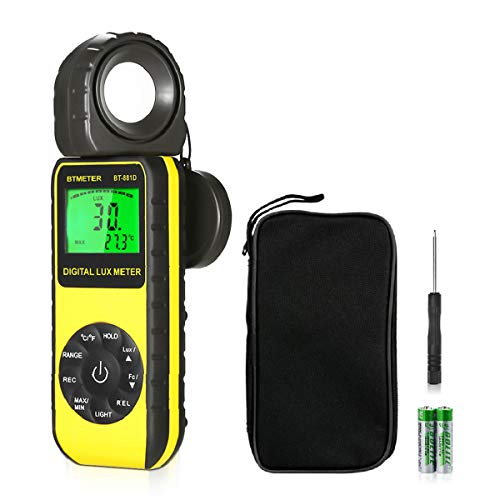
The BT-881D covers a wide range from 0.01 to 400,000 Lux (0.01 to 40,000 FC) with a high-precision rating. Its sensor rotates 270°, enabling measurement from multiple angles, which is beneficial for testing lighting in irregular spaces. The meter offers rapid sampling (0.4 seconds) and strong resolution, helping users detect subtle differences across lighting setups. It is well-suited for industrial, horticultural, and educational settings where durable, fast data matters.
Klein Tools ET130 Digital Light Meter

The Klein Tools ET130 provides easy operation with dual-range measurements in Foot Candles and Lux. It supports auto and manual range modes, covering up to 40,000 Lux, suitable for general lighting analysis in commercial spaces, studios, and classrooms. The meter’s ergonomics and straightforward interface support quick checks and baseline comparisons, reducing setup time during audits or ongoing lighting maintenance.
URCERI MT-92H Split Sensor Light Meter
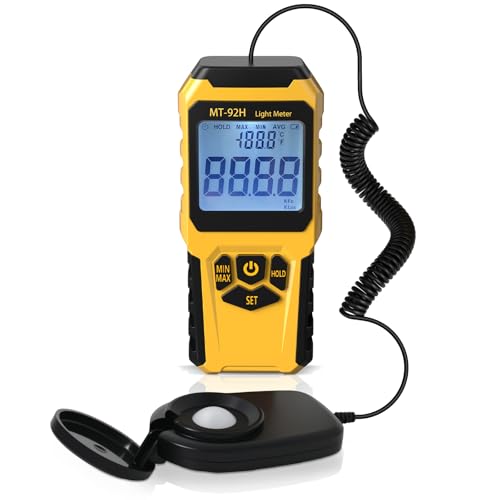
The URCERI MT-92H combines a split sensor design with a fast 500 ms refresh rate and a range up to 200,000 Lux. It supports switchable backlight and temperature measurement (°C/°F), broadening its utility for environments where both light and temperature influence outcomes. This makes it a solid option for experiments, horticulture trials, or facilities requiring synchronized climate and lighting data. The dual measurement capability enhances versatility for professional use.
Buying Guide: How to Choose the Right Lux Meter
- Illuminance range: For LED-focused work, ensure the meter covers at least 0.1 to 200,000 Lux, with some models reaching 400,000 Lux for higher intensity scenarios.
- Measurement units: Prefer meters that switch between Lux and Foot-Candles (FC) to accommodate regional preferences and project needs.
- Accuracy and resolution: Look for ±3–5% accuracy or better and a fine resolution (0.1 Lux or 0.01 FC) for precise adjustments, especially in horticulture or studio work.
- Display and readability: A backlit LCD is valuable in dim environments; ensure the screen is large enough to read from a comfortable distance.
- Response time: Faster readings (0.4–0.5 seconds) help track dynamic lighting changes, such as dimming fixtures or pulsed LEDs.
- Sensor design: Rotating or split-sensor configurations provide flexible measurement angles and placement, particularly in awkward spaces or around tall fixtures.
- Data capture: Features like MIN/MAX, peak detection, data hold, and auto power-off improve data reliability and ease of use in field work.
- Build and portability: Choose a durable body with comfortable handling for extended testing sessions; consider battery life and indicator alerts.
- Additional capabilities: Some meters include ambient temperature or temperature units, enabling combined environmental monitoring for grow rooms or studios.
When selecting a lux meter for LED-focused tasks, consider the typical environment (indoor garden, studio, office, or industrial setting), the needed precision, and whether you require supplementary measurements like temperature. The five models featured here offer a balanced mix of accuracy, range, and practical features to support reliable lighting assessments across common American scenarios.