
Best Low Voltage Electric Motors for Hobby Projects
For makers seeking compact, low voltage motors, this guide highlights five suitable options. These motors cover 1.5V to 12V ranges and serve various hobby needs—from small Arduino projects to RC toys and DIY gear. The best pick depends on voltage, shaft size, and whether you need speed control. This overview helps buyers choose motors by application, compatibility, and ease of use. The top picks are ideal for beginners, hobbyists, and light DIY engineers building small devices or learning motor fundamentals.
Buyer-friendly at-a-glance summary (selected products at a glance):
| Product | Best For | Voltage Range | Notes |
|---|---|---|---|
| Gikfun 1.5V-6V Type 130 | Small Arduino projects | 1.5V–6V | Case pack of 6 with ready leads |
| AUTOTOOLHOME 6-12V Mini DC Motor | RC cars and hobby repairs | 6V–12V | Shaft length and compatibility noted |
| EUDAX 6 Set Rectangular Mini Motor | DIY science kits and experiments | DC 3V | Includes gears and battery holder |
| Antrader DC 6V 5rpm Gear Motor | Low-speed gearing projects | DC 6V | Very low RPM for precise control |
| XYRSTOLR 5Pack DC Motors | Multiple small builds | 1V–6V | Higher pack volume at budget price |
Gikfun 1.5V-6V Type 130 Miniature DC Motor

The Gikfun Type 130 motor operates from 1.5V to 6V, with 3V recommended for consistent performance. This is a compact motor measuring about 15 x 20 mm with a 2.0 mm shaft. It ships as a case pack of six and includes 6-inch leads for easy wiring. Best for tiny, low-power projects such as microcontroller demos, wearable gadgets, or compact robotic components. Choose this if you need multiple identical motors for parallel builds or a simple Arduino project kit. A limitation is that the 3V recommendation may reduce peak speed if you run at the low end of the voltage range.
Who it’s best for: hobbyists deploying several small motors in parallel or students prototyping basic motor-driven mechanisms.
Notes: Wire leads simplify connections, but verify that your power source can safely supply current for all units if used in a multi-motor setup.
AUTOTOOLHOME 6-12V Mini DC Motor
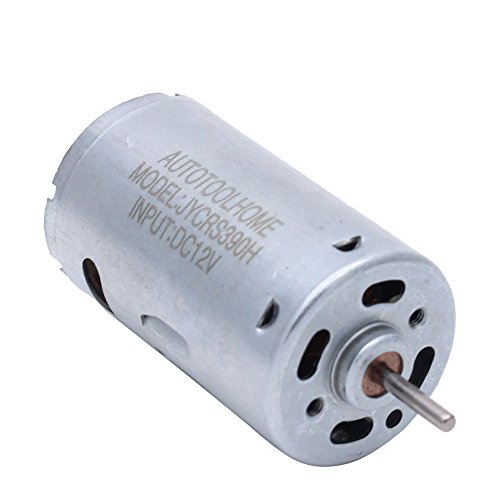
The AUTOTOOLHOME motor is designed for 6V to 12V applications, making it suitable for RC cars, small DIY drills, and hobby projects that demand more torque and speed. It features a 2.3 mm shaft with about 12 mm shaft length, enabling compatibility with gears, pulleys, and couplers. This model is particularly strong for RC vehicles and light power tools where swapping in a ready-to-use motor saves time. Best for upgrading hobby vehicles or building compact automation modules. A caution is to confirm original motor size and wiring before ordering to ensure a perfect fit in your project.
Who it’s best for: RC enthusiasts and makers needing a compact, high-torque motor for 6–12V systems.
Notes: Check shaft diameter and mounting compatibility with any gear train you intend to attach.
EUDAX 6 Set Rectangular Mini DC Motor

This set delivers 3V DC operation with multiple accessories, including 84 plastic gears and a 2 x AA battery holder, making it ideal for classroom kits and beginner science projects. Motors have a 27 mm diameter body, 15 mm mounting hole distance, and a 10 x 2.0 mm shaft. Best for educational kits and hands-on experiments that need quick assembly. A potential limitation is the emphasis on a low-voltage setup, which may not deliver high speed in demanding prototypes. Users should follow the included instructions to avoid short circuits and ensure proper circuit diagrams.
Who it’s best for: students, educators, and hobbyists building simple gear-driven demonstrations and experiments.
Notes: The package includes a battery holder; ensure you have compatible power sources and wiring for your project design.
Antrader DC 6V 5rpm Gear Motor
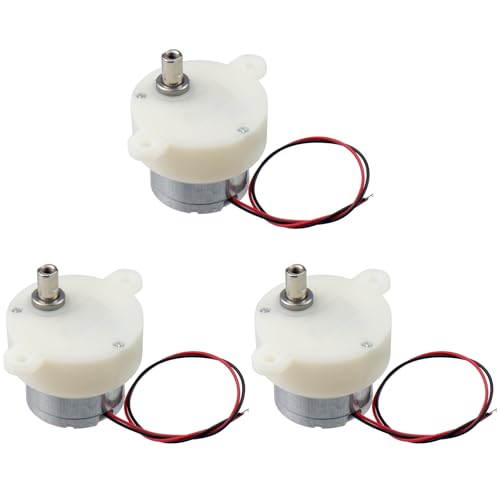
The Antrader gear motor runs at 6V with a very low 5 RPM, offering high torque suitable for precise rotary functions and slow-moving mechanisms. It is a micro motor with plastic gears, designed for low-noise operation and small form factors. It can be adjusted for direction by swapping polarity, which is convenient for learners testing gear trains or directional control. Best for projects requiring slow, deliberate motion, such as robotic grippers or step-down gearboxes. A limitation is that plastic gears may wear faster under heavy load; use in light-duty scenarios.
Who it’s best for: builders needing precise, slow rotation and compact form factors for small gearboxes.
BOJACK Low Voltage Motor Speed Controller

This PWM speed controller handles voltages from 1.8V to 12V with adjustable duty cycle from 0% to 100%. It supports up to 2A continuous current and up to 30W, making it a practical choice for projects requiring dynamic speed control without changing motor wiring. Best for experiments with variable motor speed, small robots, and DIY machines. Limitation includes the need to manage heat if running near the current limit for extended periods.
Who it’s best for: hobbyists who want adjustable speed control for one or a few motors without a dedicated motor controller system.
Gebildet PWM Low Voltage Motor Controller

Gebildet’s controller supports DC input from 1.8V to 12V with a maximum 2A output and up to 30W. It uses an NE555-based control chip and includes a potentiometer with a switch function for easy speed adjustments. It features a self-recovery fuse for added protection and a power-on indicator. Best for hobbyists seeking a robust, adjustable speed solution with built-in protection. A caveat is that it may require careful wiring to maximize safety and performance in higher-current configurations.
Who it’s best for: users who want a secure, adjustable speed controller with built-in overload protection for small motor projects.
XYRSTOLR 5Pack DC Motors

The XYRSTOLR motors cover 1V–6V, with speeds ranging from 5,000 to 20,000 RPM. They have a 21 mm body diameter and a 2 mm shaft, with relatively compact dimensions for small builds. Best for budget-conscious projects requiring multiple identical motors, such as school labs or large-scale experiments. A limitation is that higher RPM may demand adequate heat dissipation and power management in compact enclosures.
Who it’s best for: builders needing bulk motors for numerous small devices, experiments, and quick prototyping.
Buying Guide: Low Voltage Motor Considerations
Voltage range and current requirements should match your power source and load. For small Arduino projects, choose lower voltage motors (1.5V–6V) to simplify power management and wiring. For RC toys and robotics, higher ranges (6V–12V) offer more torque and speed but require appropriate controllers. Shaft diameter and length impact gear seating and pulley compatibility, so measure precisely before ordering. When selecting a motor kit, consider whether you need integrated speed control or if you will pair the motor with an external PWM controller. Always verify mounting holes, casing size, and compatibility with your enclosure. Keep in mind that plastic gears, as seen in some models, may wear under heavy use and should be used within light-load expectations.
Power and heat management matter. If you run multiple motors from a single supply, ensure your power budget is sufficient to prevent voltage drops. For steady operation, use current-limiting or protective components such as fuses or resettable polyfuses when necessary. For educational use, kits that include accessories like battery holders, gears, and connectors help accelerate learning and prototyping. If you need slow, precise rotation, gear motors at low RPM are often preferable to high-speed, high-torque options in compact spaces.
Frequently Asked Questions
- What voltage should I choose for a beginner project? Start with motors in the 1.5V–6V range for simple microcontroller demos and small gadgets to keep wiring simple and power needs modest.
- Do I need a separate motor controller? Not always. If your project requires variable speed or direction control, a PWM motor controller helps but is not mandatory for all builds.
- Are low voltage motors powerful enough for RC toys? Some models within the 6V–12V range provide adequate torque for light RC applications, but verify torque and gearing for your specific vehicle weight and load.
- Will plastic gears wear quickly? Yes, for high-load or continuous operation. Use these motors in light-duty projects or where gears are not under heavy stress.
- What should I check before buying? Confirm shaft diameter, mounting hole spacing, voltage compatibility, and whether speed control is built-in or external is required.
- Is a pack of motors better than a single unit? For prototyping multiple devices, a case pack reduces per-unit cost and ensures consistent performance across builds.